Home
Class 11
PHYSICS
A ligh rod of length 1 m is pivoted at i...

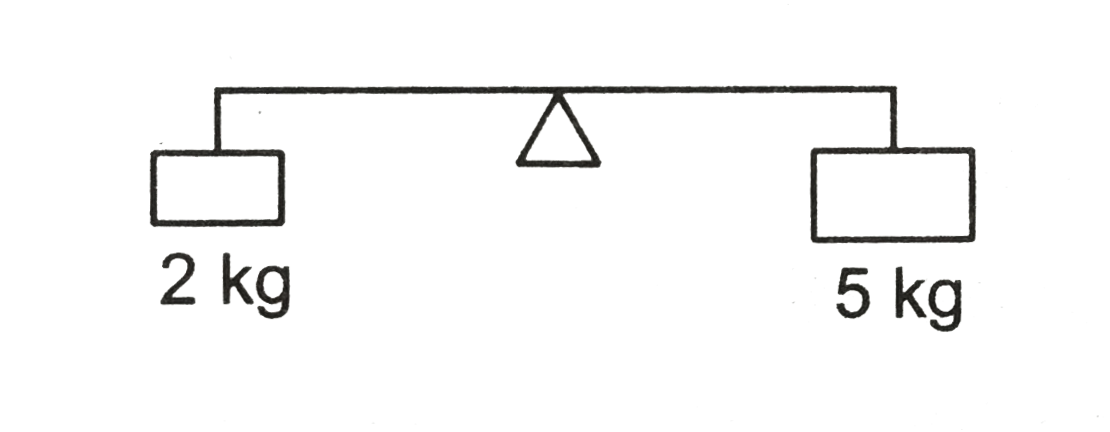
A ligh rod of length 1 m is pivoted at its centre and two masses of 5 kg and 2 kg are hung from the ends as shown in the figure. Find the initial angular acceleration of the rod assuming that it was horizontal in the beginning.

Text Solution

Verified by Experts

The correct Answer is:

A, B, D

`tau_(net)=I_(net)xxalpha`
`rarr F_1r_1-F_2r_2=(m_1r_1^2+m-2r_2^2)xxalpha`
`rarr -2xx10xx0.5+5xx10x0.5`
`=[5(1/2)^2+2(1/2)^2]alpha`
`rarr 15=7/4alpha`
`rarr alpha= 60/7=8.57rad/s^2`
Promotional Banner

Similar Questions

Explore conceptually related problems

A rod PQ of mass M and length L is hinged at end P. The rod is kept horizontal by a massless string tied to point Q as shown in figure. When string is cut, the initial angular acceleration of the rod is

In the figure shown S is a large nonconducting sheet of uniform charge density sigma . A rod R of length l and mass 'm' is parallel to the sheet and hinged at its mid point. The linear charge densities on the upper and lower half of the rod are shown in the figure. Find the angular acceleration of the rod just after it is released.

Two uniform thin rods each of length L and mass m are joined as shown in the figure. Find the distance of centre of mass the system from point O

In an experiment with a beam balance an unknown mass m is balanced by two known masses of 16 kg and 4 kg as shown in figure. Find the value of the unknown mass m in kg.

The thin rod shown below has mases M and length L. A force F acts at one end as shown and the rod is free to rotate about the other end in horizontal plane. Initial angular acceleration of the rod is :

A rod of mass m and length l is hinged at one of its ends A as shown in figure. A force F is applied at a distance x from A . The acceleration of centre of mass varies with x as -

A thin homogeneous rod of mass m and length l is free to rotate in vertical plane about a horizontal axle pivoted at one end of the rod. A small ballof mass m and charge q is attached to the opposite end of this rod. The whole system is positioned in a horizontal electric field of magnitude E=(mg)/(2q) . The rod is released from, shown position from rest. What is the angular acceleration of the rod at the instant of releasing the rod?

In space of horizontal EF (E = (mg)//q) exist as shown in figure and a mass m is released at the end of a light rod. If mass m is releases from the position shown in figure find the angular velocity of the rod when it passes through the bottom most position .

Two identical small balls each of mass m are rigidly affixed at the ends of light rigid rod of length 1.5 m and the assmebly is placed symmetrically on an elevated protrusion of width l as shown in the figure. The rod-ball assmebly is titled by a small angle theta in the vertical plane as shown in the figure and released. Estimate time-period (in seconds) of the oscillation of the rod-ball assembly assuming collisions of the rod with corners of the protrusion to be perfectly elastic and the rod does not slide on the corners. Assume theta=gl (numerically in radians), where g is the acceleration of free fall.

(a) A steel wire of mass u per unit length with a circular cross section has a radius of 0.1 cm. The wire is of length 10 m when measured lying horizontal and hangs from a hook on the wall. A mass of 25 kg is hung from the free end of the wire. Assuming the wire to be uniform an lateral strains lt lt longitudinal strains find the extension in the length of the wire. The density of steel is 7860 kgm ^(-3) and Young's modulus =2 xx 10 ^(11) Nm ^(-2) (b) If the yield strength of steel is 2.5 xx 10 ^(8) Nm ^(-2), what is the maximum weight that can be hung at the lower end of the wire ?
