Home
Class 11
PHYSICS
A uniform rod of length L rests against ...

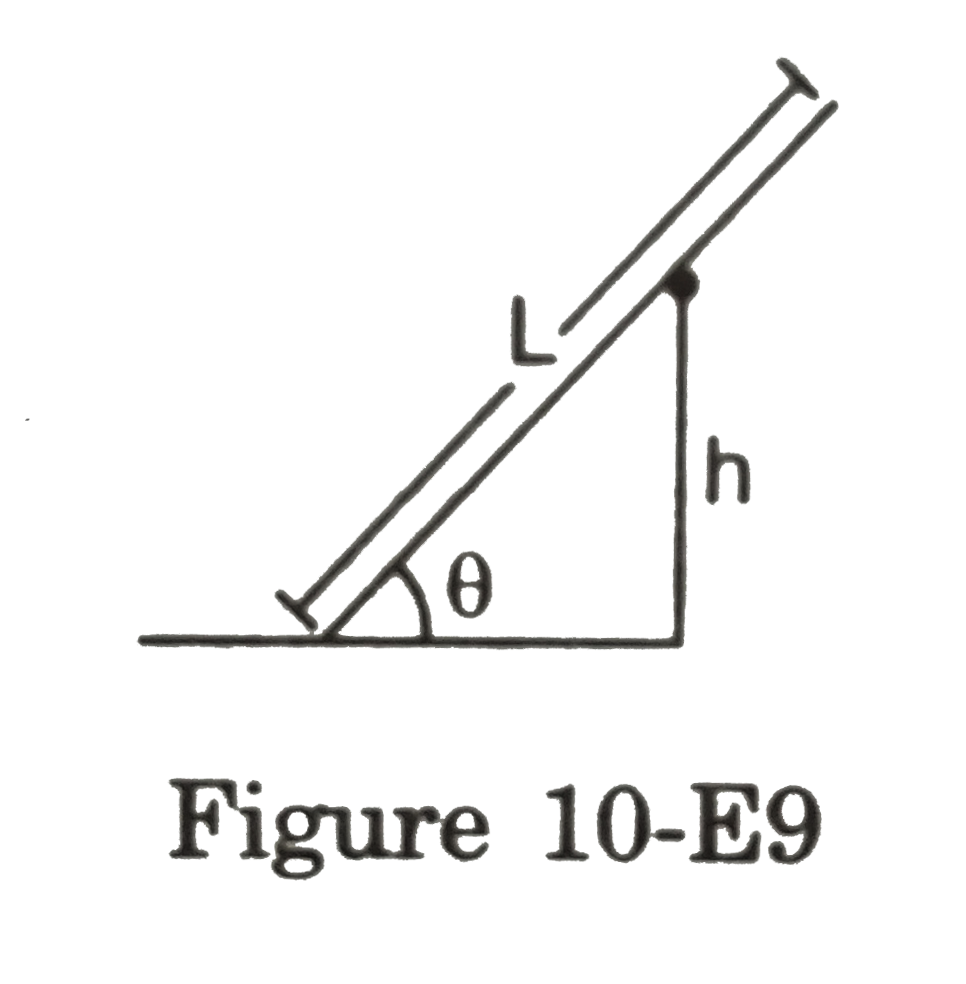
A uniform rod of length L rests against a smooth roller as shown in figure. Find the friction coefficient between the ground and the lower end if the minimum angle that rod can make with the horizontal is `theta`.

Text Solution

Verified by Experts

The correct Answer is:
A, B, C

Road has a length =L
It makes an angle e`theta` wilth the floor.
The vertical wall has a height =h

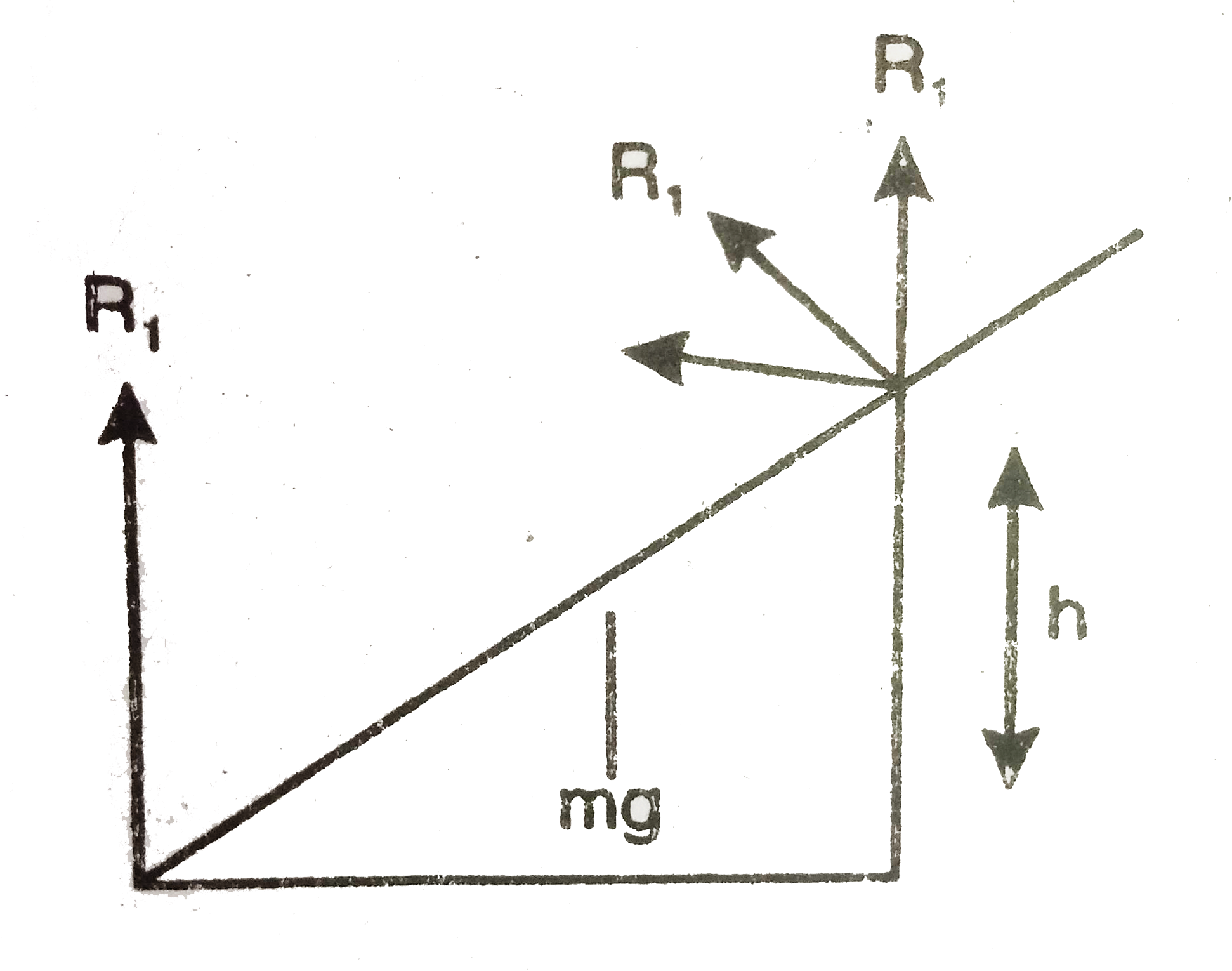
`R_2=mg-R_1costheta`………….1
`R_1sintheta=muR_2`…….2
`R_1costhetaxx(h/(tantheta)+R_1sinthetaxxh`
`=mgxxL/2costheta`
`rarr R_1=(mgxxL/2costheta)/({(cos^2theta)/(sintheta)h+sinthetah})`
`rarr R_1costheta=(1/2mgLcos^2theta)/({(cos^2theta)/(sintheta)h+sinthetaxxh})`
`rarr mu=(R_1sintheta)/R_2`
`=(R_1sintheta)/(mg-R_1costheta)`
`-. mu=(L/2costhet.sinthetaxx2sintheta)/(2(cos^2thetah+sin^2theta)h=Lcos^2thetasintheta)`
`rarr mu=(Lcosthetains^2theta)/(2h-Lcos^2thetasintheta)`
Promotional Banner

Similar Questions

Explore conceptually related problems

Two uniform thin rods each of length L and mass m are joined as shown in the figure. Find the distance of centre of mass the system from point O

A block of mass m lies on wedge of mass Mas shown in figure. Find the minimum friction coeffcient required between wedge Mand ground so that it does not move while block m slips down on it.

A block of mass m rests on a rough horizontl surface as shown in figure (a) and (b). Coefficient of friciton between block and surface is mu . A force F-mg acting at an angle theta with the vertical side of the block. Find the condition for which block will move along the surface.

Two bodies A and B of masses 5 kg and 10 kg in contact with each other rest on a table against a rigid wall as shown in figure. The coefficient of friction between the bodies and the table is 0.15. A force of 200 N is applied horizontally to A. What are (a) the reaction of the partition, (b) The action-reaction forces between A and B ? What happens when the wall is removed ? Does the answer to (b) change, when the bodies are in motion ? Ignore the difference between p_(s) and p_(k) .

The friction coefficient between the board and the floor shown in figure is mu Find the maximum force that the man can exert on the rope so that the board does not slip on the floor

A uniform rod of length (L) and mass (M) is pivoted at the centre. Its two ends are attached to two springs of equal spring constants (k). The springs are fixed to rigid supports as shown in the figure, and the rod is free to oscillate in the horizontal plane. The rod is free to oscillate in the horizontal plane. The rod is gently pushed through a small angle (theta) in one direction and released. The frequency of oscillation is. ? (##JMA_CHMO_C10_009_Q01##).

On end of a light spring of natural length d and spring constant k is fixed on a rigid wall and the other is attached to a smooth ring of mass m which can slide without friction on a vertical rod fixed at a distance d from the wall. Initially the spring makes an angle of 37^@ with the horizontal. as shown in figure. When the system is released from rest, find the speed of the ring when the spring becomes horizontal. (sin 37^@=3/5) .

A uniform rod of mass m and length l rotates in a horizontal plane with an angular velocity omega about a vertical axis passing through one end. The tension in the rod at a distance x from the axis is

A long horizontal rod has a bead which can slide along its length and initially placed at a distance L from one end A of the rod. The rod is set in angular motion about A with constant angular acceleration alpha. if the coefficient of friction between the rod and the bead is mu , and gravity is neglected, then the time after which the bead starts slipping is

A rod of mass m and length l is hinged at one of its ends A as shown in figure. A force F is applied at a distance x from A . The acceleration of centre of mass varies with x as -

