Home
Class 11
PHYSICS
Find the degree of the D.E (y’’)^2+25y’=...

Find the degree of the D.E `(y’’)^2+25y’=0`.
a) 1
b) 2
c) 4
d) 3

Text Solution

Verified by Experts

The correct Answer is:
A, B

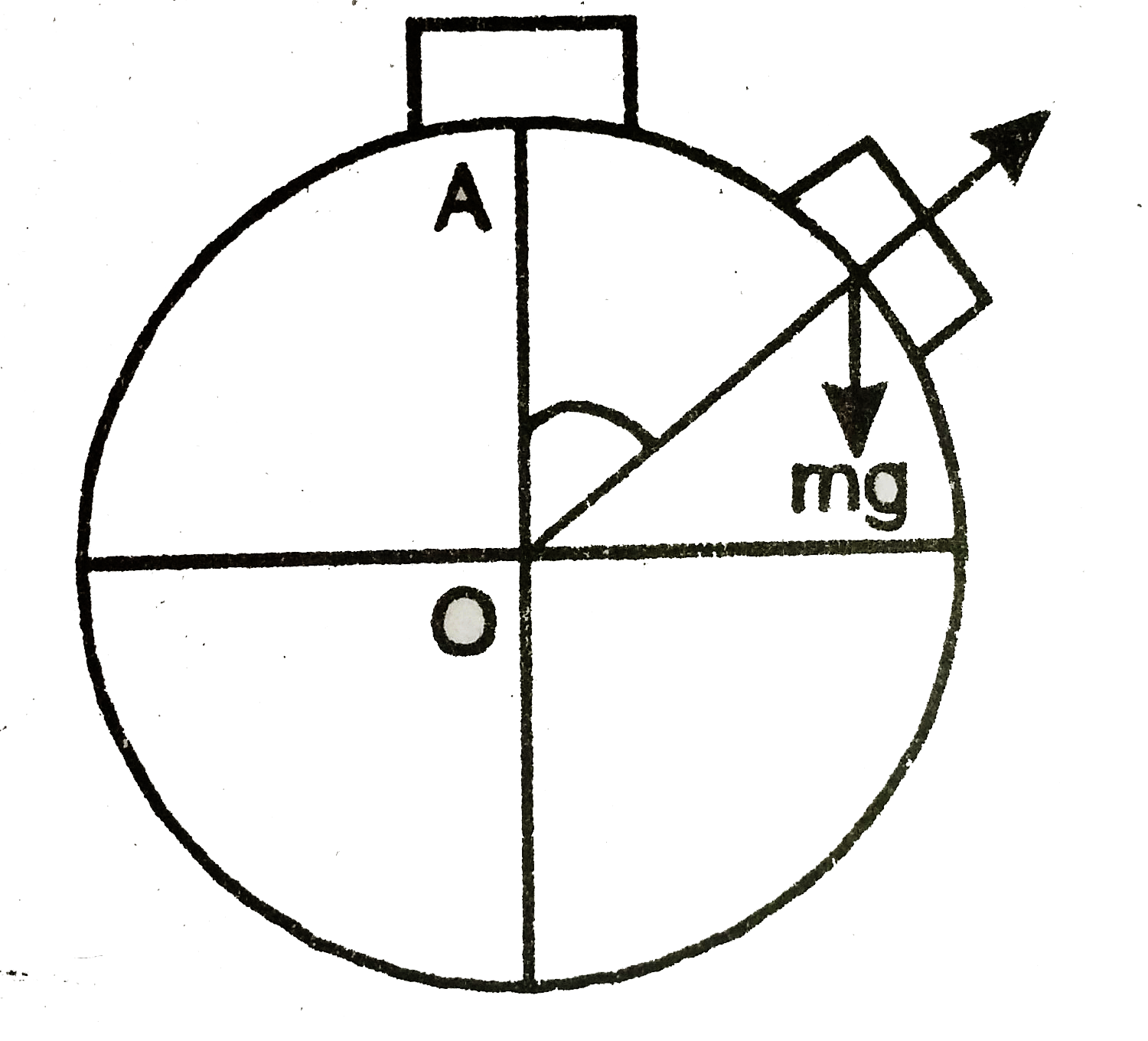
Let the mass of the particle =m
and the mass of the rod =M
Let the particles stirke the rod with as velocity V.
If we take two body to be a system.
Therefore the net externla torque and exterN/Al force =0


Therfore applying laws of conservation of linear momentum
`MV'=mV`
`(V'=velocity of the rod after striking)
`rarrV'/V=m/M`
Again applying laws of conservatioin of angular momentum
`rarr (mVR)/2=I omega`
`-(mVR)/2=((MR^2)/12)xx(pi/(2t))`
`t=((MRpi)/(mxx12xxV))`

`Therefore distance travelled
`=Vt=V'(Mrpi)(m12pi)`
`=(m/M)xx(M/m)xx((RPi)/12)`
`=(Rpi)/12`
Promotional Banner

Similar Questions

Explore conceptually related problems

Find the degree of (y_2)^(2)-sqrt(y_1)=y^3

Match the following list of animals with their level of organisation. (A) (a - 2), (b - 3), (C-4), (d - 1) (B) (a - 2), (b - 4), (C-3), (d - 1) (C) (a - 4), (b - 1), (C-2), (d - 3) (D) (a - 1), (b - 4), (C-3), (d - 2)

The order and degree of differential equation xy (d^2 y)/( dx^2) +((dy)/(dx))^2 -y ((dy)/(dx))^3 =0 is …….

The equation of the line through the intersection of the lines 2x - 3y=0 and 4x -5y =2 and {:("Column - I","Column - II"),("(i) through the point (2, 1) is","(a)" (2x - y =4)),("(ii) perpendicular to the line" x + 2y + 1 =0 "is" , "(b)" x+y -5 =0),("(iii) parallel to the line" 3x - 4y + 5=0 "is","(c)" x-y -1 =0),("(iv) equally inclined to the axis is","(d)" 3x-4y-1 =0):}

Match the column A with column B and choose the correct option. (A) (a - 2), (b - 3), (C-5), (d - 4), (e - 1) (B) (a - 2), (b-5), (C-3), (d - 4), (e - 1) (C) (a - 1), (b - 3), (C-5), (d - 4), (e - 2) (D) (a - 1), (b - 5), (C-3), (d - 4), (e - 2)

Find Order and Degree of given differential equation(y''')^(2) + (y'')^(3) + (y')^(4) + y^(5) = 0

Match the following and choose the correct option. (A) (a - 4) (b - 3) (C-5) (d - 2) (e - 1) (B) (a - 5) (b - 4) (c - 2) (d - 1) (e - 3) (C) (a - 4) (b - 5) (C - 2) (d - 1) (e - 3) (D) (a - 5) (b - 3) (c - 2) (d - 1) (e - 4)

The degree of the differential equation (d^(2)y)/(dx^(2))^(3) + ((dy)/(dx))^(2) + sin ((dy)/(dx)) + 1 = 0 is

The degree of the differential equation ((d^(2)y)/(dx^(2)))+((dy)/(dx))^(2)=xsin((d^(2)y)/(dx^(2))) is