Home
Class 11
PHYSICS
Find the order of the D.E (y’)^2+5y=0. ...

Find the order of the D.E `(y’)^2+5y=0`.
a) 1
b) 2
c) 4
d) 3

Text Solution

Verified by Experts

The correct Answer is:
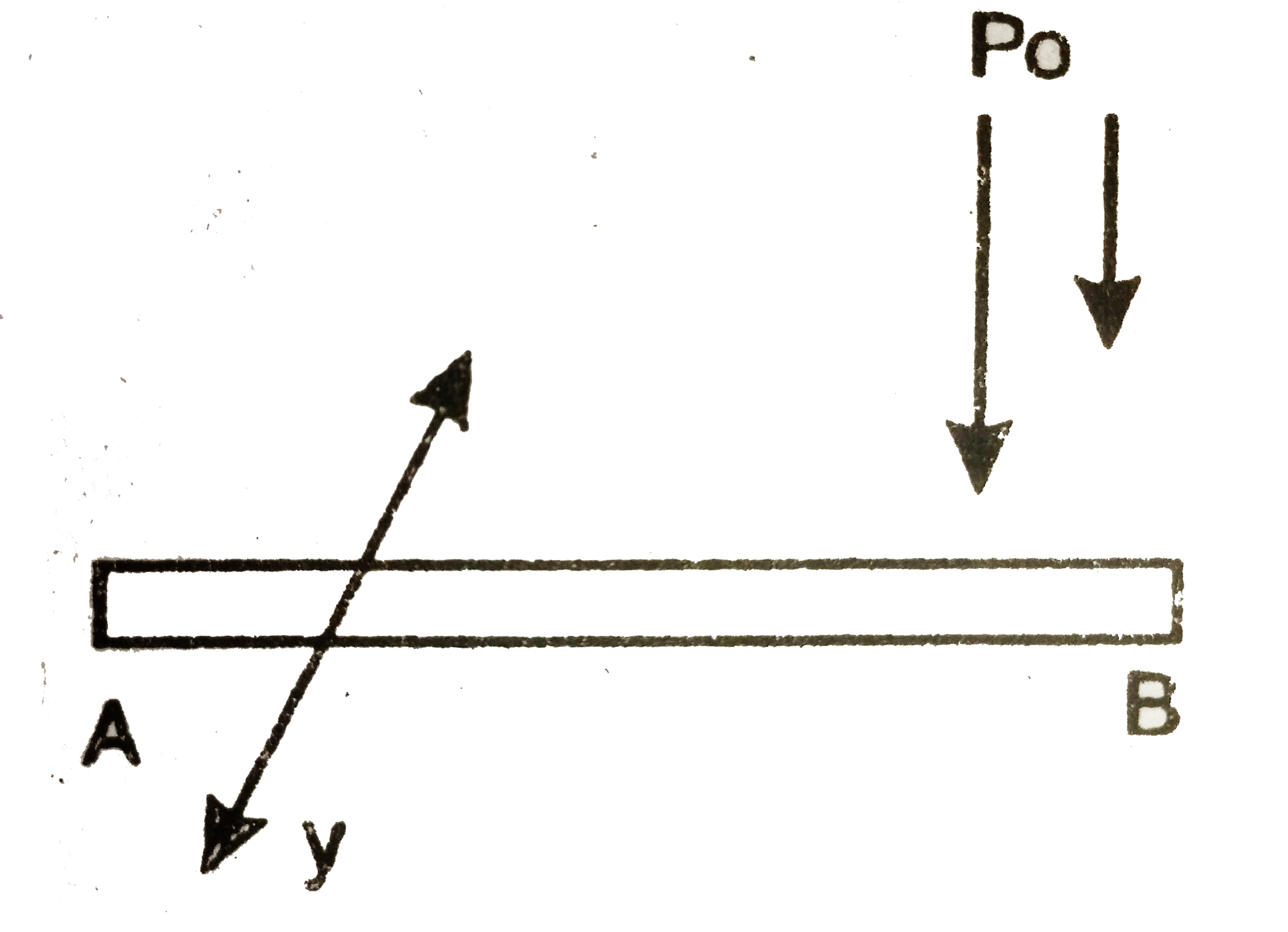
A, B, C

a. Angular momentum `=mvr`
conservation of linear momentum
`mu=2mv-mv=mv`
`:.u=v=mvr`

Velocity =sqrt(2gh)`
and `r=L/2`
`Angular momentum =m.sqrt(2gh.L/2`
`=(mLsqrt(gh))/sqrt2`
Angular momentum =lw
`:.omega=angular velocity =L/I`
or `=I=(2mL^2)/4+(mL^2)/4=(3mL^2)/4`
`:. omega=(mLsqrtI(gh)/sqrt2)/(3mL^2/4)=sqrt(8gh)/(3L)`
b. When the mass 2m wil be at the top most position and the mass m be that the lowest point. They will automaticaly rotate.
in this position the total gaion in potential energy
`=2mgxx(L/2)-mg(L/2)`
therefore `mgL/2=((1/2x2mL^2))/4xx((8gh)/(9gL^2))`
`rarr h=(3L)/2`
Promotional Banner

Similar Questions

Explore conceptually related problems

Find the order of the family of curves y=(c_1+c_2)e^x+c_3e^(x+c_4)

The equation of the line through the intersection of the lines 2x - 3y=0 and 4x -5y =2 and {:("Column - I","Column - II"),("(i) through the point (2, 1) is","(a)" (2x - y =4)),("(ii) perpendicular to the line" x + 2y + 1 =0 "is" , "(b)" x+y -5 =0),("(iii) parallel to the line" 3x - 4y + 5=0 "is","(c)" x-y -1 =0),("(iv) equally inclined to the axis is","(d)" 3x-4y-1 =0):}

Match the following and choose the correct option. (A) (a - 4) (b - 3) (C-5) (d - 2) (e - 1) (B) (a - 5) (b - 4) (c - 2) (d - 1) (e - 3) (C) (a - 4) (b - 5) (C - 2) (d - 1) (e - 3) (D) (a - 5) (b - 3) (c - 2) (d - 1) (e - 4)

In the following cases, find the coordinates of the foot of the perpendicular drawn from the origin : (a) 2x + 3y + 4z - 12 = 0 (b) 3y + 4z - 6 = 0 (c) x + y + z = 1 (d) 5y + 8 = 0

Answer each question by selecting the proper alternative from those given below each question so as to make the statement true: If (4)/(x)+5y=7 and x=-(4)/(3) , then y = ….... . a) 37 / 15 b) 2 c) 1/2 d) 1/3

Match the column A with column B and choose the correct option. (A) (a - 2), (b - 3), (C-5), (d - 4), (e - 1) (B) (a - 2), (b-5), (C-3), (d - 4), (e - 1) (C) (a - 1), (b - 3), (C-5), (d - 4), (e - 2) (D) (a - 1), (b - 5), (C-3), (d - 4), (e - 2)

If a line x+ y =1 cut the parabola y^2 = 4ax in points A and B and normals drawn at A and B meet at C. The normals to the parabola from C other than above two meets the parabola in D, then point D is : (A) (a,a) (B) (2a,2a) (C) (3a,3a) (D) (4a,4a)

Find differentiation of y w.r.t x. (i) y=x^(2)-6x (ii) y=x^(5)+2e^(x) (iii) y=4 ln x +cos x

If x=a t^2,\ \ y=2\ a t , then (d^2y)/(dx^2)= (a) -1/(t^2) (b) 1/(2\ a t^3) (c) -1/(t^3) (d) -1/(2\ a t^3)

In the following cases, determine whether the given planes are parallel or perpendicular, and in case they are neither, find the angles between them : (a) 7x + 5y + 6z + 30 = 0 and 3x - y-10z + 4 = 0 (b) 2x + y + 32 - 2 = 0 and x - 2y + 5 = 0 (c) 2x - 2y + 4z + 5 = 0 and 3x - 3y + 6z-1 = 0 (d) 2x – y + 3z-1 = 0 and 2x - y + 3z + 3 = 0 (e) 4x + 8y + z - 8 = 0 and y + z - 4 = 0

