Home
Class 11
PHYSICS
A solid sphere is set into motion on a r...

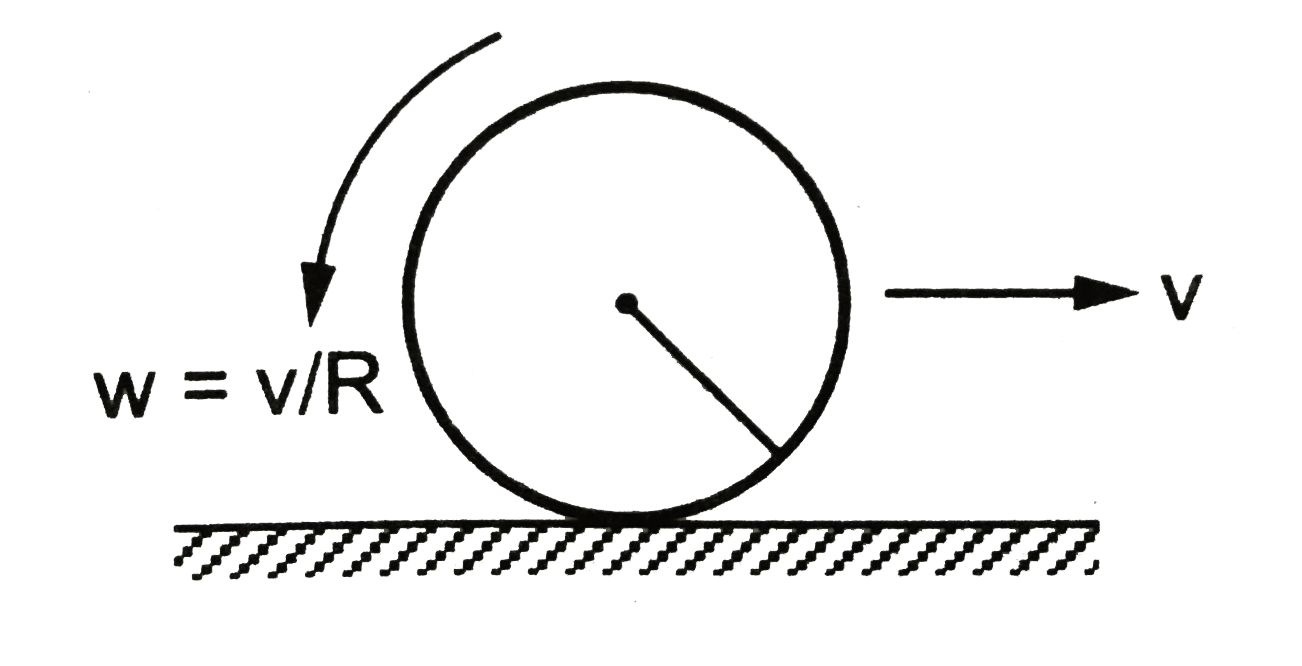
A solid sphere is set into motion on a rough horizontal surfce with a linar speed v in the forward direction and an angular speed v/R in the anticlockwise direction as shown infigure . Find the linear speed of the sphere a. where it stops rotating and b. when slipping finally ceases sand pure rolling starts.

Text Solution

Verified by Experts

The correct Answer is:
A, B, C

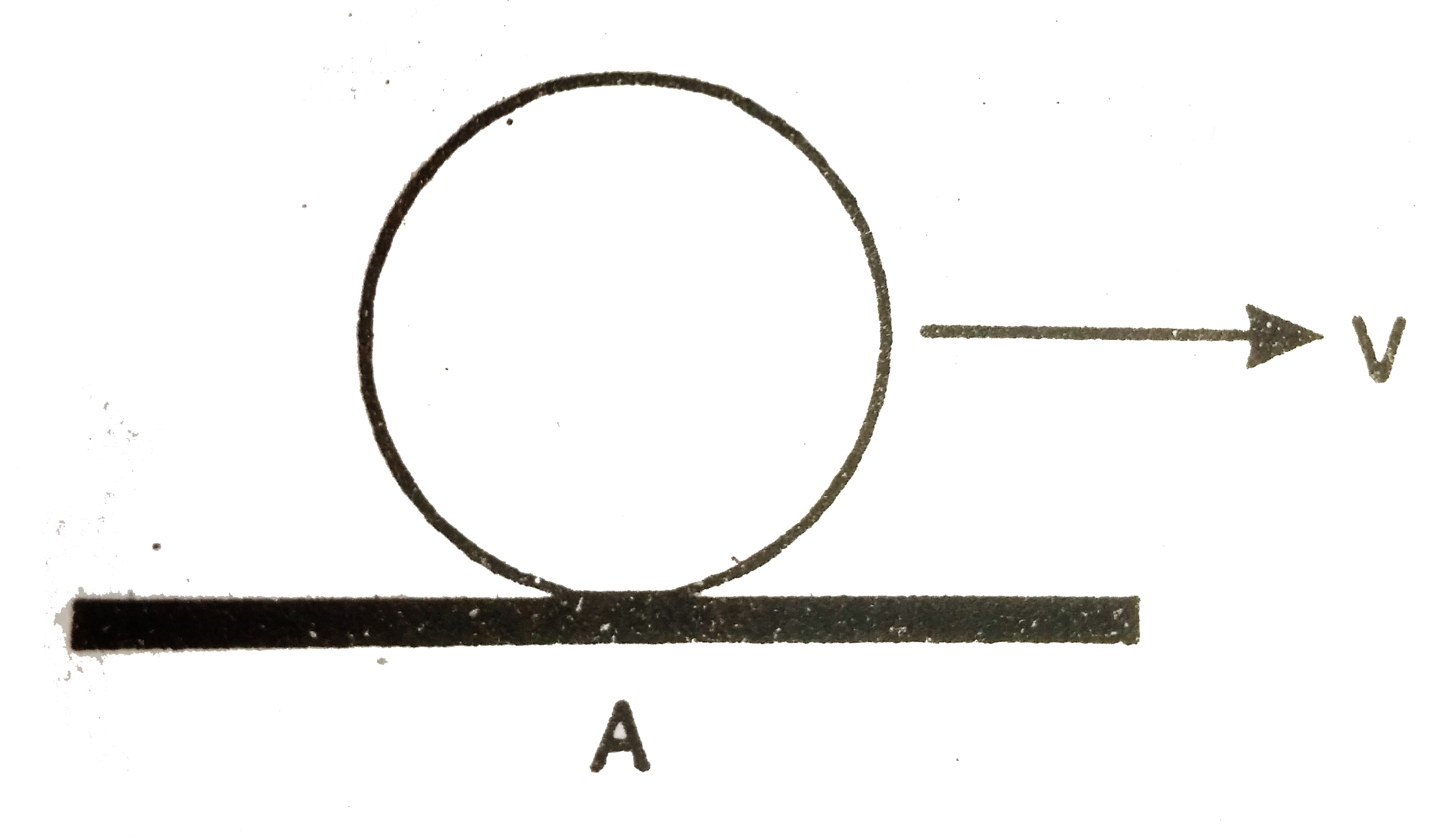
a. If we take moment at A then external torque will be zero.
`Therefore the initial angular momentum= the angular momentum after rotation stop (i.e. only linear velocity exists).
`MVxxR-(2/5)Ixxw=MV_0xxR`
`rarr MVR-2/5xxMR^2V/R=MV_0R`
`rarr V_0=(3V)/5`

b. Again after some time pure rolling starts.
Therefore `
`rarr MxV_0xxR=(2/5)MR^2xx(VR)+Mv'R`
`rarr mxx(3V)/7`
Promotional Banner

Similar Questions

Explore conceptually related problems

A large , heavy box is sliding without friction down a smooth plane of inclination theta . From a point P on the bottom of the box , a particle is projected inside the box . The initial speed of the particle with respect to the box is u , and the direction of projection makes an angle alpha with the bottom as shown in Figure . (a) Find the distance along the bottom of the box between the point of projection p and the point Q where the particle lands . ( Assume that the particle does not hit any other surface of the box . Neglect air resistance .) (b) If the horizontal displacement of the particle as seen by an observer on the ground is zero , find the speed of the box with respect to the ground at the instant when particle was projected .

A particle of mass m is moving with constant speed v on the line y=b in positive x-direction. Find its angular momentum about origin, when position coordinates of the particle are (a, b).

A particle is moving with constant speed v along the line y = a in positive x -direction. Find magnitude of its angular velocity about orgine when its position makes an angle theta with x-axis.

A sphere of mass M and radius r slips on a rough horizontal plane. At some instant it has translational velocity V_(0) and rotational velocity about the centre (V_(0))/(2r) . The translational velocity when the sphere starts pure rolling motion is

As shown, a big box of mass M is resting on a horziontal smooth florr. On the bottom of the box there is a small block of mass m. The block is given an intial speed v_(0) relative to the floor, and starts to bounce back and forth between the two walls of the box. Find the final speed of the box when the block has finally come to rest in the box :-

A disc of radius R is rotating with an angular omega_(0) about a horizontal axis. It is placed on a horizontal table. The coefficient of kinetic friction is mu_(k) . (a) What was the velocity of its centre of mass before being brought in contact with the table? (b) What happens to the linear velocity of a point on its rim when placed in contact with the table? (c) What happens to the linear speed of the centre of mass when disc is placed in contact with the table? (d) Which force is responsible for the effects in (b) and (c )? (e) What condition should be satisfied for rolling to being? (f) Calculate the time taken for the rolling to begin.

A 100 turn closely wound circular coil of radius 10 cm carries a current of 3.2 A. (a) What is the field at the centre of the coil? (b) What is the magnetic moment of this coil? The coil is placed in a vertical plane and is free to rotate about a horizontal axis which coincides with its diameter. A uniform magnetic field of 2T in the horizontal direction exists such that initially the axis of the coil is in the direction of the field. The coil rotates through an angle of 90^@ under the influence of the magnetic field. (c) What are the magnitudes of the torques on the coil in the initial and final position? (d) What is the angular speed acquired by the coil when it has rotated by 90^@ ? The moment of inertia of the coil is 0.1 kg m^2 .

An accelration produces a narrow beam of protons, each having an initial speed of v_(0) . The beam is directed towards an initially uncharges distant metal sphere of radius R and centered at point O. The initial path of the beam is parallel to the axis of the sphere at a distance of (R//2) from the axis, as indicated in the diagram. The protons in the beam that collide with the sphere will cause it to becomes charged. The subsequentpotential field at the accelerator due to the sphere can be neglected. The angular momentum of a particle is defined in a similar way to the moment of a force. It is defined as the moment of its linear momentum, linear replacing the force. We may assume the angular momentum of a proton about point O to be conserved. Assume the mass of the proton as m_(P) and the charge on it as e. Given that the potential of the sphere increases with time and eventually reaches a constant velue. One the potential of the sphere has reached its final, constant value, the minimum speed v of a proton along its trajectory path is given by

Two identical discs of same radius R are rotating about their axes in opposite directions with the same constant angular speed omega . The discs are in the same horizontal plane. At time t = 0 , the points P and Q are facing each other as shown in the figure. The relative speed between the two points P and Q is v_(r) . In one time period (T) of rotation of the discs , v_(r) as a function of time is best represented by

