Home
Class 11
PHYSICS
Three portion A , B and C each of mass r...

Three portion A , B and C each of mass re placed ina line with AB=BC=d. Find the gravittional force on a fourth article P of same mass placed at a distance d from the particle B on the perpendicular bisector of the line AC.

Text Solution

Verified by Experts
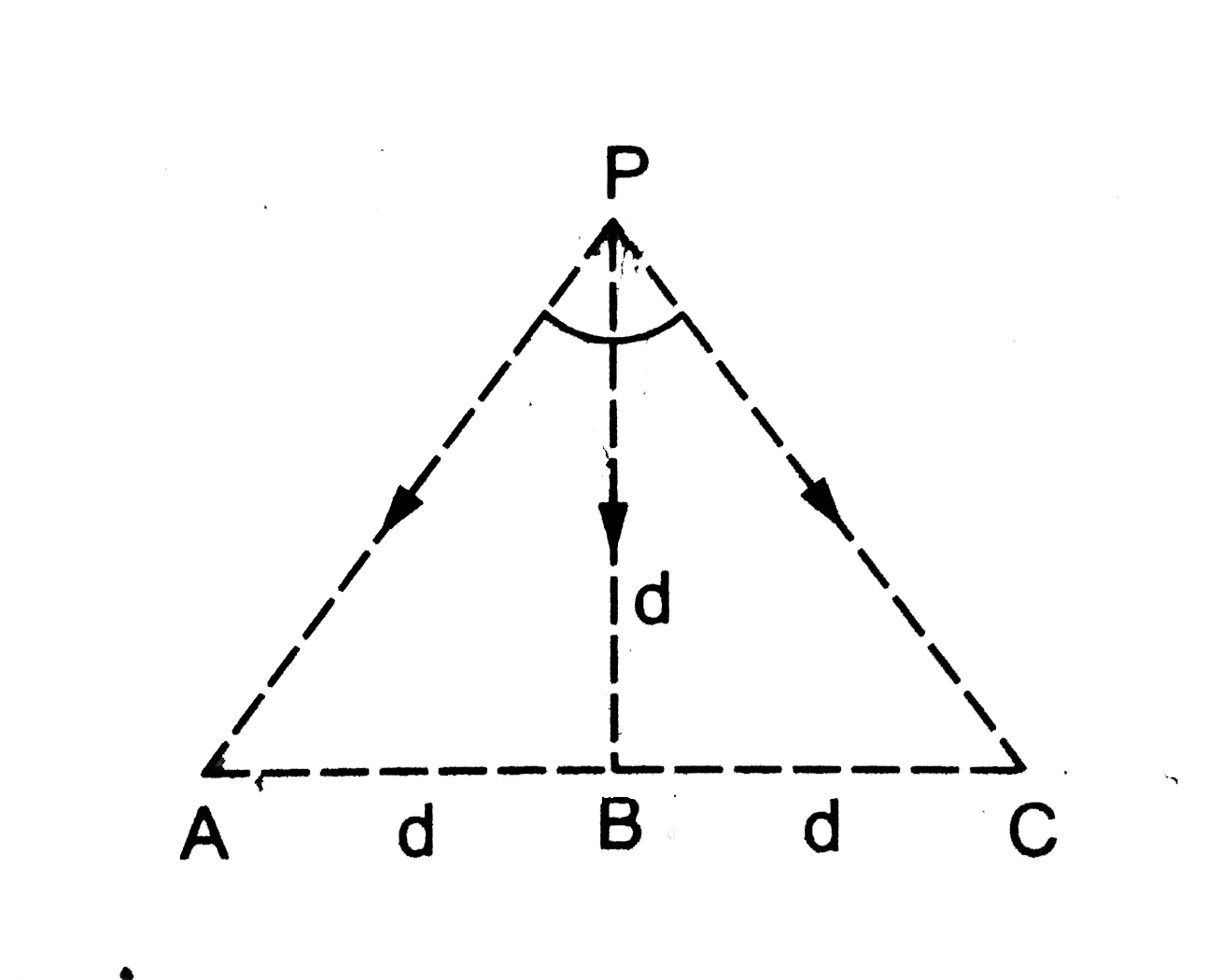

The force ast P due to A is
`F_A=(Gm^2)/((AP)^2)=(Gm^2)/(2d^2)`
along PA. the force at P due to C is
`F_C=(Gm^2)/((CP)^2)=(Gm^2)/(2d^2)`
along PC. The force at P due to B is
`F_B=(Gm^2)/d^2` along PB
The resultant of `F_A,F_B and F_c` will be along PB. Clearly `/_APB=/_BPC=45^@`
Component of `F_A` and `PB=F_Acos5^@ =(Gm^2)/(2sqrt2d^2)`
component of `F_C` along `PB=F_Ccos45^@=(Gm^2)/(2sqrt2d^2)`
component of `F_B along PB=(Gm^2)/d^2`
Hence the resultant of three forces is
`(Gm^2)/d^2)1/(2sqrt2)+1/2sqrt2)+1)=(Gm^2)/d^2(1+1/sqrt2)` along PB.
Promotional Banner

Similar Questions

Explore conceptually related problems

Two fixed, equal, positive charges, each of magnitude 5xx10^-5 coul are located at points A and B separated by a distance of 6m. An equal and opposite charge moves towards them along the line COD, the perpendicular bisector of the line AB. The moving charge, when it reaches the point C at a distance of 4m from O, has a kinetic energy of 4 joules. Calculate the distance of the farthest point D which the negative charge will reach before returning towards C.

Two particles A and B having equal charges are placed at distance d apart. A third charged particle placed on the perpendicular bisector at a distance x will experience the maximum Coulomb’s force when :

AB is a line - segment. P and Q are points on either side of AB such that each of them is equidistant from the points A and B (See Fig ). Show that the line PQ is the perpendicular bisector of AB.

Three blocks A, B and C each of mass m are placed on a surface as shown in the figure. Blocks B and C are initialyy at rest. Block A is moving to the right with speed v. It collides with block B and stricks to it. The A-B combination collides elastically with block C. Which of the following statement is (are) true about the velocity, of block B and C.

Two particles, each of mass m, are connected by a light inextensible string of lenthe 2l . Initially they lie on a smooth horizontal table at points A and B distant l apart. The particle at A is projected across the table with velocity u. Find the speed with which the second particle begins to move if the direction of u is :- (i) along BA. (ii) at an angle of 120^(@) with AB (iii) perpendicular to AB. In each case calculate (in teerms of m and u) the impulsive tension in the string.

A particle of mass m is placed at each vertices of equilateral triangle. If the particle of 5 kg is placed at the centroid of triangle, then find the gravitational force on it. The distance between centroid to vertice is 2 m.

Two spherical , nonconducting and very tin shells of uniformly distributed positive charge Q and radius d are located a distance 10d from each other . A positive point charge q is placed inside one of the shells at a distance d//2 from the center, on the line connecting the centers of the two shells , as shown in the figure, What is the net force on the charge q ? .

A long straight wire of negligible resistance is bent into V shape, its two arms making an angle alpha with each other and placed horizotally in a vertical, homogeneous field B. A rod of total mass m, and resistance r per unit length, is placed on V shaped conductor, at a distance x_(0) from its vertex A, and perpendicular to the bisector of angle alpha (see fegure) The rod is started off with an initial veloctiy v_(0) in the direction of bisector and away from vertex A. The rod is long enough not to fall off the wire during the subsquent motion, and the electrical contact between the two is good although friction between them is negligible. Choose CORRECT statements(s)

AB is a line segment. P and Q are points on opposite sides of AB such that each of them is equidistant from the points A and B (see the given figure). Show that the line PQ is the perpendicular bisector of AB.

Two particles of masses m and 2m are placed at separation L . Find the M.I. about an axis passing through the center of mass and perpendicular to the line joining the point masses.

