Home
Class 11
PHYSICS
Suppose the acceleration due to gravity ...

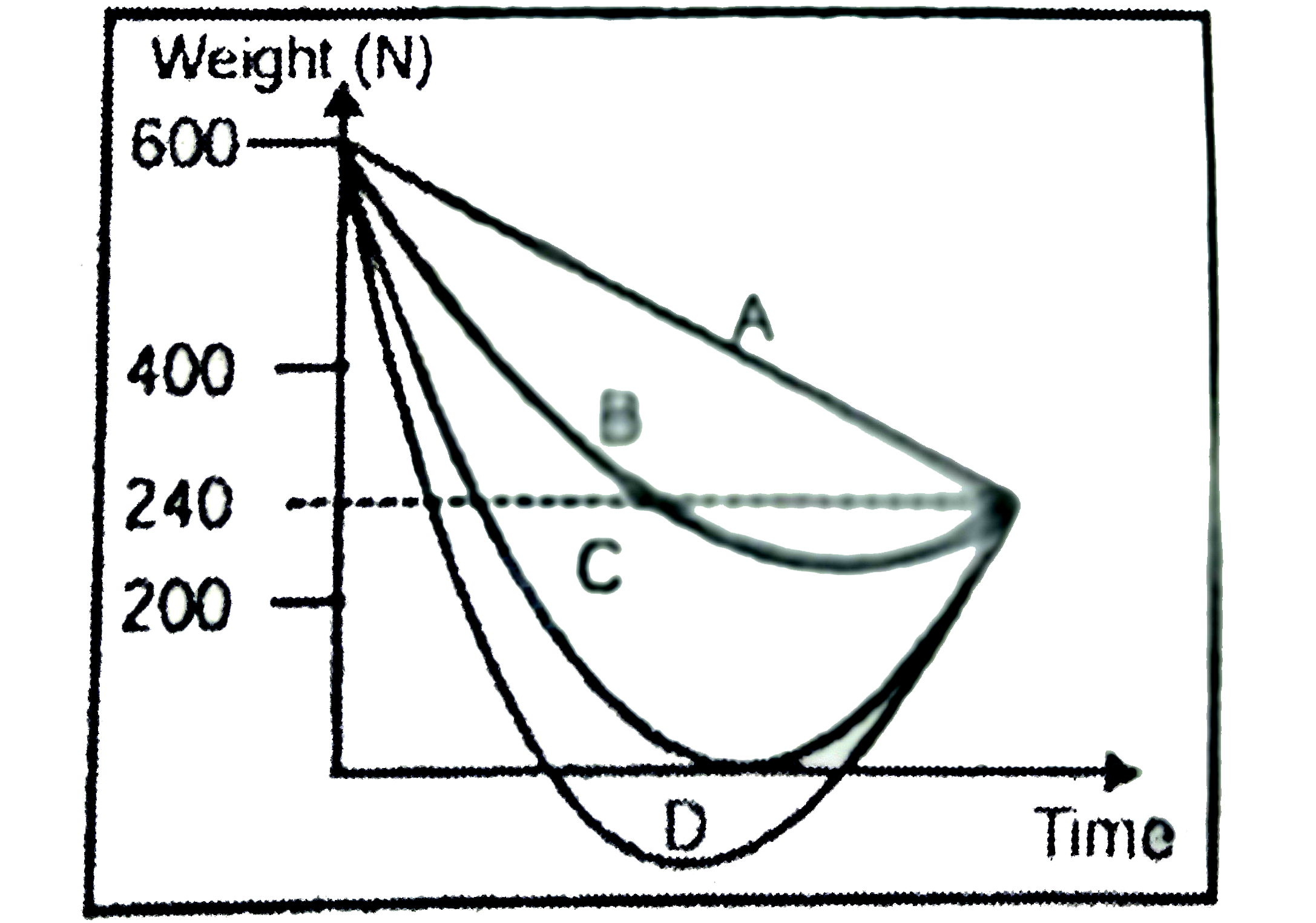
Suppose the acceleration due to gravity at the earth's surface is `10 m//s^(2)` and at the surface of mars it is `4.0 m//s^(2)`. A 60 kg passenger goes from the earth to the mars in a spaceship moving with a constant velocity. Neglect all other objects in the sky. which part of figure best represent the weight (Net gravitational force) of the passenger as a function of time :

A

A

B

B

C

C

D

D

Text Solution

Verified by Experts

The correct Answer is:

C
Promotional Banner

Similar Questions

Explore conceptually related problems

Suppose the acceleration due to gravity at earth's surface is 10ms^-2 and at the surface of Mars it is 4.0ms^-2 . A passenger goes from the to the mars in a spaceship with a constant velocity. Neglect all other object in sky. Which part of figure best represent the weight (net gravitational force) of the passenger as a function of time?

What is the value of acceleration due to gravity at a height equal to helf the radius of earth, from surface of earth ? [take g = 10 m//s^(2) on earth's surface]

Acceleration due to gravity at earth's surface if 'g' m//s^(2) . Find the effective value of acceleration due to gravity at a height of 32 km from sea level : (R_(e)=6400 km)

The acceleration due to gravity on the surface of moon is 1.7 m s^(-2) . What is the time period of a simple pendulum on the surface of moon if its time period on the surface of earth is 3.5 s ? (g on the surface of earth is 9.8 m s^(-2) )

A body of mass 10kg is moving with a constant velocity of 10m//s . When a constant force acts for 4 seconds on it, it moves with a velocity 2m//sec in the opposite direction. The acceleration produced in it is

A motor cyclist accelerate from rest with acceleration of 2 m//s^(2) for a time of 10 sec . Then he moves with a constant velocity for 20 sec and then finally comes to rest with a deceleration of 1 m//s^(2) . Average speed for complete journey is :-

Acceleration of particle moving along the x-axis varies according to the law a=-2v , where a is in m//s^(2) and v is in m//s . At the instant t=0 , the particle passes the origin with a velocity of 2 m//s moving in the positive x-direction. (a) Find its velocity v as function of time t. (b) Find its position x as function of time t. (c) Find its velocity v as function of its position coordinates. (d) find the maximum distance it can go away from the origin. (e) Will it reach the above-mentioned maximum distance?

Acceleration of a particle moving along the x-axis is defined by the law a=-4x , where a is in m//s^(2) and x is in meters. At the instant t=0 , the particle passes the origin with a velocity of 2 m//s moving in the positive x-direction. (a) Find its velocity v as function of its position coordinates. (b) find its position x as function of time t. (c) Find the maximum distance it can go away from the origin.

The imaginary angular velocity of the earth for which the effective acceleration due to gravity at the equator shall be zero is equal to [Take g = 10 m//s^(2) for the acceleration due to gravity if the earth were at rest and radius of earth equal to 6400 km.]
