Home
Class 11
PHYSICS
Three particle of mas m each are placed ...

Three particle of mas m each are placed at the three corners of an equlateral triangle of side a. Find the work which should be done on this system to increase the sides of the triangle to 2a.

Text Solution

Verified by Experts

The correct Answer is:
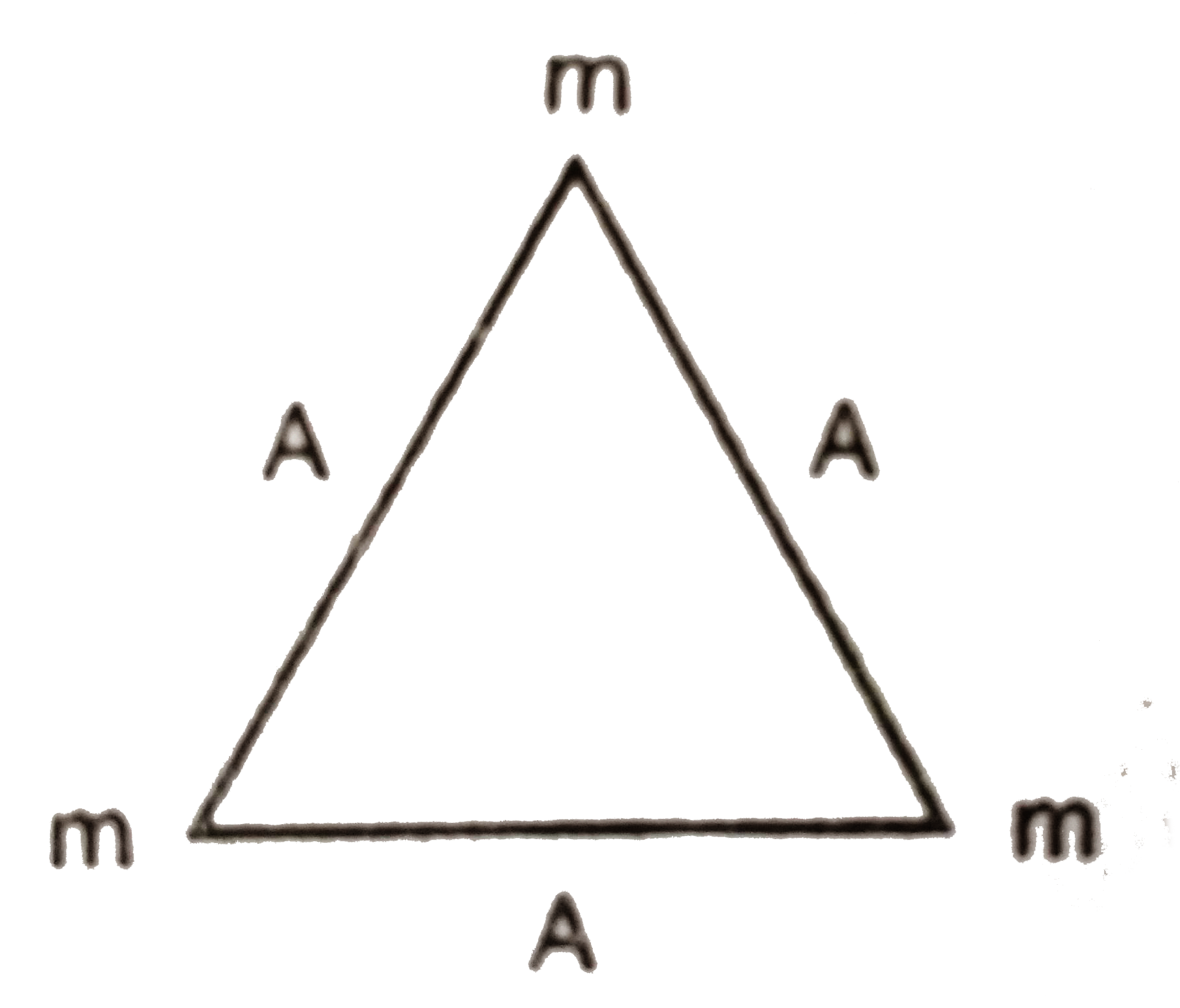
A, B, C

Initially the side the triangle =a
To increase it 2a
work done `=(GM^2)/(2a)+(GM^2)/a`
`=(3GM^2)/(2a)`
Promotional Banner

Similar Questions

Explore conceptually related problems

ABC is an equilateral triangle of side 2a. Find each of its altitude.

Three points charges are placed at the corners of an equilateral triangle of side L as shown in the figure: find the resultant dipole moment

The particles of mass m_(1),m_(2) and m_(3) are placed on the vertices of an equilateral triangle of sides .a.. Find the centre of mass of this system with respect to the position of particle of mass m_(1) .

Three sphere of masses m_,m andm_ are located at the vertices of an equilateral triangle having side of same length. Find the moment of inertia of the system about one of side of triangle.

Four bodies each of mass m are placed at the different corners of a square of side a. find the work done on the system to take any one budy to infinity.

Draw an equilateral triangle whose sides are 5.2 cm. each

Three point charges 1C, 2C and 3C are placed at the corners of an equilaternal triangle of side 1m . The work required to move these charges to the corners of a smaller equilaternal triangle of side 0.5 m in two differenct ways as in fig. (A) and fig. (B) are W_(a) and W_(b) then:

Three poistive charges of equal value q are placed at the vertices of an equilateral triangle. The resulting lines of force should be sketched as in

Three masses, each equal to M, are placed at the three corners of a square of side a. the force of attraction on unit mass at the fourth corner will be

Three particles, each of the mass m are situated at the vertices of an equilateral triangle of side a . The only forces acting on the particles are their mutual gravitational forces. It is desired that each particle moves in a circle while maintaining the original mutual separation a . Find the initial velocity that should be given to each particle and also the time period of the circular motion. (F=(Gm_(1)m_(2))/(r^(2)))

