Home
Class 11
PHYSICS
A block of mass m hangs from a vertical ...

A block of mass m hangs from a vertical spring of spring constant k. If it is displaced from its equilibrium position, find the time period of oscillations.

Text Solution

Verified by Experts
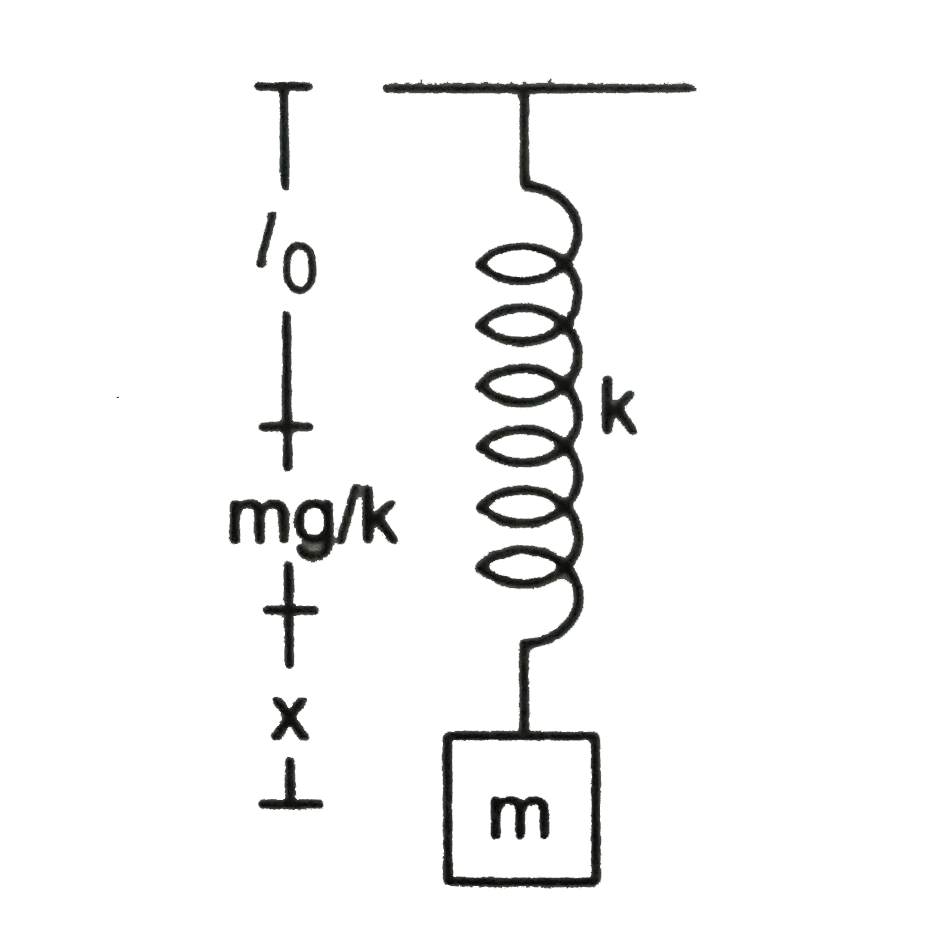
Supose the length of the spring is stretche by a length `/_\l`. The tension in the spring is `k/_\l` and this is the force by the spring on the block. The other force on the block is mg due to gravity. For equilibrium, `mg=k/_\lor /_\l=mg/k`. Take this position of the block as x=0. If block is further displaced by x the resultant force is `k(mg/k+x)-mg=kx`.

Thus the resultnt force is proportioN/Al to the displacement. The motion is simple harmonic with a the period `T=2pisqrt(m/k)`
We see that in vertical osciltions, gravity has no effect on time period. The only effect it has is to shift the equilibrium position by a distance mg/k s if the N/Atural length is increased (or decreased if the lower end of the spring is fixed) by mg/k.
Promotional Banner

Similar Questions

Explore conceptually related problems

A block of mass m suspended from a spring of spring constant k . Find the amplitude of S.H.M.

Figure shows a pulley block system in which a block A is hanging one side of pulley and an other side a small bead B of mass m is welded on pe=ulley. The moment of intertia of pulley is I and the sytem is in equilibrium position when bead is at an angle alpha from the vertical. If the system is slightly disturbed from its equlibrium position, find the time period of its oscillations.

Figure shows a system consisting of a massless pulley, a spring of force constant k and a block of mass m. If the block is slightly displaced vertically down from is equilibrium position and then released, the period of its vertical oscillation is

Two identical springs of spring constant k are attached to a block of mass m and to fixed supports as shown in Fig. 14.14. Show that when the mass is displaced from its equilibrium position on either side, it executes a simple harmonic motion. Find the period of oscillations.

A 5kg collar is attached to a spring of spring constant 500 Nm^(-1) . It slides without friction over a horizontal rod. The collar is displaced from its equilibrium position by 10.0 cm and released. Calculate the period of oscillation.

A 5 kg collar is attached to a spring of spring constant 500 N m^(-1) . It slides without friction over a horizontal rod. The collar is displaced from its equilibrium position by 10.0 cm and released. Calculate (a) the period of oscillation, (b) the maximum speed and (c) maximum acceleration of the collar.

A 2kg collar is attached to a spring of spring constant 800 Nm^(-1) . It slides without friction over a horizontal rod. The collar is displaced from its equilibrium position by 10.0 cm and released. Calculate the period of the oscillation.

In the following arrangements, bock is slightly displaced vertically down from its equilibrium position and released. Find time period of vertical oscillations. The pulley is light.

A small ring of mass m_(1) is connected by a string of length l to a small heavy bob of mass m_(2) . The ring os free to move (slide) along a fixed smooth horizontal wire. The bob is given a small displacement from its equilibrium position at right angles to string. Find period of small oscillations.

