Home
Class 11
PHYSICS
The pulley shown in figure has a moment ...

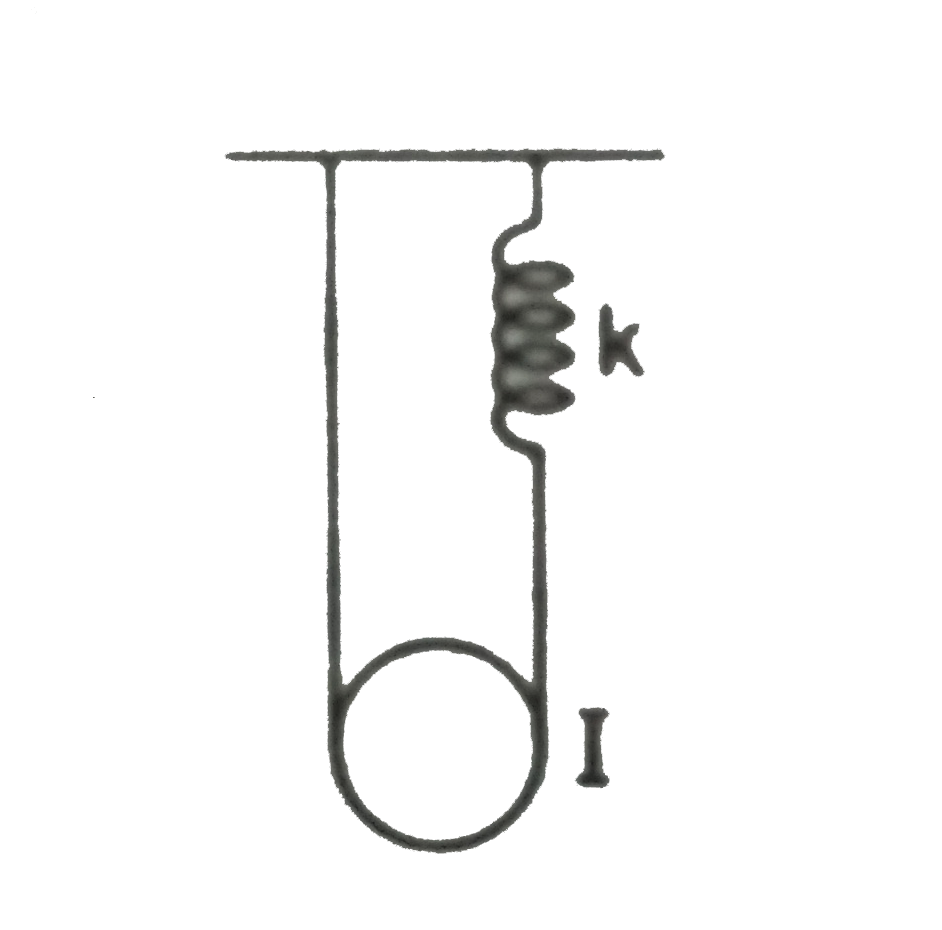
The pulley shown in figure has a moment of inertias I about its xis and mss m. find the tikme period of vertical oscillastion of its centre of mass. The spring has spring constant k and the string does not slip over the pulley.

Text Solution

Verified by Experts

Let us first find the equilibrium position. For rotatioN/Al equilibrium of the pulley, the tensions in the two strings should be equal. Only then the torque on the pulley wil be zero. Let this tension be T. The extension of the spring wil be `y=T/k`, as teh tension in the spring will be the same as the tension in the string. For translatioN/Al equilibrium of the pulley.
`2T=mgor 2ky=mg, or ly=(mg)/(2k)`
The spring is extended by a distance `(mg)/(2k)` when the pulley is in equilibrium.
Now suppose the centre of the pulley goes down further by a distance x. The total inrease in tehlengthof the stringplus the springnis `2x(x` on the left of the pulley and x on the right). As the string has a constant length, the extension of the spring is 2x. The energy of the system is
`U=1/2iomega^2+1/2mv^2-mgx+1/2k((mg)/(2k)+2x)^2 `
`=1/2(1/r^2+m)v^2+(m^2g^2)/(8k)+2kx^2`
As the system is conservative `(dU)/(dt)=0, ` ltbr. giving `0=(I/r^2+m)v(dv)/(dt)+4kxv`
`or (dv)/(dt)=-(4kx)/((I/r^2+m))`
or `a=-omega^2x, where omega^2=(4k)/((I/r^2+m))`
Thus the centre of mass of the pulley executes a simple harmonic motion with time period
`T=2pisqrt((I/r^2+m)/(4k))`.
Promotional Banner

Similar Questions

Explore conceptually related problems

A uniform equilateral triangular lamina of side a has mass m. Its moment of inertia about the axis passing through the centroid and prependicular to the plane of the lamina is :-

A uniform equilateral triangular lamina of side a has mass m. Its moment of inertia about the axis passing through the centroid and perpendicular to the plane of the lamina is :-

Two blocks each of mass m, connected by an un-stretched spring are kept at rest on a frictionless horizontal surface. A constant force F is applied on one of the blocks pulling it away from the other as shown in figure. (a)Find accelaration of the mass center. (b) Find the displacement of the centre of mass as function of time t. (c) If the extension of the spring is X_(0) at an instant t, find the displacements of the two blocks relative to the ground at this instant.

A solid sphere of mass M and radius R has a moment of inertia about an axis tangent to its surface is given by formula …………..

A uniform thin cylindrical disk of mass M and radius R is attaached to two identical massless springs of spring constatn k which are fixed to the wall as shown in the figure. The springs are attached to the axle of the disk symmetrically on either side at a distance d from its centre. The axle is massless and both the springs and the axle are in horizontal plane. the unstretched length of each spring is L. The disk is initially at its equilibrium position with its centre of mass (CM) at a distance L from the wall. The disk rolls without slipping with velocity vecV_0 = vacV_0hati. The coefficinet of friction is mu. The maximum value of V_0 for whic the disk will roll without slipping is-

A uniform thin cylindrical disk of mass M and radius R is attaached to two identical massless springs of spring constatn k which are fixed to the wall as shown in the figure. The springs are attached to the axle of the disk symmetrically on either side at a distance d from its centre. The axle is massless and both the springs and the axle are in horizontal plane. the unstretched length of each spring is L. The disk is initially at its equilibrium position with its centre of mass (CM) at a distance L from the wall. The disk rolls without slipping with velocity vecV_0 = vacV_0hati. The coefficinet of friction is mu. The centre of mass of the disk undergoes simple harmonic motion with angular frequency omega equal to -

A uniform thin cylindrical disk of mass M and radius R is attaached to two identical massless springs of spring constatn k which are fixed to the wall as shown in the figure. The springs are attached to the axle of the disk symmetrically on either side at a distance d from its centre. The axle is massless and both the springs and the axle are in horizontal plane. the unstretched length of each spring is L. The disk is initially at its equilibrium position with its centre of mass (CM) at a distance L from the wall. The disk rolls without slipping with velocity vecV_0 = vacV_0hati. The coefficinet of friction is mu. The net external force acting on the disk when its centre of mass is at displacement x with respect to its equilibrium position is.

A fixed pulley of radius 20 cm and moment of inertia 0.32 kg. m^(2) about its axle has a massless cord wrapped around its rim. A mass M of 2 kg is attached to the end of the cord. The pulley can rotate about its axis without any friction. The acceleration of the mass M is :- (Assuming g=10m//s^(2) )

A heavy cart is pulled by a constant force F along a horizontal track with the help of a rope that passes over a fixed pulley, as shown in the figure. Assume the tension in the rope and the frictional forces on the cart remain constant and consider motion of the cart until it reaches vertically below the pulley. As the cart moves to the right, its acceleration

In the system shown in figure all surface are smooth, string in massless and inextensible. Find: (a) acceleration of the system (b) tensionin the string and (c ) ectension in the spring if force constant of spring is k = 50 N/m (Take g = 10 m//s^(2) )
