Home
Class 11
PHYSICS
A block of mass m is suspended from the ...

A block of mass m is suspended from the ceiling of a stationary standig elevator through a spring of spring constant k. Suddenly, the cable breaks and the elevator starts falling freely. Show that the bklock now executes a simple harmonic motion of amplitude `mg/k` in the elevator

Text Solution

Verified by Experts
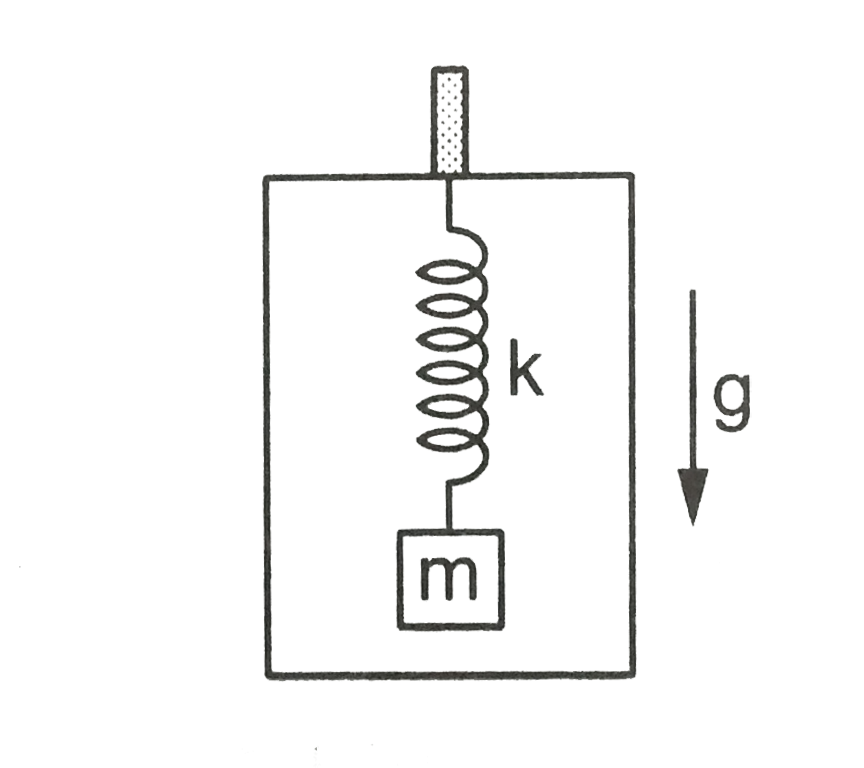
When the elevator is statioN/Ary the spring is stretched to support the block. If the extension is x, the tension is kx which should balance the weight of the block

Thus `x=mg/k`. As the cable breaks the elevator starts falling with acceleratio g. e shall work in the frame of reference fo the elevator. THen we have to use a pseudo force mg upward on teh blck. This force will balance the weight. Thus, the block is subjected to net force kx by the spring hasrmonic with its measn position corresponding to the unstretched spring. Initially the spring is stretched by `x=mg/k`, where the velocity of the block (with respect to the elevator) is zero. Thus, the amplitude of the resulting simple harmonic motion is `mg/k`.
Promotional Banner

Similar Questions

Explore conceptually related problems

A block of mass m suspended from a spring of spring constant k . Find the amplitude of S.H.M.

The angular frequency of a spring block system is omega_(0) . This system is suspeded from the ceilling of an elevator moving downwards with a constant speed v_(0) . The block is at reast realtive to the elevator. Lift is suddenly stopped. Assuming the downward as a positive direction, choose the wrong statement :

Two identical springs of spring constant k are attached to a block of mass m and to fixed supports as shown in figure. When the mass is displaced from equilibrium position by a distance x towards right, find the restoring force.

A tunnel is dug through the centre of the earth. Show that a body of mass m when dropped from rest from one end of the tunnel will execute simple harmonic motion.

A bolt of mass 0.3 kg falls from the ceiling of an elevator moving down with an uniform speed of 7 ms^(-1) . It hits the floor of the elevator (length of the elevator = 3m) and does not rebound. What is the heat produced by the impact? Would your answer be different if the elevator were stationary?

A block of mass 1kg hangs without vibrations at the end of a spring with a force constant 1 N//m attached to the ceilling of an elevator. The elevator is rising with an upward acceleration of g//4 . The acceleration of the elevator suddenly ceases. What is the amplitude of the resulting oscillations?

Two identical springs of spring constant k are attached to a block of mass m and to fixed supports as shown in Fig. 14.14. Show that when the mass is displaced from its equilibrium position on either side, it executes a simple harmonic motion. Find the period of oscillations.

A mass of 2kg is put on a flat pan attached to a vertical spring fixed on the ground as shown in figure. The mass of the spring and the pan is negligible. When spring is pressed and released the mass executes a simple harmonic motion. The spring constant is 200 N"/"m . What should be the minimum amplitude of the motion so that the mass gets detached from the pan? (take g= 10 m"/"s^(2) )

A mass M is suspended from a spring of negligible mass. The spring is pulled a little and then released so that the mass executes simple harmonic oscillation with a time period T. If the mass is increased by m, the time period becomes ((5)/(4)T) . The ratio of (m)/(M) is...........

