Home
Class 11
PHYSICS
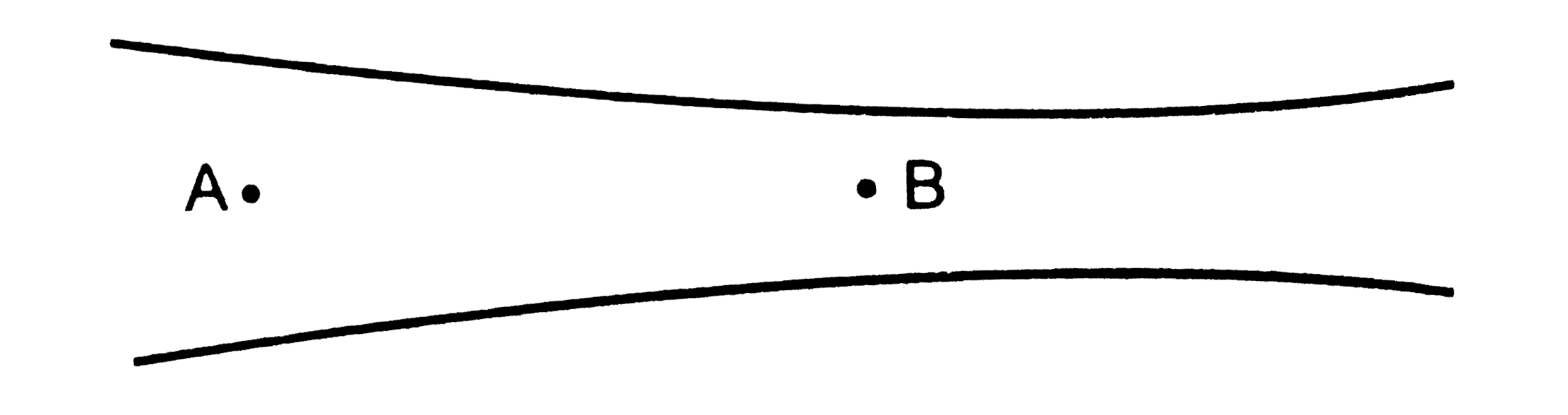
Figure shows a liquid of densith 1200kgm...

Figure shows a liquid of densith `1200kgm^-3` flowing steadily in a tube of varying cross section. The cross section at a point A is `1.0cm^2` and that at B is `20mm^2`, the points A and B are in the same horizontal plane.The speed of the liquid at A is 10 `cms^-1`. Calculate the difference in pressure at A and B.

Text Solution

Verified by Experts

From equation of continuity the speed `v_2` at B is given by
`A_1v_1=A_2v_2` ltbrrarr `(1.0cm^2)(10cms^-1)=(20mm^2)v_2`
`or v_2=(1.0cm^2)/(20mm^2)xx10cms^-1=50cms^-1`
By Bernoullil equation
`P_1+rhogh_1+1/2 rhov_1^2=P_2+rhogh_2+1/2rhov_2^2`.
here `h_1=h_2` Thus,
`P_1-P_2=1/2rhov_2^2-1/2rhov_1^2`
`=1/2xx91200kgm^-3)(2500cm^2s^-2-100cm^2^-2)`
`=600kgm^-3xx2400cm^2s^-2=144Pa`
Promotional Banner

Similar Questions

Explore conceptually related problems

A non-viscous liquid of constant density 1000kg//m^3 flows in a streamline motion along a tube of variable cross section. The tube is kept inclined in the vertical plane as shown in Figure. The area of cross section of the tube two point P and Q at heights of 2 metres and 5 metres are respectively 4xx10^-3m^2 and 8xx10^-3m^2 . The velocity of the liquid at point P is 1m//s . Find the work done per unit volume by the pressure and the gravity forces as the fluid flows from point P to Q.

Liquid is flowing throgh a tube of nonuniform cross section ratio of the radius at entry a and exit end B of the tube is 3 :2. Then the ratio of velocities at entry A and exit B of liquid is ……

A non viscous liquid of constant density 10^(3) kg//m^(3) flows in stream line motion along a vertical tube PQ of variable cross-section. Height of P and Q are 2m and 2.5m respectively. Area of tube at Q is equal to 3 times the area of tube at 'P'. Then work done per unit volume by pressure as liquid flows from P and Q. Speed of liquid at 'P' is 3 m//s .

Water is filled in a cylindrical container to a height of 3m . The ratio of the cross-sectional area of the orifice and the beaker is 0.1 . The square of the speed of the liquid coming out from the orifice is (g=10m//s^(2)) .

A sealed tank containing a liquid of density rho moves with horizontal acceleration a as shown in the figure. The difference in pressure between two points A and B will be

Figure shows a container filled with a liquid of density rho . Four points A, B, C and D lie on the vertices of a vertical square. Points A and C lie on a vertical line and points B and D lies on a horizontal line. Choose the correct statement(s) about the pressure at the four points.

Show that the points A(1,3,2),B(-2,0,1) and C(4,6,3) are collinear.

A uniform solid cylinder of density 0.8g//cm^3 floats in equilibrium in a combination of two non-mixing liquids A and B with its axis vertical. The densities of the liquids A and B are 0.7g//cm^3 and 1.2g//cm^3 , respectively. The height of liquid A is h_A=1.2cm. The length of the part of the cylinder immersed in liquid B is h_B=0.8cm . (a) Find the total force exerted by liquid A on the cylinder. (b) Find h, the length of the part of the cylinder in air.

A mild steel wire of length 1.0 m and cross sectional area 0.50 xx 10 ^(-2) cm^(2) is stretched, well within its elastic limit, horizontally between two pillars. A mass of 100 g is suspended from the mid-point of the wire. Calculate the depression at the midpoint.
