Home
Class 11
PHYSICS
The area of cross section of the wider t...

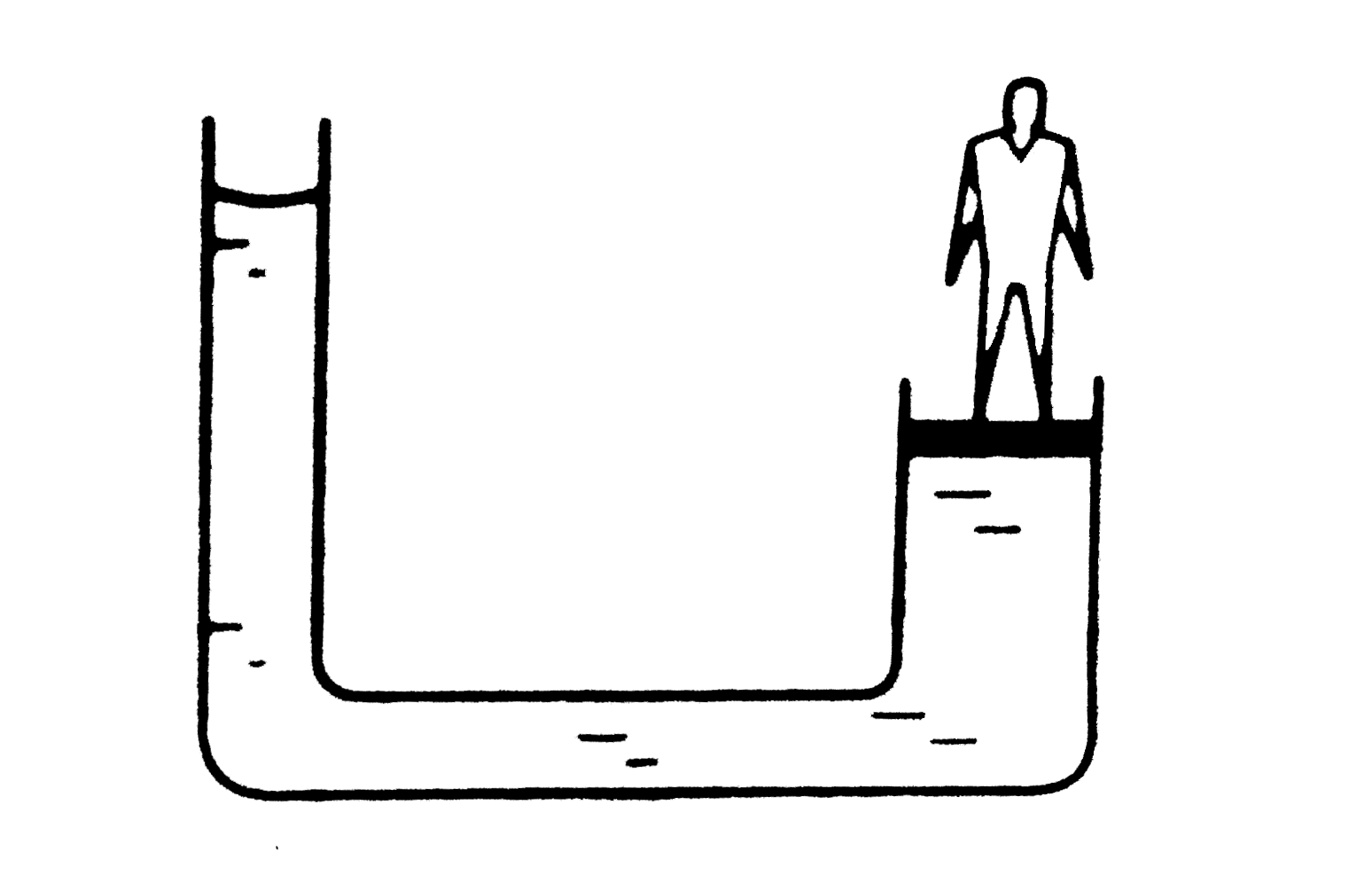
The area of cross section of the wider tube shown in figure is `900 cm^2`. If the boy standing on the piston weights 45 kg, find the difference in the levels of water in the two tubes.

Text Solution

Verified by Experts

The correct Answer is:

C

`P_1-P_2pgh`
`mg=1000xxgxxhA`
`rarr h=m/(1000xxA)`
`=45/(1000xx900xx10^-4)`
`=1/2m=50cm`
Promotional Banner

Similar Questions

Explore conceptually related problems

In the previous problem, If 15.0 cm of water and spirit each are further poured into the respective arms of the tube, what is the difference in the levels of mercury in the two arms?

In the previous problem , if 15.0 cm of water and spirit each are further poured into the respective arms of the tube , what is the difference in the levels of mercury in the two arms ? (Specific gravity of mercury =13.6)

Two narrow bores of diameters 3.0 mm and 6.0mm are joined together to form a U- tube open at both ends . If the U- tube contains water , what is the difference in its levels in the two limbs of the tube ? Surface tension of water at the temperature of the experiment is 7.3xx10^(-2)Nm^(-1) . Take the angle of contact to be zero and density of water to be 1.0xx10^(3)kgm^(-3)(g=9.8ms^(-2)) .

The Young's modulus of steel is twice that of brass. Two wires of same length and of same area of cross section, one of steel and another of brass are suspended from the same roof. If we want the lower ends of the wires to be at the same level, then the weights added to the steel and brass wires must be in the ratio of:

The area of cross-section of the two vertical arms of a hydraulic press are 1 cm ^(2) and 10 cm^(2) respectively. A force of 10N applied. As shown in the figure, to a tight fitting light piston in the thinner arm balances a force F applied to the corresponding piston in the thicker arm. Assuming that the levels of water in both the arms are the same, we can conclude:-

Two narrow bores of diameters 3.00mm and 6.0mm are joined together to form a U-tube open at both ends. If the U-tube contains water, what is the difference in its levels in the two limbs of the tube? Surface tension of water at the temperature of the experiment is 7.3 times 10^-2 N m^-1 .Take the angle of contact to be zero and density to water to be 1.0 times 10^3 kg m^-3

A diatomic gas is enclosed in a vessel fitted with massless movable piston. Area of cross section of vessel is 1m^2 . Initial height of the piston is 1m (see the figure). The initial temperature of the gas is 300K. The temperature of the gas is increased to 400K, keeping pressure constant, calculate the new height of the piston. The piston is brought to its initial position with no heat exchange. Calculate the final temperature of the gas. You can leave answer in fraction.

The area enclosed between two concentric circles is 770 cm^(2) . If the radii of the circles differ by 7 cm, find both the radii.

A liquid flows through a horizontal tube. The velocities of the liquid in the two sections, which have areas of cross section A_(1) and A_(2) are v_(1) and v_(2) respectively. The difference in the levels of the liquid in the two vertical tubes is h . Then

A non-viscous liquid of constant density 1000kg//m^3 flows in a streamline motion along a tube of variable cross section. The tube is kept inclined in the vertical plane as shown in Figure. The area of cross section of the tube two point P and Q at heights of 2 metres and 5 metres are respectively 4xx10^-3m^2 and 8xx10^-3m^2 . The velocity of the liquid at point P is 1m//s . Find the work done per unit volume by the pressure and the gravity forces as the fluid flows from point P to Q.
