Home
Class 11
PHYSICS
A liquid is containe in a vertical tube ...

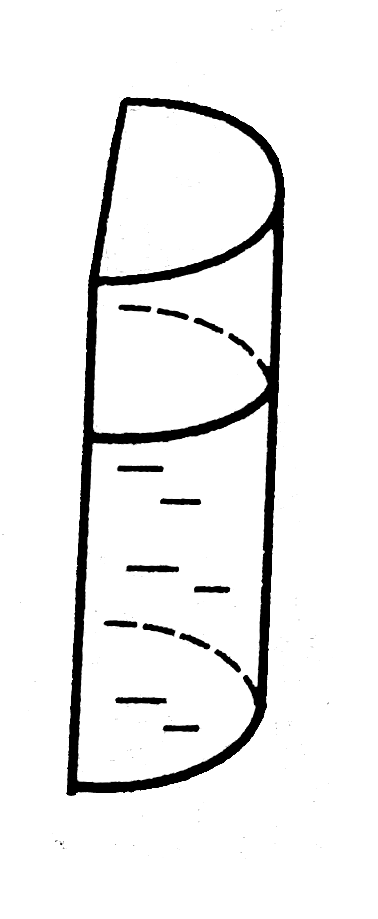
A liquid is containe in a vertical tube of semicircular cross section figure.The contact angle is zero. The force of surface tension on the curved part and on the flat part are in ratio

A

`1:1`

B

`1:2`

C

`pi:2`

D

`2:pi`

Text Solution

Verified by Experts

Promotional Banner

Similar Questions

Explore conceptually related problems

A solid sphere of radius r made of a soft material of bulk modulus K is surrounded by a liquid in a cylindrical container. A massless piston of area a floats on the surface of the liquid, covering entire cross section of cylindrical container. When a mass m is placed on the surface of the piston to compress the liquid, the fractional decrement in the radius of the sphere, ((dr)/(r)), is.....

Water is filled up to a height h in a beaker of radius R as shown in the figure. The density of water is rho, the surface tension of water is T and the atmospheric pressure is P_0. Consider a vertical section ABCD of the water column through a diameter of the beaker. The force on water on one side of this section by water on the other side of this section has magnitude

When a vertical capillary of length l with a sealed upper end was brought in contact with the surface of a liquid, the level of this liquid rose to the height h . The liquid density is rho , the inside diameter the capillary is d , the contact angle is theta , the atmospheric pressure is rho_(0) . Find the surface tension of the liquid. (Temperature in this process remains constant.)

A non viscous liquid of constant density 10^(3) kg//m^(3) flows in stream line motion along a vertical tube PQ of variable cross-section. Height of P and Q are 2m and 2.5m respectively. Area of tube at Q is equal to 3 times the area of tube at 'P'. Then work done per unit volume by pressure as liquid flows from P and Q. Speed of liquid at 'P' is 3 m//s .

A non-viscous liquid of constant density 1000kg//m^3 flows in a streamline motion along a tube of variable cross section. The tube is kept inclined in the vertical plane as shown in Figure. The area of cross section of the tube two point P and Q at heights of 2 metres and 5 metres are respectively 4xx10^-3m^2 and 8xx10^-3m^2 . The velocity of the liquid at point P is 1m//s . Find the work done per unit volume by the pressure and the gravity forces as the fluid flows from point P to Q.

A spray gun is shown in the figure where a piston pushes air out of a nozzle. A thin tube of uniform cross section is connected to the nozzle. The other end of the tube is in a small liquid container. As the piston pushes air through the nozzle, the liquid from the container rises into the nozzle and is sprayed out. For the spray gun shown, the radii of the piston and the nozzle are 20mm and 1mm respectively. The upper end of the container is open to the atmosphere. If the piston is pushed at a speed of 5mms^-1 , the air comes out of the nozzle with a speed of

Water is filled in a cylindrical container to a height of 3m . The ratio of the cross-sectional area of the orifice and the beaker is 0.1 . The square of the speed of the liquid coming out from the orifice is (g=10m//s^(2)) .

A tube is fixed in a vertical plane as shown in figure .Form point A a sphere of mass 0.314 kg is released .During its motion in the tube it faces a constant resistive force R . At B its velocity becomes zero . Calculate (i) the constant resistive force R and (if) work done by resistive force (average radisu of semicircular path is 1 m ) .

A spray gun is shown in the figure where a piston pushes air out of a nozzle. A thin tube of uniform cross section is connected to the nozzle. The other end of the tube is in a small liquid container. As the piston pushes air through the nozzle, the liquid from the container rises into the nozzle and is sprayed out. For the spray gun shown, the radii of the piston and the nozzle are 20mm and 1mm respectively. The upper end of the container is open to the atmosphere. If the density of air is rho_a , and that of the liquid rho_l , then for a given piston speed the rate (volume per unit time) at which the liquid is sprayed will be proportional to

A cylindrical container of radius 'R' and height 'h' is completely filled with a liquid. Two horizontal L -shaped pipes of small cross-sectional area 'a' are connected to the cylinder as shown in the figure. Now the two pipes are opened and fluid starts coming out of the pipes horizontally in opposite directions. Then the torque due to ejected liquid on the system is

