Home
Class 11
PHYSICS
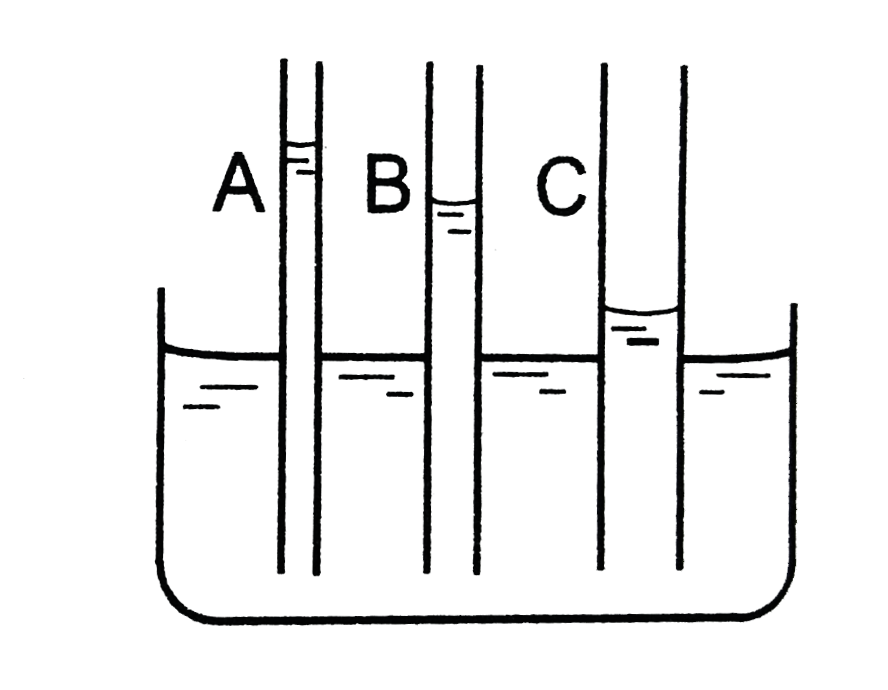
The capillaries shown in figure (14-E4) ...

The capillaries shown in figure (14-E4) have inner radii 0.5 mm, 1.0 mm and 1.5 mm respectively. The liquid in the beaker is water. Find the heights of water level in the capillaries. The surface tension of water is `7.5xx10^-2Nm^-1`.

Text Solution

Verified by Experts

The correct Answer is:

A, B, C

a. `T=7.5xx10^-2N/m, costheta=1`
`(a)`. `h_A=(2Tcostheta)/(r_A.rhog)`
`=(2xx7.5xx10^-2)/(5xx10^-3xx1000xx10)`
`=3xx10^-2m=3cm`
`(b)`. `h_B=(2Tcostheta)/(r_B.rhog)`
`=(2xx7.5xx10^-2)/(5xx10^-3xx10^3xx10)`
`=15xx10^-xm=1.5cm`
c. `h_0=(2Tcostheta)/(r_Crhog)`
`=(2xx7.5xx10^-2)/(1.5xx10^-3xx10^3xx10)`
`=15/1.5xx10^-3=10^-2m=1cm`
The height of `H_2O` levle in A,B,C cappliareis are 3 cm 1.5 cm nd 1 cm respectivel.
Promotional Banner

Similar Questions

Explore conceptually related problems

Two vertical glass plates 1 mm apart are dipped into water. How high will the water rise between the plates. If the surface tension of water is 70 dyne cm^(-1)

Diameters of the arms of a U tube are 10 mm and 1 mm . It is partially filled with water and it is held in a vertical plane . Find the difference in heights of water in both the arms . (Surface tension of water =70 dyne cm^(-1) angle of contact =0^(@).g=980cms^(-2))

The refractive indices of water and glass are 1.2 and 1.5 respectively. What will be the refractive index of glass with respect to water ?

A conical vessel with radius 10 cm and height 15 cm is completely filled with water. This water is poured into a cylinder with radius 5 cm. Find the height of water in the cylinder.

A capillary tube of radius 0.25 mm is submerged vertically in water so that 25 mm of its length is outside water. The radius of curvature of the meniscus will be (surface tension of water =75xx10^(-3) N/m)

Work done in splitting a drop of water of 1 mm radius into 10^6 droplets is (Surface tension of water= 72xx10^(-3)J//m^(2) )

A capillary tube of diameter 0.20 mm is lowered vertically into water in a vessel. What should be the pressure in N//m^(2) to be applied on the water in the capillary tube so that water level in the tube is same as that in the vessel ? (surface tension of water is 0.07 N/m and atm pressure is 10^(5)N//m^(2))

The lower end of a capillary tube of diameter 2.00 mm is dipped 8.00 cm below the surface of water in a beaker . What is the pressure required in the tube in order to blow a hemispherical bubble at the end in water ? The surface tension of water at temperature of the experiments is 7.30xx10^(-2)Nm^(9-1) . 1 atmospheric pressure =1.01xx10^(5)Pa . Density of water =1000kg//m^(3),g=9.80ms^(-2) . Also calulate the excess pressure .

The lower end of a capallary tube of diameter 2.50 mm is dipped 8.00 cm below the surface of water in a beaker .What is the pressure required in the tube in order to blow a hemispherical bubble at the end in water ? The surface tension of water at temperature of the experiments is 7.30xx10^(-2)Nm^(-1) . 1 atmospheric pressure 1.01xx10^(5)Pa . Density of water =1000kg//m^(3),g=9.80ms^(-2) .Also calculate the excess pressure .

Calculate the force required to separate the glass plates of area 10^(-2)m^(2) with a film of water 0.05 mm thickness between them (surface tension of water =70xx10^(-3)N//m) )
