Home
Class 12
PHYSICS
Consider the situation shown in figure. ...

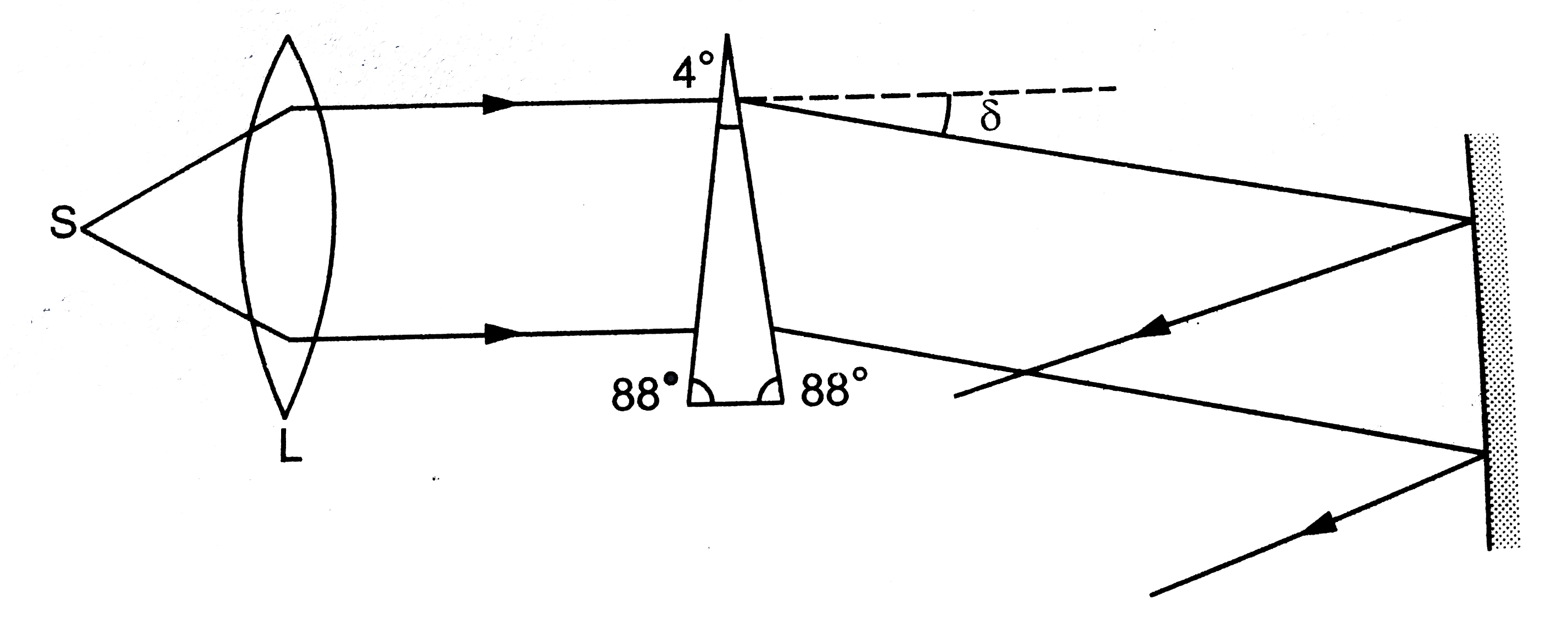
Consider the situation shown in figure. Light from a point source S is made paralel by aconvex lens L. The beam travels horizontlly andfals on an `88^@-88^@-4^@` prism as shown in figure. It passes through the prism symmetrically. The transmited light falls on a vertial mirror. Through what angle should the mirror be rotated so that an image of S is formed as S itself?

Text Solution

Verified by Experts

The parallel beam after going through the prism will be deviated by an angle `delta`. If the mirror is also rotated by this angle `delta`. The rays will fal normally on it. The rays will be reflected back along the same path and form the image of S on itself.
as the prismis thin, the angle `delta` is given by
`delta=(mu-1)A`
`=(1.5-10xx4^@=2^@`
thus , the mirror should be rotated by `2^@`
Promotional Banner

Topper's Solved these Questions

  • GEOMETRICAL OPTICS

    HC VERMA|Exercise Short Answer|18 Videos
  • GEOMETRICAL OPTICS

    HC VERMA|Exercise Question For short Answer|1 Videos
  • GEOMETRICAL OPTICS

    HC VERMA|Exercise EXAMPLE|3 Videos
  • GAUSS LAW

    HC VERMA|Exercise Exercises|24 Videos
  • LIGHT WAVES

    HC VERMA|Exercise Exercises|41 Videos

Similar Questions

Explore conceptually related problems

A horizontal ray of light passes through a prism of index 1.50 and apex angle 4^(@) and then strikes a vertical mirror , as shown in the figure. Through what angle must the mirror be rotated if after reflection the ray is to be horizontal?

A point source S is placed at distance of 15 cm from a converging lens of focal length 10 cm . Where should a (i) concave mirror (ii) convex mirror of focal length 12 cm be placed so that real image is formed on object itself.

A diverging beam of light from a point source S having devergence angle alpha , falls symmetrically on a glass slab as shown. The angles of incidence of the two extreme rays are equal. If the thickness of the glass slab is t and the refractive index n, then the divergence angle of the emergent beam is

A point object O is placed at a distance of 20 cm from a convex lens of focal length 10 cm as shown in figure. At what distance x from the lens should a concave mirror of focal length 60 cm, placed so that final image coincides with the object ?

Two parallel beams of light P and Q (separation d) containing radiations of wavelengts 4000Å and 5000 Å (which are mutually coherent in each wavelength separately) are incident normally on a prism as shown in figure the refractive index of the prism as a function of wavelength is given by the relation mu(lamda)=1.20+(b)/(lamda^(2)) where lamda is in Å and b is a positive constant. The value of b is such that the condition for total reflection at the face AC is just satisfied for one wavelength and is not satisfied for the other. A convergent lens is used to bring these transmitted beams into focus. If the intensities of the upper and the lower beams immediately after transmission from the face AC, are 4I and I respectively, find the resultant intensity at the focus.

A point source of light ,S is placed at a distance L in front of the centre of plane mirror of width d which is a hanging vertically on wall ,A man walks in front of the mirror , at a distance 2L as shown below . The distance over which the man can see the image of the light source in the mirror is :

Two plane mirrors, a source S of light, emitting monochromatic rays of wavelength lamda and a screen are arranged as shown in figure. If angle theta is very small, calculate fringe width of the interference pattern formed by reflected rays.

A vessel ABCD of 10 cm width has two small slits S_(1) and S_(2) sealed with idebtical glass plates of equal thickness. The distance between the slits is 0.8 mm . POQ is the line perpendicular to the plane AB and passing through O, the middle point of S_(1) and S_(2) . A monochromatic light source is kept at S, 40 cm below P and 2 m from the vessel, to illuminate the slits as shown in the figure. Calculate the position of the central bright fringe on the other wall CD with respect of the line OQ . Now, a liquid is poured into the vessel and filled up to OQ . The central bright fringe is fiund to be at Q. Calculate the refractive index of the liquid.

A narrow tube is bend in the form of a circle of radius R, as shown in the figure. Two small holes S and D are made in the tube at the positions right angle to each other. A source placed at S generated a wave of intensity I_(0) which is equally divided into two parts : One part travels along the longer path, while the other travels along the shorter path. Both the parts wave meet at the point D where a detector is placed. The maximum value of lamda to produce a maxima at D is given by :-

A narrow tube is bend in the form of a circle of radius R, as shown in the figure. Two small holes S and D are made in the tube at the positions right angle to each other. A source placed at S generated a wave of intensity I_(0) which is equally divided into two parts : One part travels along the longer path, while the other travels along the shorter path. Both the parts wave meet at the point D where a detector is placed. The maximum value of lamda to produce a minima at D is given by :-

HC VERMA-GEOMETRICAL OPTICS-Worked Out Examples
  1. A beaker contains water up to a height h1 and K oil above water up to...

    Text Solution

    |

  2. Monochramatic light is incident on the pane interface AB between two m...

    Text Solution

    |

  3. A concave mirror of radius 40 cm lies on a horizontla tale and wateis ...

    Text Solution

    |

  4. An object is placed 21 cm in fron of a concave mirror of radis of curv...

    Text Solution

    |

  5. The refractive indices of silicate fint glass for wavelength 400 nm an...

    Text Solution

    |

  6. Consider the situation shown in figure. Light from a point source S is...

    Text Solution

    |

  7. Locate the image formed by refractio in the situastionn shown in figur...

    Text Solution

    |

  8. One end of a horizontal cylindrical glass rod (mu=1.5) of radius 5.0 c...

    Text Solution

    |

  9. There is a small air bubble inside a glass sphere (mu=1.5) of radius ...

    Text Solution

    |

  10. A parallel bean of light travelling in water (refractie index =4/3) is...

    Text Solution

    |

  11. Calculate the focal length of the thin lens shown infigure. The pionts...

    Text Solution

    |

  12. A point source S is placed at distance of 15 cm from a converging lens...

    Text Solution

    |

  13. A conveying lens of focal length 15 cm and a converging mirror of foca...

    Text Solution

    |

  14. A biconvex thin lens is prepared from glass (mu=1.5), the two bounding...

    Text Solution

    |

  15. A concave convex figure lens made of glas (mu=1.5) has surface of radi...

    Text Solution

    |

  16. A thin lens of focal length + 12 cm is immersed in water (mu = 1.33). ...

    Text Solution

    |

  17. A long cylindrical tube containing water in closed by an equinvex lens...

    Text Solution

    |

  18. A slide projector produces 500 times enlarged image of a slide on a sc...

    Text Solution

    |

  19. A convex lens focusses ab object 10 cm from it on a screen paced 10 cm...

    Text Solution

    |

  20. Two convex lenses f focal length 20 cm each are placed coaxially with ...

    Text Solution

    |
