Home
Class 12
PHYSICS
A spherical surface of radius 30 cm sepa...

A spherical surface of radius 30 cm separates two transparent media A and B with refractive indices 1'33 and 1.48 respectively. The medium A is on the convex side of the surface. Where should a point object be placed in medium A so that the paraxial rays become parallel after refraction at the surface ?

Text Solution

Verified by Experts

The correct Answer is:
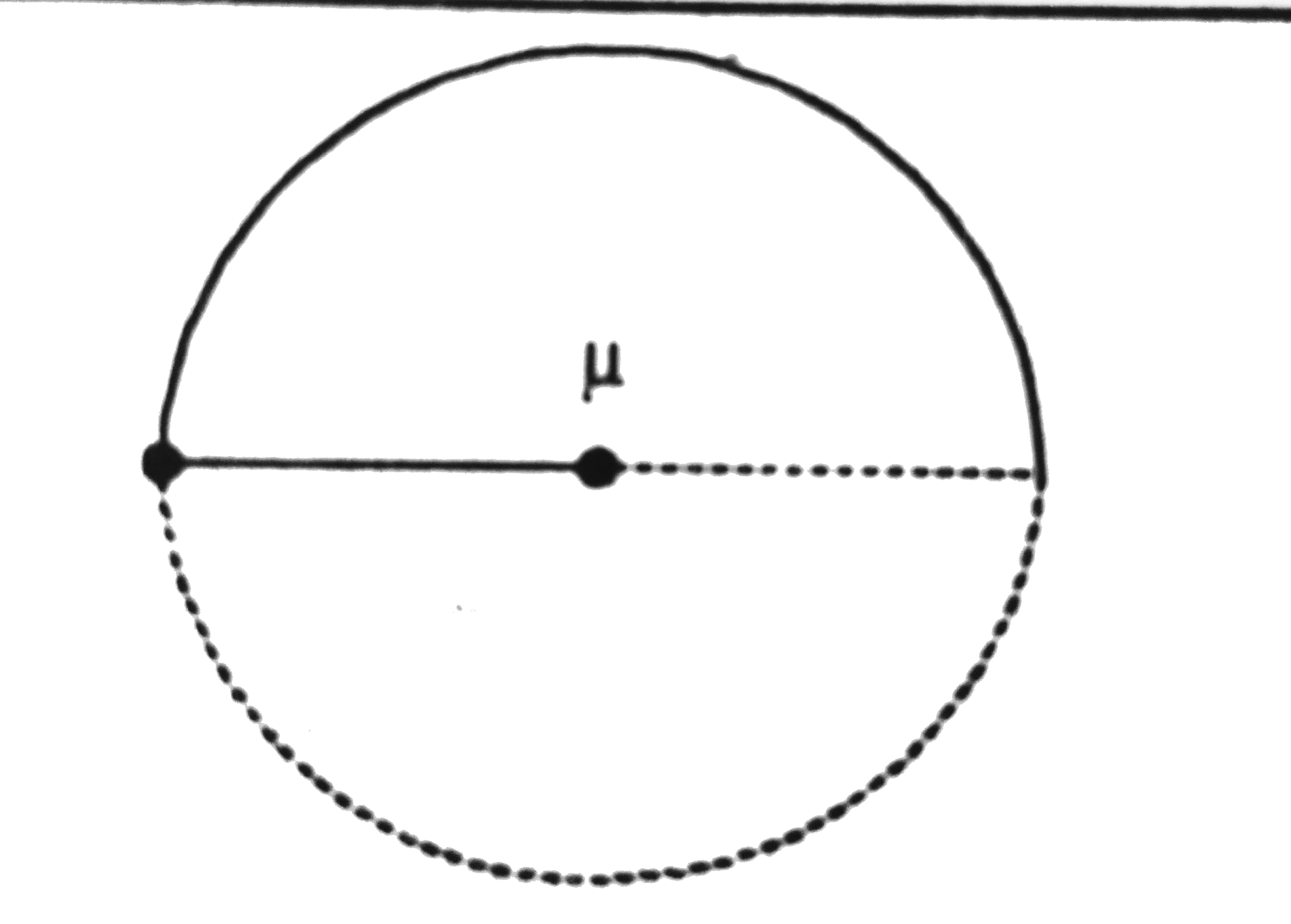
A, B, C

`mu_2/v-mu_1/u=(mu_2-mu_1)/R`
`(-1.33)/u=0.15/(30xx100)`

`u=20xx0.35/100=-266cm`
Promotional Banner

Topper's Solved these Questions

Similar Questions

Explore conceptually related problems

A concave spherical surface of radius of curvature 10 cm separates two mediums X and Y of refractive indices 4//3 and 3//2 respectively. Centre of curvature of the surfaces lies in the medium X . An object is placed in medium X .

A spherical surface of radius of curvature R separates air (refractive index 1.0) from glass (refractive index 1.5). The centre of curvature is in the glass. A point object P placed in air is found to have a real image Q in the glass. The line PQ cuts the surface at a point O, and PO=OQ . The distance PO

A curved surface of radius R separates two medium of refractive indices mu_(1) "and" mu_(2) as shown in figures A and B . Choose the correct statement(s) related to the virtual image formed by object O placed at a distance x, as shown in figure

A curved surface of radius R separates two medium of refractive indices mu_(1) "and" mu_(2) as shown in figures A and B . Choose the correct statement(s) related to the real image formed by the object O placed at a distance x, as shown in figure A.

A curved surface of radius R separates two medium of refractive indices mu_(1) "and" mu_(2) as shown in figures A and B . Identity the correct statement(s) related to the formation of images of a real object O placed at x from the pole of the concave surface, as shown in figure B

A ray of light passes through four transparent media with refractive indices mu_1 , mu_2 , mu_3 and mu_4 as shown in the figure. The surfaces of all media are parallel. If the emergent ray CD is parallel to the incident ray AB, we must have

Fig. shows a surface XY separating two transparent media, medium 1 and medium 2. Lines ab and cd represent wavefronts of a light wave travelling in medium 1 and incident on XY. Line ef and gh represent wavefront of the light wave in medium 2 after rafraciton. Light travel as a

Fig. shows a surface XY separating two transparent media, medium 1 and medium 2. Lines ab and cd represent wavefronts of a light wave travelling in medium 1 and incident on XY. Line ef and gh represent wavefront of the light wave in medium 2 after rafraciton. Speed of light is

Write equation of image formed by curved surface of radius of curvature R in medium of refractive index n_1

A point object is placed at the centre of a glass sphere of radius 6cm and refractive index 1.5. The distance of virtual image from the surface is

HC VERMA-GEOMETRICAL OPTICS-Exercises
  1. A light ray, going through a prism with the angle of prism 60^@, is fo...

    Text Solution

    |

  2. Locate the image formed by refraction in the situation shown in figure

    Text Solution

    |

  3. A spherical surface of radius 30 cm separates two transparent media A ...

    Text Solution

    |

  4. Figure shows a transparent hemisphere of radius 3'0 cm made of a mate...

    Text Solution

    |

  5. A small object is embedded in a glass sphere (mu =1.5) of radius 5.0 c...

    Text Solution

    |

  6. A biconvex thick lens is constructed with glass (mu = 1.50). Each of t...

    Text Solution

    |

  7. A narrow pencil of parallel light is incident normally on a solid tran...

    Text Solution

    |

  8. One end of a cylindrical glass rod (mu = 1.5) of radius 1.0 cm is roun...

    Text Solution

    |

  9. A paperweight in the form of a hemisphere of radius 3.0 cm is used to ...

    Text Solution

    |

  10. Solve the previous problem if the paperweight is inverted at its place...

    Text Solution

    |

  11. A hemispherical portion of the surface of a solid glass sphere (mu = 1...

    Text Solution

    |

  12. The convex surface of a thin concave-convex lens of glass of refractiv...

    Text Solution

    |

  13. A double convex lens has focal length 25 cm. The radius of curvature o...

    Text Solution

    |

  14. The radii of curvature of a lens are + 20 cm and + 30 cm. The material...

    Text Solution

    |

  15. Lenses are constructed by a material of refractive indeic 1.50. The ma...

    Text Solution

    |

  16. A thin lens made of a material of refractive indexmu2 has a medium of ...

    Text Solution

    |

  17. A convex lens has a focal length of 10 cm. Find the location and natur...

    Text Solution

    |

  18. A slide projector has to project a 35 mm slide (35 mm xx 23 mm) on a 2...

    Text Solution

    |

  19. A particle executes a simple harmonic motion of amplitude 1.0 cm along...

    Text Solution

    |

  20. An extended object is placed at a distance of 5.0 cm from a convex len...

    Text Solution

    |

