Home
Class 12
PHYSICS
A small object is embedded in a glass sp...

A small object is embedded in a glass sphere (mu =1.5) of radius 5.0 cm at a distance 1.5 cm left to the centre. Locate the image of the object as seen by an observer standing (a) to the left of the sphere and (b) to the right of the sphere.

Text Solution

Verified by Experts

The correct Answer is:
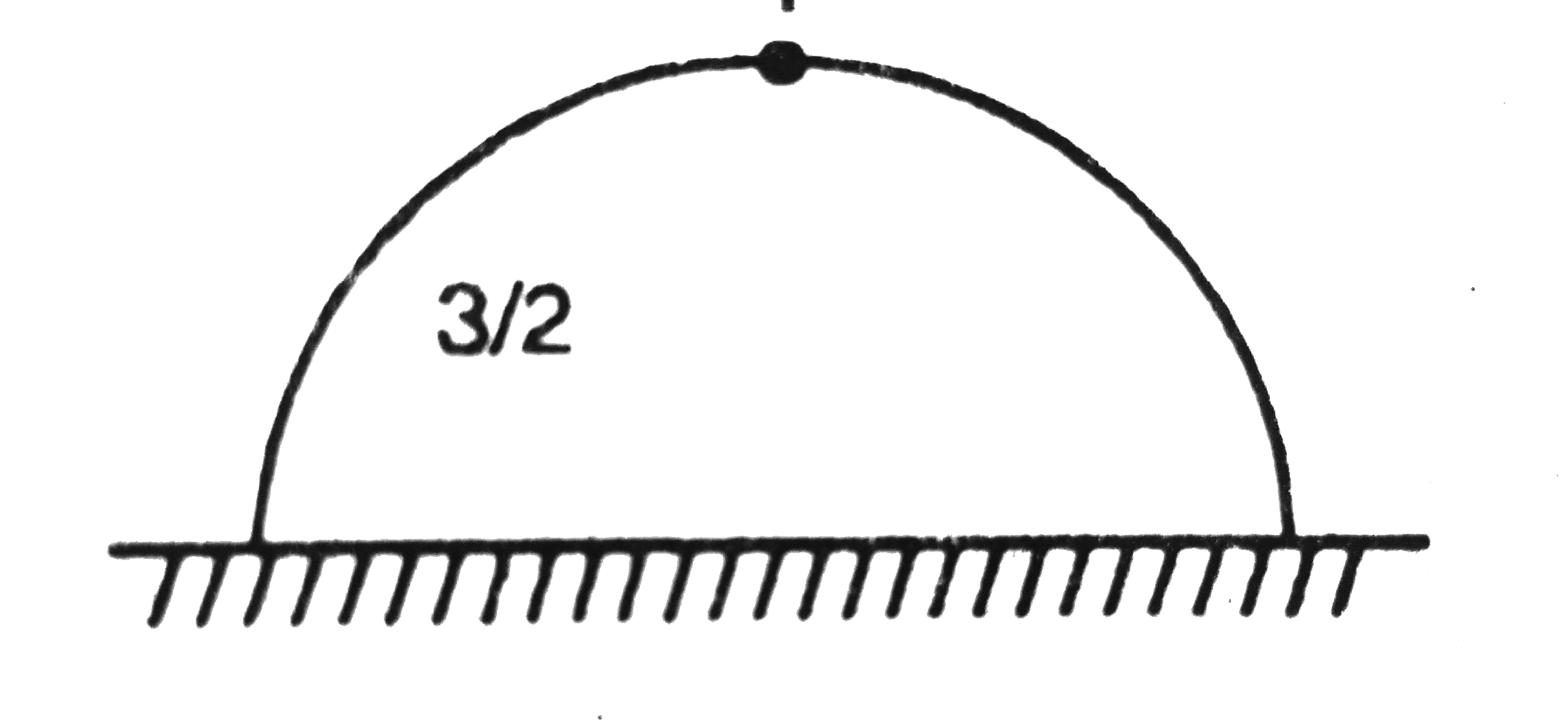
A, B, C

a. for surface `u=-3.5cm`
`mu_1=1.5`
`mu_2=1`
`v_1=?`

`mu_2/v_1-mu_1/u=(mu_1-mu_1)/R`
1/v_1-1.5/(-(3.5))=(-0.5)/(-5)`
`1/v_1=1/10-3/7`
`=(7-30)/70`
`=(-23)/70`
`v_1=(-70)/23=~-3`
So from centre 2 cm towards left
b. for survace `2, -6.5, `
`mu_1=1.5, m_2=1, v=?`
`mu_2/v_1-mu_1/u=(mu_2-mu_1)/R`
`1/v-1.5/6.3=1/10`
`1/v=1/10-3/13`
`=(13-30)/130`
`=(-17)/130`
`v=(-130)/17=-2.6`
`So, 7.6-5=2.6 towards let from centre.
Promotional Banner

Topper's Solved these Questions

Similar Questions

Explore conceptually related problems

A point object is placed at the centre of a glass sphere of radius 6cm and refractive index 1.5. The distance of virtual image from the surface is

An air bubble in a glass sphere (mu = 1.5) is situated at a distance 3 cm from a convex surface of diameter 10 cm . At what distance from the surface will the bubble appear ?

A point charge + mu c is a distance 5 cm directly above the centre of a square of side 10 cm as what is the magnitude of the electric flux through the square

An insulating solid sphere of radius R has a uniformaly positive charge density rho . As a result of this uniform charge distribution there is a finite value of electric potential at the centre of the sphere, at the surface of the sphere and also at a point out side the sphere. The electric potential at infinity is zero. Statement-1: Wgen a charge 'q' is taken from the centre to the surface of the sphere, its potential energy charges by (qrho)/(3 in_(0)) Statement-2 : The electric field at a distance r (r lt R) from the centre of the the sphere is (rho r)/(3in_(0))

(a) Find the moment of inertia of a sphere about a tangent to the sphere, given the moment of inertia of the sphere about any of its diameters to be 2MR^(2)//5 , where M is the mass of the sphere and R is the radius of the sphere. (b) Given the moment of inertia of a disc of mass M and radius R about any of its diameters to be MR^(2)//4 , find its moment of inertia about an axis normal to the disc and passing through a point on its edge.

(a) Find the moment of inertia of a sphere about a tangent to the sphere, given the moment of inertia of the sphere about any of its diameters to be 2(MR^(2))/(5) , where M is the mass of the sphere and R is the radius of the sphere. (b) Given the moment of inertia of a disc of mass M and radius R about any of its diameters to be (MR^(2))/(4) , find its moment of inertia about an axis normal to the disc and passing through a point on its edge.

A hollow metal sphere of radius 5 cm is charged such that the potential on its surface is 10V . The potential at the distance 3 cm from the centre of the sphere is:

A conducting sphere of radius 10 cm has an unknown charge if the electric field 20 cm from the centre of the sphere is 1.5 xx10^(3) N/C and points radialy inward what is the net charge on the sphere

A solid sphere has a radius of 2 cm and a mas of 0.05 kg. What is the relative density of the sphere ? (AS_(1))

A circle is the locus of a point in a plane such that its distance from a fixed point in the plane is constant. Anologously, a sphere is the locus of a point in space such that its distance from a fixed point in space in constant. The fixed point is called the centre and the constant distance is called the radius of the circle/sphere. In anology with the equation of the circle |z-c|=a , the equation of a sphere of radius is |r-c|=a , where c is the position vector of the centre and r is the position vector of any point on the surface of the sphere. In Cartesian system, the equation of the sphere, with centre at (-g, -f, -h) is x^2+y^2+z^2+2gx+2fy+2hz+c=0 and its radius is sqrt(f^2+g^2+h^2-c) . Q. Radius of the sphere, with (2, -3, 4) and (-5, 6, -7) as xtremities of a diameter, is

HC VERMA-GEOMETRICAL OPTICS-Exercises
  1. A spherical surface of radius 30 cm separates two transparent media A ...

    Text Solution

    |

  2. Figure shows a transparent hemisphere of radius 3'0 cm made of a mate...

    Text Solution

    |

  3. A small object is embedded in a glass sphere (mu =1.5) of radius 5.0 c...

    Text Solution

    |

  4. A biconvex thick lens is constructed with glass (mu = 1.50). Each of t...

    Text Solution

    |

  5. A narrow pencil of parallel light is incident normally on a solid tran...

    Text Solution

    |

  6. One end of a cylindrical glass rod (mu = 1.5) of radius 1.0 cm is roun...

    Text Solution

    |

  7. A paperweight in the form of a hemisphere of radius 3.0 cm is used to ...

    Text Solution

    |

  8. Solve the previous problem if the paperweight is inverted at its place...

    Text Solution

    |

  9. A hemispherical portion of the surface of a solid glass sphere (mu = 1...

    Text Solution

    |

  10. The convex surface of a thin concave-convex lens of glass of refractiv...

    Text Solution

    |

  11. A double convex lens has focal length 25 cm. The radius of curvature o...

    Text Solution

    |

  12. The radii of curvature of a lens are + 20 cm and + 30 cm. The material...

    Text Solution

    |

  13. Lenses are constructed by a material of refractive indeic 1.50. The ma...

    Text Solution

    |

  14. A thin lens made of a material of refractive indexmu2 has a medium of ...

    Text Solution

    |

  15. A convex lens has a focal length of 10 cm. Find the location and natur...

    Text Solution

    |

  16. A slide projector has to project a 35 mm slide (35 mm xx 23 mm) on a 2...

    Text Solution

    |

  17. A particle executes a simple harmonic motion of amplitude 1.0 cm along...

    Text Solution

    |

  18. An extended object is placed at a distance of 5.0 cm from a convex len...

    Text Solution

    |

  19. A pin of length 2.00 cm is placed perpendicular to the principal axis ...

    Text Solution

    |

  20. A convex lens produces a double size real image when an object is plac...

    Text Solution

    |

