Home
Class 12
PHYSICS
The separation L between the objective (...

The separation L between the objective `(f=0.5cm)` and the eyepiece (f=5cm) of a compound microscope is 7 cm. Where should a small object be placed so that the eye is least strained to see the image? Find the angular magnification produced by the microscope.

Text Solution

Verified by Experts
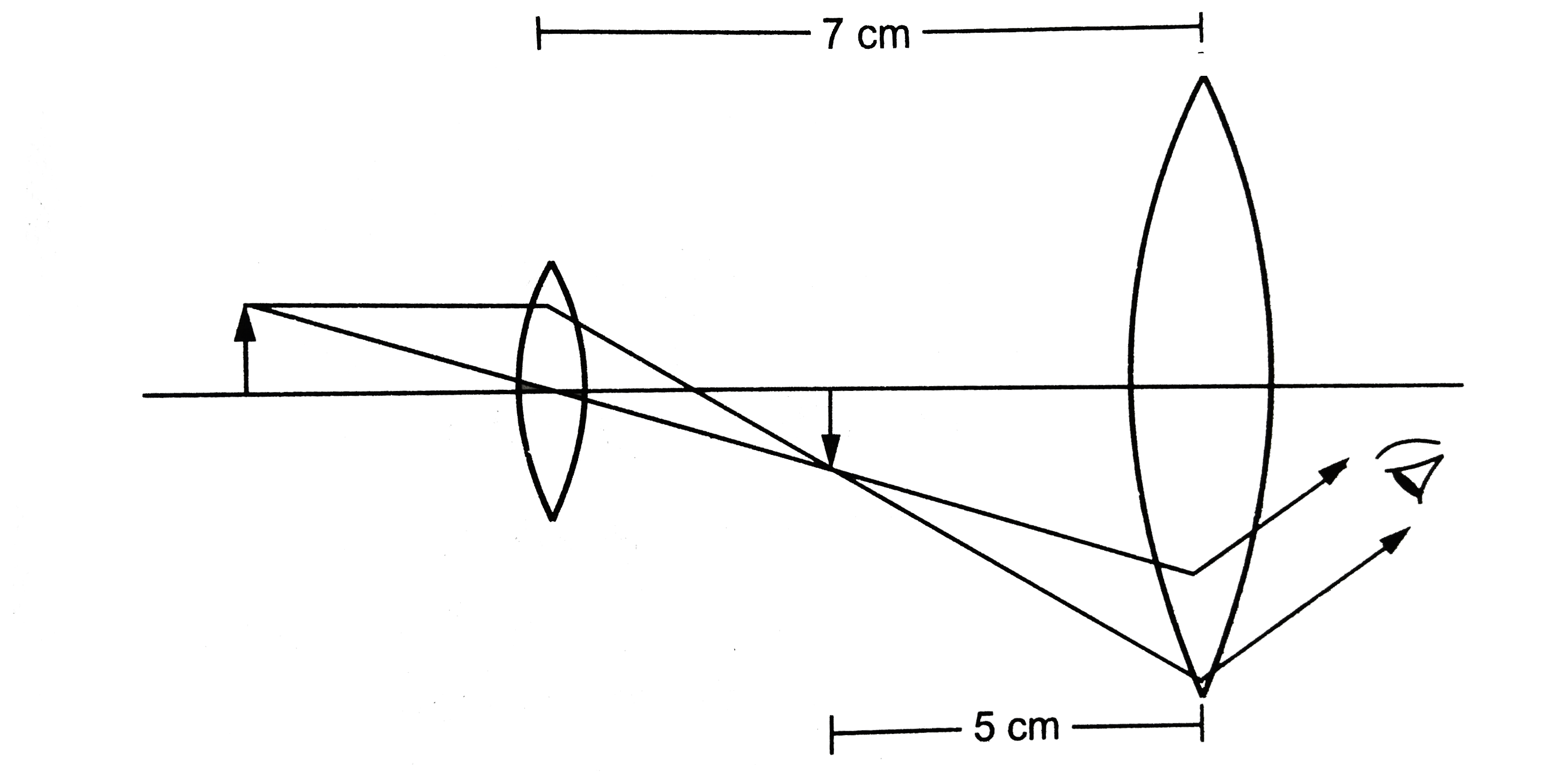
The eye is least strain dif the fiN/Al image is formed at infinity. In such a case, the image formed by the objective should fal at the focus of the eyepiece. As `f_e=5 and L=7` cm, this first image shold be formed at 7 cm -5cm=2cm from the objective. Thus, `v=+2. Also f_0=0.5` cm for the objective using
`1/v-1/u=1/f_0`
`1/u=1/v-1/f_0`
`=1/(2cm)-1/(0.5cm)`
or `u=-2/3cm

the angular magnification in this case is
`m=v/u D/f_0`
`=(2cm)/((2/3)cm)=(25cm)/(5cm)-15.`
Promotional Banner

Topper's Solved these Questions

  • OPTICAL INSTRUMENTS

    HC VERMA|Exercise Short Answer|11 Videos
  • OPTICAL INSTRUMENTS

    HC VERMA|Exercise Question for short Answer|1 Videos
  • OPTICAL INSTRUMENTS

    HC VERMA|Exercise Exercises|23 Videos
  • MAGNETIC PROPERTIES OF MATTER

    HC VERMA|Exercise Exercises|9 Videos
  • PERMANENT MAGNETS

    HC VERMA|Exercise Exercises|25 Videos

Similar Questions

Explore conceptually related problems

If f_0 and f_e , are respective focal lengths of objective and eye-piece of compound microscope, then ......

A concave lens has focal length of 15 cm. At what distance should the object from the lens be placed so that it forms an image at 10 cm from the lens ? Also find the magnification produced by the lens.

A concave lens has focal length of 15 cm. At what distance should the object from the lens be placed so that it forms an image at 10 cm from the lens ? Also find the magnification produced by the lens.

(a) For the telescope described in Exercise 9.28 (a), what is the separation between the objective lens and the eyepiece? (b) If this telescope is used to view a 100 m tall tower 3 km away, what is the height of the image of the tower formed by the objective lens? (c) What is the height of the final image of the tower if it is formed at 25cm?

A thin equiconvex lens of glass of refractive index mu=3//2 & of focal length 0.3m in air is sealed into an opening at one end of a tank filled with water (mu=4//3) .On the opposite side of the lens ,a mirror is placed inside the tank on the tank wall perpendicular to the lens axis ,as shown in figure .the separation between the lens and the mirror is 0.8m A small object is placed outside the tank in front of the lens at a distance of 0.9 m form the lens along its axis .Find the position (relative to the lens)of the image of the object fromed by the stsyem.

A person with a normal near point (25 cm) using a compound microscope with objective of focal length 8.0 mm and an eyepiece of focal length 2.5cm can bring an object placed at 9.0mm from the objective in sharp focus. What is the separation between the two lenses? Calculate the magnifying power of the microscope,

An eye can distinguish between two points of an object if they are separated by more than 0.22 mm when the object is placed at 25 cm from the eye. The object is now seen by a compound microscope having a 20 D objective and 10 D eyepiece separated by a distance of 20 cm. The final image is formed at 25 cm from the eye. What is the minimum separation between two points of the object which can now be distinguished?

An object is placed at a distance of 25 cm on the axis of a concave mirror, having focal length 20 cm. Find the lateral magnification of an image.

A compound microscope consists of an objective lens of focal length 2.0 cm and an eyepiece of focal length 6.25 cm separated by a distance of 15cm. How far from the objective should an object be placed in order to obtain the final image at (a) the least distance of distinct vision (25cm), and (b) at infinity? What is the magnifying power of the microscope in each case?

