Home
Class 12
PHYSICS
A narrow beam of light passes through a ...

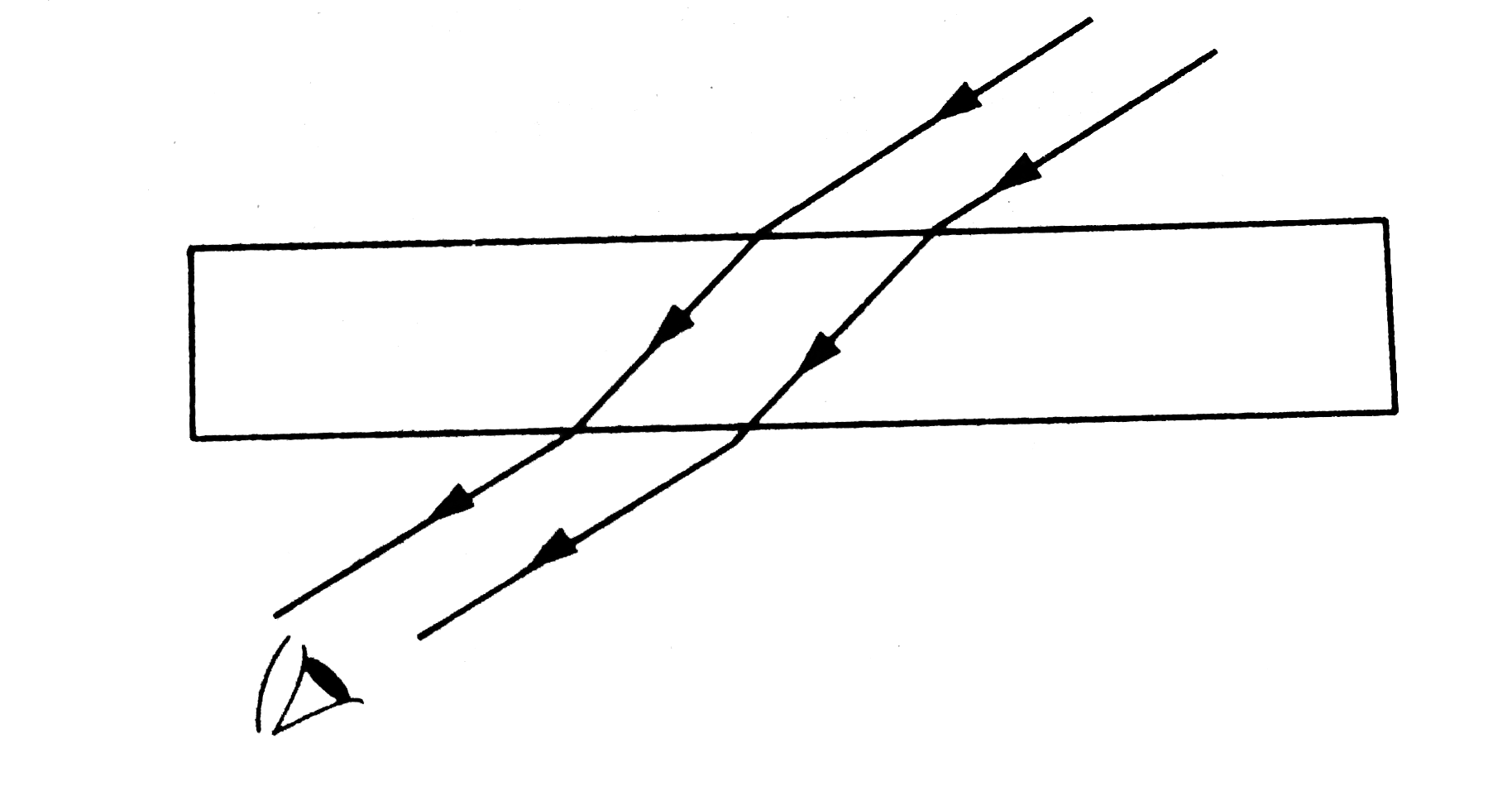
A narrow beam of light passes through a slab obliquely and is then received by an eye. The index of refraction of the material in the slab fluctuates slowly with time. How will it appear to the eye? The twinkling of stars has a similar explanation.

A

The light neve splits in different colours.

B

The emergent beam is white

C

the light inside the slab is split into different colours

D

The light inside the slab is white

Text Solution

Verified by Experts

The correct Answer is:

B, C
Promotional Banner

Topper's Solved these Questions

  • DISPERSION AND SPECTRA

    HC VERMA|Exercise Objective 2|1 Videos
  • DISPERSION AND SPECTRA

    HC VERMA|Exercise Exercises|11 Videos
  • DISPERSION AND SPECTRA

    HC VERMA|Exercise Objective -1|4 Videos
  • CAPACITORS

    HC VERMA|Exercise Exercise|2 Videos
  • ELECTRIC CURRENT IN CONDUCTORS

    HC VERMA|Exercise Exercises|84 Videos

Similar Questions

Explore conceptually related problems

Time taken by the sunlight to pass through a slab of 4 cm and refractive index 1.5 is ...... s.

Time taken by the sunlight to pass through a slab of thickness 4 mm and refractive index 3 is ........ sec.

Light passes through a glass slab of refractive index .n. and thickness .t.. If .C. is the speed of light in free space, then time taken to emerge | light out of glass slab will be ......

The lens governing the behavior of the rays namely rectilinear propagation laws of reflection and refraction can be summarised in one fundamental law known as Fermat's principle. According to this principle a ray of light travels from one point to another such that the time taken is at a stationary value (maximum or minimum). if c is the velocity of light in a vacuum the velocity in a medium of refractive index mu is (c)/(mu) hence time taken to travel a distance l is (mul)/(c) if the light passes through a number of media, the total time taken is ((1)/(c))summul or (1)/(c)intmudl if refractive index varies continuously. Now summul is the total path, so that fermat's principle states that the path of a ray is such that the optical path in at a stationary value. this principle is obviously in agreement with the fact that the ray are straight lines i a homogenous isotropic medium. it is found that it also agrees with the classical laws of reflection and refraction. Q. If refractive index of a slab varies as mu=1+x^(2) where x is measured from one end then optical path length of a slab of thickness 1 m is

(a) How many anstronomical units (AU) make 1 parsec ? (b) Consider a sunlike star at a distance of 2 parsecs. When it is seen through a telescope with 100 magnification what should be the angular size of the star ? Sun appears to be (1/2) from the earth. Due to atmospheric fluctuations, eye cannot resolve objects smaller than 1 arc minute. (c) Mars has approximately half of the earth's diameter. When it is closest to the earth it is at about 1/2 AU from the earth. Calculate what size it will appear when seen through the same telescope.

A glass prism of angle A = 60^(@) gives minimum angle of deviation theta ~~ 30^(@) with the maximum error of 1^(@) when a beam of parallel light passed through the prism during an experiment. Find the permissible error in the measurement of refractive index mu of the material of the prism.
