Home
Class 12
PHYSICS
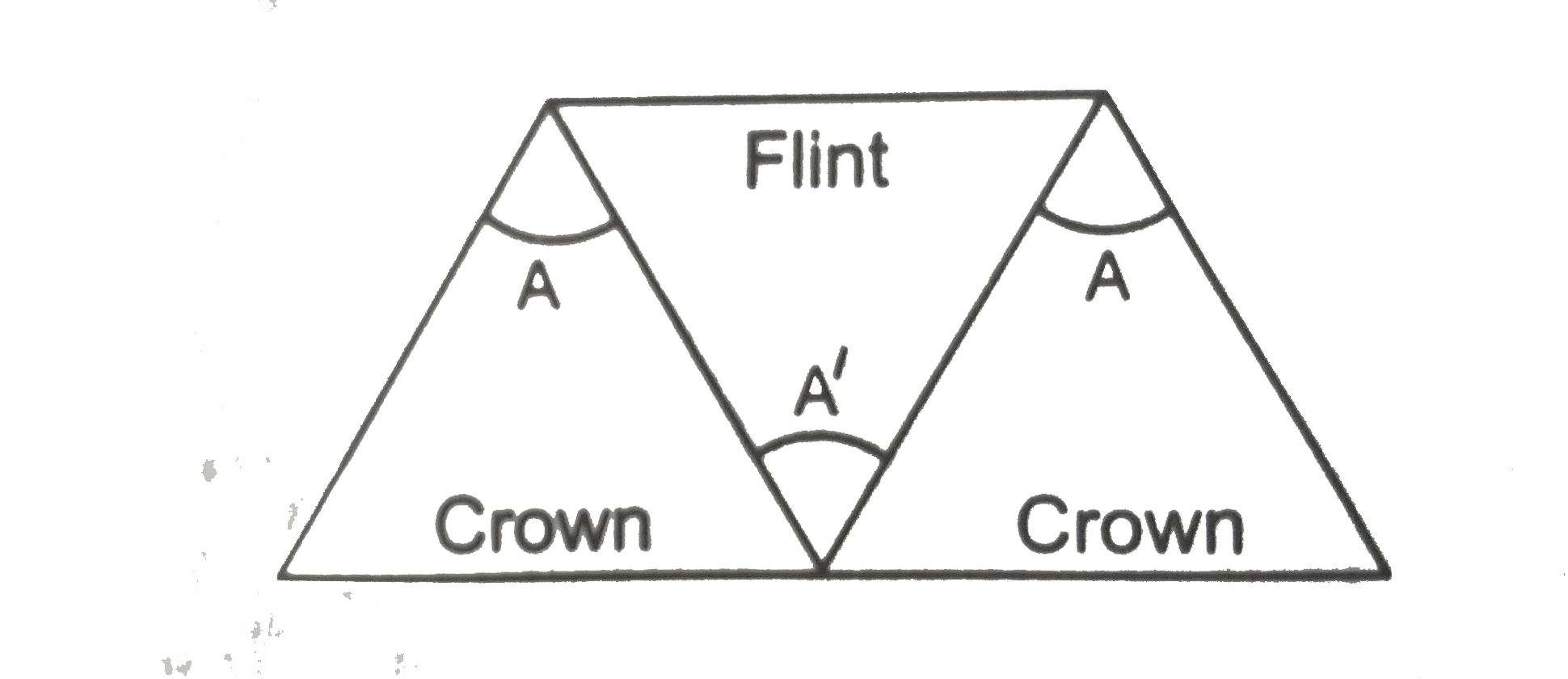
Three thin prisms are combined as shown ...

Three thin prisms are combined as shown in figure. The refractive indices of the crown glass for red, yellow and violet rays are `mu_r, mu_y and mu_v` respectively and those for the flint glass are `mu_r^', mu_y^r and mu_v^'` respectively. Find the ratio A'/A for which (a) there is no net angular dispersion, and (b) there is no net deviation in the yellow ray.

Text Solution

Verified by Experts

The correct Answer is:

A, B

Total deviation for yellow ray produced by the prismcombination is ,
`delta_y = delta_(ey) - delta_(ty)`
` =2 delta_(ey) - 2delta_(ry)`
`= 2 (mu_y + 1)A - (mu_(re) -1)A`
Similarlyu the angular dispersion produced by the combination is
`(a) For net angular dispersion to be zero,
`delta_t - delta_t = 0 =2 (mu_(upsilon c) - mu_(tc)A`
`=(mu_(upsilon t) - mu_(rt)A`
rArr (A)/(A) = (2(mu_(upsilon c) - mu_(r c)`/((mu_(upsilon c) - uu_rc)`
`= (2(mu_r - u_r))/((mu_r - mu))`
(b) Fro net deviation in the yellow ray to be zero,
`delta = -0`
`rArr 2(mu_(cy) -1)A = (2(mu_(cy) -1))/((mu_(ty) -1))`
`=(2(mu_y -1))/((mu_y -1))`
Promotional Banner

Topper's Solved these Questions

  • DISPERSION AND SPECTRA

    HC VERMA|Exercise Objective 2|1 Videos
  • CAPACITORS

    HC VERMA|Exercise Exercise|2 Videos
  • ELECTRIC CURRENT IN CONDUCTORS

    HC VERMA|Exercise Exercises|84 Videos

Similar Questions

Explore conceptually related problems

The wavelengths of violet, yellow and red light are lambda_(v), lambda_(y) and lambda_(r) respectively, then …………

The refractive indices of the crown glass for violet and red lights are 1.51 and 1.49 respectively and those of the flint glass are 1.77 and 1.73 respectively A prism of angle 6^(@) is made of crown glass .A beam of white light is incident at a small angle on this prism.The other thin flint glass prism is combined white the crown glass prism such that te net mean deviation is 1.5^(@) anticlockwise. (i)Determine the angle of the flint glass prism. (ii)A screen is placed normal to the emerging beam at a distance of 2m from the prism combination.find the distance between red and violet spot on the screen Which is the topmost colour on screen.

If the focal length of a lens for red and violet light rays respectively are f_R and f_V then which of the following is true relationship ?

Relative permittivity and permeability of a material are in_(r) and mu_(r) , respectively. Which of the following values of these quantities are allowed for a diamagnetic material ?

Two parallel beams of light P and Q (separation d) containing radiations of wavelengts 4000Å and 5000 Å (which are mutually coherent in each wavelength separately) are incident normally on a prism as shown in figure the refractive index of the prism as a function of wavelength is given by the relation mu(lamda)=1.20+(b)/(lamda^(2)) where lamda is in Å and b is a positive constant. The value of b is such that the condition for total reflection at the face AC is just satisfied for one wavelength and is not satisfied for the other. A convergent lens is used to bring these transmitted beams into focus. If the intensities of the upper and the lower beams immediately after transmission from the face AC, are 4I and I respectively, find the resultant intensity at the focus.

Consider the situation in figure. The bottom of the pot is reflecting plane mirror , S is small fish is a human eye . Refractive index of water is mu . Fish can see two images of human eye , first due to refractive only and other due to refraction and than reflection . Distance of these images from fish are S_(1) "and" S_(2) respectively . Human eye can also see the two images of fish, first due to refraction only and other due to reflection and then refraction . Distance of these images from human eye are S_(3) "and" S_(4) respectively . Match the quantities of column-I (with their value in column-(II) {:("Column I","Column II"),((A) S_(1),(p)H[1 + (1)/(2mu)]),((B)S_(2),(q) H[mu + (1)/(2)]),((C)S_(3) , (r) H[1 + (3)/(2mu)]) , ((D) S_(4) , (s) H[mu + (3)/(2)]):}

An object O (real ) is placed at focus of an equi-biconvex lens as shown in. figure-I . The refractive index of lens is mu = 1.5 and the radius of curvature of either suface of lens is R . The lens is surronded by air . In each statement of column-I some changes are made to situation given above and information regarding final image formed as a result is given in column-II . The distance between lens and object is unchanged in all statements of column-I. match the statements in column-I with resulting image in column-II.

A, B and C arc voltmeters of resistance R, 1.5R and 3R respectively as shown in the figure. When some potential difference is applied between X and Y, the voltmeter readings are V_(A) , V_(B) and V_(C) repsectively. Then :

The young's double slit experiment is done in a medium of refractive index 4//3 .A light of 600nm wavelength is falling on the slits having 0.45 mm separation .The lower slit S_(2) is covered by a thin glass sheet of thickness 10.4mu m and refractive index 1.5 .the intereference pattern is observed ona screen placed 1.5m from the slits are shown (a) Find the location of the central maximum (bright fringe with zero path difference)on the y-axis. (b) Find the light intensity at point O relative to the maximum fringe intensity. (c )Now,if 600nm light is replaced by white light of range 400 to700 nm find the wavelength of the light that from maxima exactly point O .[All wavelengths in this problem are for the given medium of refractive index 4//3 .Ignore dispersion]

A uniform thin cylindrical disk of mass M and radius R is attaached to two identical massless springs of spring constatn k which are fixed to the wall as shown in the figure. The springs are attached to the axle of the disk symmetrically on either side at a distance d from its centre. The axle is massless and both the springs and the axle are in horizontal plane. the unstretched length of each spring is L. The disk is initially at its equilibrium position with its centre of mass (CM) at a distance L from the wall. The disk rolls without slipping with velocity vecV_0 = vacV_0hati. The coefficinet of friction is mu. The maximum value of V_0 for whic the disk will roll without slipping is-
