Home
Class 12
PHYSICS
A particle a having a charge of 5.0 xx 1...

A particle a having a charge of `5.0 xx 10 ^(-7) C` is fixed in. a vertical wall. A second particle B of mass 100 g and. having equal charge is supended by a silk thread. of length 30 cm form the wall. The point of suspension is. 30 cm above the particle A. Find the angle of the thread. with the vertical when it stays in equilibrium.

Text Solution

Verified by Experts
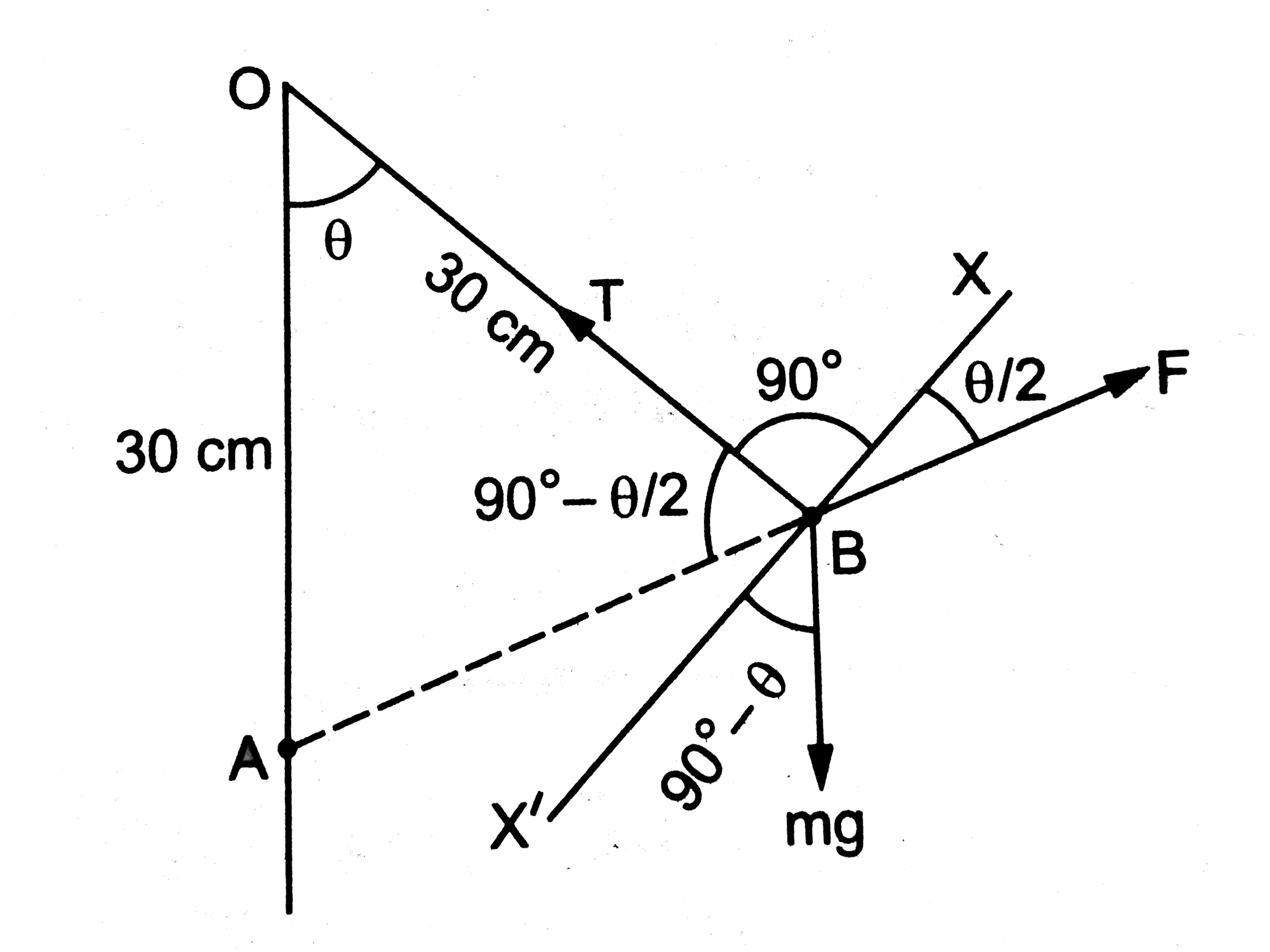

The situation is shown in figure . Supppose the
piont suspension is O and let theta be the angle between
the thread and the vertical. Forces on the particle B are
(i) weight mg downward
(ii) tension T along the thread and
(iii) electric force of repulsion F along AB.
For equilibrium, these forces should add to zero. Let
X'' BX be the line perpendicular to OB. we shall take the
components of the forces along BX. This will giva a
relation between F, mg and `theta`
The verious andgles are shown in the figure. As
`OA= OB, /_OAB =` 90^@ - (theta)/(2)`
The other angles can be writen down directly.
Taking components along BX, we get
`F cos (theta) /(2) = mg cos ( 90^@ - theta)`
`= 2 mg sin (theta)/(2) cos (theta)/(2)`
or, `sin (theta)/(2) = (F)/ (2mg)`
Now,` F = (9xx10 ^9 Nm^2 C^(-2) xx (5.0 xx 10 ^(-7) C)^2 xx (1)/(AB^2)`
and `AB = 2 (OA) sin (theta)/(2).`
Thus, `F = (9 xx 10 ^9 xx 25 xx 10(-14))/(4 xx (30xx10^(-2))^2 xx sin^2. (theta)/(2)) N`
from (i) and (ii),
`sin (theta)/(2) = (F )/(2 mg) = (9xx 10^9 xx 25 xx 10 ^(-14) N )/(4xx ( 30 xx 10 ^(-2)^2 xx sin^2 .(theta)/(2)) . (1)/(2mg) or
`sin^3 (theta)/(2) =(9xx10^9 xx 25 xx 10 ^(-14) N)/(4xx9xx 10^(-2) xx 2 xx (100xx 10^(-3)kg) xx 9.8 ms(-2))`
=0.0032
or sin (theta)/(2) = 0.15, giving theta =17^@.`
Promotional Banner

Topper's Solved these Questions

  • ELECTRIC FIELD AND POTENTIAL

    HC VERMA|Exercise Short Answer|14 Videos
  • ELECTRIC FIELD AND POTENTIAL

    HC VERMA|Exercise Objective 1|9 Videos
  • ELECTRIC FIELD AND POTENTIAL

    HC VERMA|Exercise Exercises|75 Videos
  • ELECTRIC CURRENT THROUGH GASES

    HC VERMA|Exercise Exercises|23 Videos
  • ELECTROMAGNETIC INDUCTION

    HC VERMA|Exercise EXERCISE|9 Videos

Similar Questions

Explore conceptually related problems

A non-conducting disc of radius a and uniform positive surface charge density sigma is placed on the ground, with its axis vertical. A particle of mass m and positive charge q is dropped, along the axis of the disc, from a height H with zero initial velocity. The particle has q//m=4 in_0 g//sigma (a) Find the value of H if the particle just reaches the disc. (b) Sketch the potential energy of the particle as a function of its height and find its equilibrium position.

Particles of masses 10 g and 20 g have position vectors (5,3,0) and (2,0,3) respectively. The position vector of their centre of mass is ………… cm.

A small ball if mass 2 xx 10^(-3) Kg having a charges of 1 mu C is suspended by a string of length 0. 8 m Another identical ball having the same charge is kept at the point of suspension . Determine the minimum horizontal velocity which should be imparted to the lower ball so that it can make complete revolution .

Two metal plates having a potential difference of 800 V are 0.02 m apart horizontally. A particle of mass 1.96 xx 10^(-15) kg is suspended in equilibrium between the plates. If e is the elementary charge, the charge on the particle is

A particle having mass 1 g and electric charge 10^(-8) C travels from a point A having electric potential 600 V to the point B having zero potential. What would be the change in its kinetic energy ?

An inclined plane of length 5.60 m making an angle of 45^(@) with the horizontal is placed in an uniform electric field E= 100 Vm^(-1) . A particle of mass 1 kg and charge 10^(@)C is allowed to slide down from rest position from maximum height of slope. If the co-efficient of friction is 0.1, the time taken by the particle to reach the bottom is________

When a particle is restricted to move aong x axis between x =0 and x = a , where a is of nanometer dimension. Its energy can take only certain specific values. The allowed energies of the particle moving in such a restricted region, correspond to the formation of standing waves with nodes at its ends x = 0 and x = a . The wavelength of this standing wave is realated to the linear momentum p of the particle according to the de Breogile relation. The energy of the particl e of mass m is reelated to its linear momentum as E = (p^(2))/(2m) . Thus, the energy of the particle can be denoted by a quantum number 'n' taking values 1,2,3,"......." ( n=1 , called the ground state) corresponding to the number of loop in the standing wave. Use the model decribed above to answer the following three questions for a particle moving in the line x = 0 to x =a . Take h = 6.6 xx 10^(-34) J s and e = 1.6 xx 10^(-19) C . If the mass of the particle is m = 1.0 xx 10^(-30) kg and a = 6.6 nm , the energy of the particle in its ground state is closet to

A football player kicks a ball at ball at an angle of 30 ^(0) with the horizontal with an initial speed of 20 m//s . Assuming that the ball travels in a vertical plance, calculate (a) the time at which the ball reaches the highest point (b) maximum height reached (c ) the horizrontal range of the ball (d) the time for wich the ball is in air. g =10 m//s^(2) .

A particle is projected upwards with a velocity of 100 m//s at an angle of 60^(@) with the vertical. Find the time when the particle will move perpendicular to its initial direction, taking g = 10 m//s^(2) .

HC VERMA-ELECTRIC FIELD AND POTENTIAL-Worked Out Examples
  1. Charges 5.0 xx ^(-7) C , -2.5 xx ^(-7) C and 1.0 xx 10^(-7) C are ...

    Text Solution

    |

  2. Two particles A and B having charges 8.0 xx 10 ^(-6) C and -2.0 xx 1...

    Text Solution

    |

  3. Three equal charges, each having a magnitude of. 2.0 xx 10 ^ (-6) C, ...

    Text Solution

    |

  4. Two small iron particles, each of mass 280 mg, are. placed at a distan...

    Text Solution

    |

  5. A charge Q is to be divided on two objects. What shouold. be the valu...

    Text Solution

    |

  6. Two particles, each having a mass of 5 g and charge. 1.0 xx 10^(-7) C...

    Text Solution

    |

  7. A vertical electric field of magnitude 4.00xx 10^5 NC^(-1). just preve...

    Text Solution

    |

  8. Three charges each equal to q, are placed at the three corners of a sq...

    Text Solution

    |

  9. A Charged particle of mass 1.0 g is suspended through a silk thread of...

    Text Solution

    |

  10. A particle a having a charge of 5.0 xx 10 ^(-7) C is fixed in. a verti...

    Text Solution

    |

  11. Four particles each having a charge q, are placed on the four vertices...

    Text Solution

    |

  12. Find the electric field at a point P on the perpendicular bisector of ...

    Text Solution

    |

  13. A uniform electric field E is created between two parallel charged pla...

    Text Solution

    |

  14. In a circuit, 10 C of charge is passed through a battery in a given...

    Text Solution

    |

  15. charges 2.0 xx 10^(-6) C and 1.0 xx 10^(-6) C are placed at. corners A...

    Text Solution

    |

  16. The electric field in a region is given by vecE = (A/x^3) vecI. Write ...

    Text Solution

    |

  17. Three point charges q, 2q and 8q are to be placed on a 9 cm long strai...

    Text Solution

    |

  18. The electric dipole moment of an HCl atom is 3.4 xx 10^(-30) Cm. The c...

    Text Solution

    |

  19. show an electric dipole formed by two particles fixed at the ends of ...

    Text Solution

    |

