Home
Class 12
PHYSICS
Some equipotential surfaces are shown in...

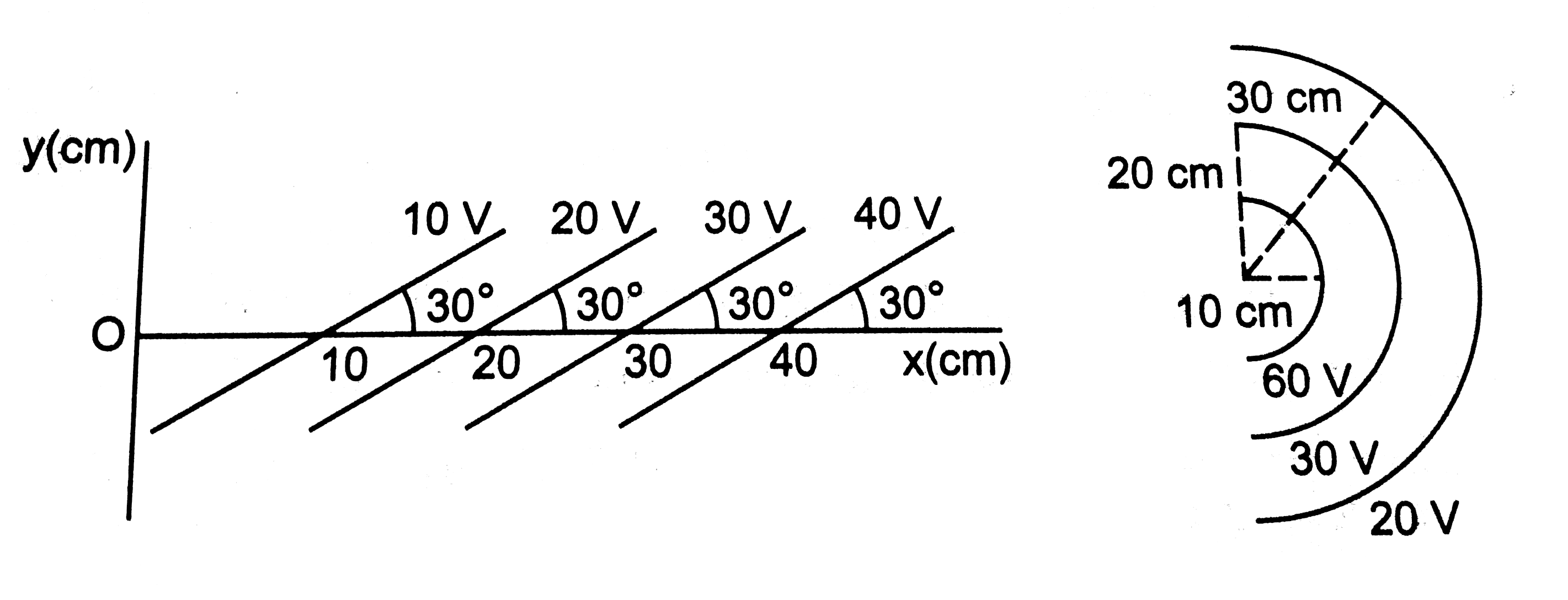
Some equipotential surfaces are shown in figure(29.E3) What can you say about the magnitude and the direction of the electric field?

Text Solution

Verified by Experts

` (a) The angle between potential edl=dv change in potential =10V=dV `
` As E=rdV `
` (As potential surface) `
` S0, Edl=dv `
` rArr Edlcos(90+30) =-dV `
` rArr E(10xx10^-2)cos120=-dV `
` E=200V//m `
making an angle 120 with yaxis
(b) As electric field intensity is r to potential surface
` So, E=r `
` rArr =60vq `
` So, E=v.m=V.M. `
Promotional Banner

Topper's Solved these Questions

  • ELECTRIC FIELD AND POTENTIAL

    HC VERMA|Exercise Objective 2|8 Videos
  • ELECTRIC CURRENT THROUGH GASES

    HC VERMA|Exercise Exercises|23 Videos
  • ELECTROMAGNETIC INDUCTION

    HC VERMA|Exercise EXERCISE|9 Videos

Similar Questions

Explore conceptually related problems

What can you say about the resistance of an ammeter?

What can you say about the resistance of a voltmeter?

A plane electromagnetic wave travels in vacuum along z-direction. What can you say about the directions of its electric and magnetic field vectors? If the frequency of the wave is 30 MHz, what is its wavelength?

A plane electromagnetic wave travels in vacuum along z - direction. What can you say about the directions of its electric and magnetic field vectors ? If the frequency of the wave is 30 MHz, what is its wavelength ?

The nuclear charge ( Ze ) is non uniformlly distribute with in a nucleus of radius r. The charge density rho(r) (charge per unit volume) is dependent only on the radial distance r form the centre of the nucleus s shown in figure. The electric field is only along the radial direction. The electric field at r=R is

A thin rod of mass M and length L is bent in a semicircle as shown in figure (a). What is its gravitational force (both magnitude and direction) on a particle with mass m at O the centre of curvature ? (b) what would be the force on m if the rod is in the form of complete circle?

The nuclear charge ( Ze ) is non uniformlly distribute with in a nucleus of radius r. The charge densilty rho(r) (charge per unit volume) is dependent only on the radial distance r form the centre of the nucleus s shown in figure. The electric field is only along the radial direction. The electric field within the nucleus is generaly observed to be linearly dependent on r. This implies

Two charges 2 µC and –2 µC are placed at points A and B 6 cm apart. (a) Identify an equipotential surface of the system. (b) What is the direction of the electric field at every point on this surface?

HC VERMA-ELECTRIC FIELD AND POTENTIAL-Exercises
  1. An electric field of 20 N//C exists along the x-axis in space. Calcula...

    Text Solution

    |

  2. Consider the situation of the previous problem. A charge of 2.0xx 10 ^...

    Text Solution

    |

  3. An electric field vecE = vec(i20 + vecj30 ) NC^(-1) exists in the spac...

    Text Solution

    |

  4. An electric field vecE = vec i Ax exists in the space, where A= 10 V ...

    Text Solution

    |

  5. The electric potential existing in space is V(x,y,z)= A (xy+ yz+zx).(a...

    Text Solution

    |

  6. Two charged particles, having equal charges of 2.0xx 10^(-5) C each, a...

    Text Solution

    |

  7. Some equipotential surfaces are shown in figure(29.E3) What can you sa...

    Text Solution

    |

  8. Consider a circular ring of radius r, uniformly charged with linear ch...

    Text Solution

    |

  9. An electric field of magnitude 1000 NC ^(-1) is produced between two p...

    Text Solution

    |

  10. A uniform field of 2.0 NC^(-1) exists in space in x direction (a) Taki...

    Text Solution

    |

  11. How much work has to be done in assembling three charged particles at ...

    Text Solution

    |

  12. The kinetc energy of a chargd particle decreased by 10 J as it moves f...

    Text Solution

    |

  13. Two identical particles, each having a charge of 2.0xx10^(-4) C and ma...

    Text Solution

    |

  14. Two particles have equal masses of 5.0 g each and opposite charges of ...

    Text Solution

    |

  15. A sample of HCl gas is placed in an electric field of 2.5xx 10^4 NC^(-...

    Text Solution

    |

  16. Two particles A and B, having opposite charges2.0xx 10^(-6) and -2.0 ...

    Text Solution

    |

  17. Three charges are arranged on the vertices of an equilateral triangle ...

    Text Solution

    |

  18. find the magnitude of the electric field at the point P in the configu...

    Text Solution

    |

  19. Two particles, carrying charges -q and +q and having equal masses m ea...

    Text Solution

    |

  20. Assume that each atom in a copper wire contributes one free electron. ...

    Text Solution

    |
