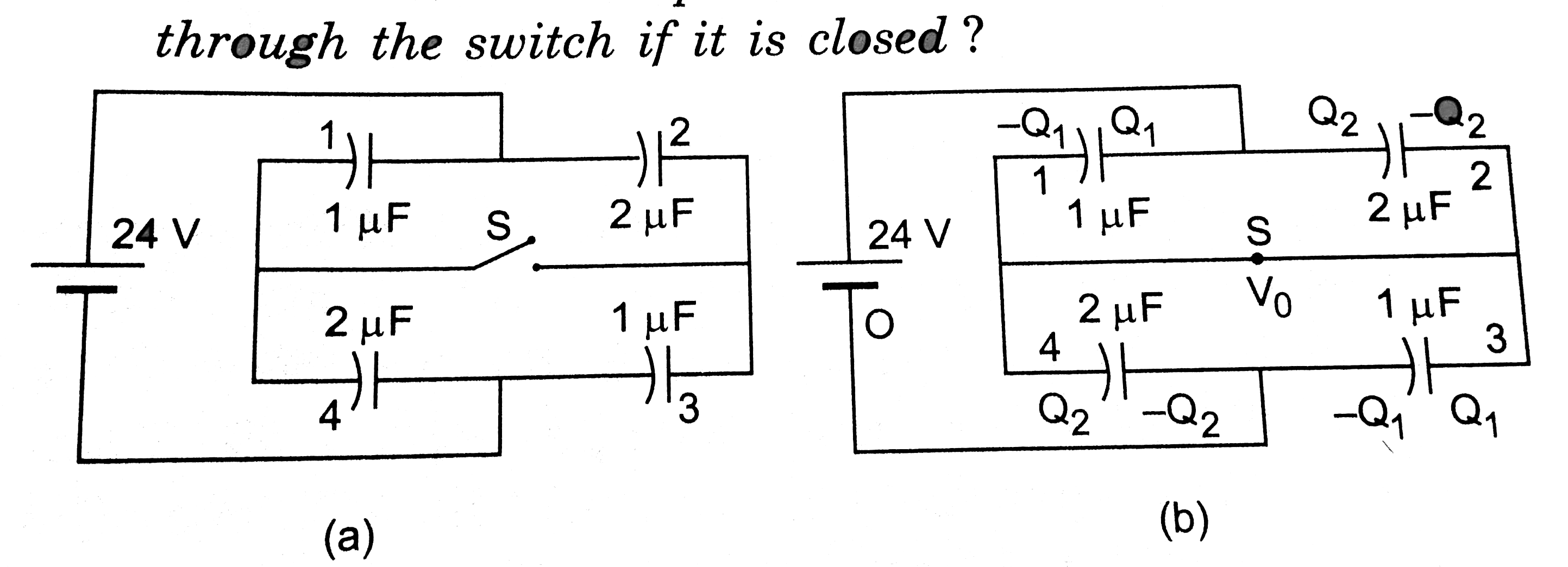
Find the equivalent capacitance of the combination shown in figure (31.11a) between the point P and N.
Text Solution
Verified by Experts
Let us connect a battery between the points P and N. The charge and the potentials are shown in figure The positive terminal of the battery supplies a charge+Q which appears on the plate `A_1`. The facing plate `A_2` gets a charge_Q. The plates `A_2`. `A_3` and `A_5` taken together from an isolated system. The total charge on these three plates should be zero. Let a charge `Q_1` appear on `A_3`, then a charge `Q-Q_1` will appeat on `A_5` to make the total charge zero on the three plates. The plate `A_4` will get a charge`-Q_1 (facing plate of `A_3) and `A_6` will get a charge `-(Q-Q_1) ( facing plate of `A_5`). The total charge `_Q on A_4 and A_6` is supplied by the negative terminal of the battery. This completes the charge distribution. Next, suppose the potential at the point N is zero and at P it is V. The potential of the plates `A_4 and A_6` is also zero. The potential of the plate `A_1` is V. The plates `A_2, A_3 and A_5` are at the same potential. Let this common potential be `V_1`. This completes the potential distributino. Applying the capacitor equation `Q=CV` to the three capacitors, `Q=C_1(V-V_1)................(1)` `Q_1= C_2V_1...............(2)` and `Q-Q_1=C_3V_1..................(3) Adding (2) and (3), `Q =(C_2+C_3)V_1` or `Q/C_2+C_3= V_1`...............(4) From(1), `Q/C_1=V-V_1`...................(5) Adding (4) and (5) `Q/C_2+C_3+ Q/C_1= V` or`)C_1+C_2+C_3)Q/C_1(C_2+C_3)=V` or `C=Q/V=C_1(C_2+C_3)/C_1+C+N64_2+C_3`. It may be noted that the above example could be solved bby using the equations for series-parallel combinations. However, the general method wax used to demonstrate its application.
Topper's Solved these Questions
CAPACITORS
HC VERMA|Exercise Worked Out Examples|23 Videos
CAPACITORS
HC VERMA|Exercise Short Answer|7 Videos
BOHR'S MODEL AND PHYSICS OF THE ATOM
HC VERMA|Exercise Exercises|46 Videos
DISPERSION AND SPECTRA
HC VERMA|Exercise Exercises|11 Videos
Similar Questions
Explore conceptually related problems
Determine the equivalent resistance of networks shown in figure.
Equivalent capacitance between X and Y point in the given figure is
Find the equivalent resistance of the circuit shown in the following figure: Also find the total current flowing in this circuit.
Four resistors, each of 10 Omega are connected to form a square as shown in the given figure. Find the eqUivalent resistance between the opposite corner A and C and between two points on anyone side (AB).
Calculate the equivalent resistance of the resistance network between the points A and B as shown in the figure, when switch S is closed.
For the network of resistance shown in the figure the equivalent resistance of the network between the points A and B is 18 ohm. The value of unknown resistance R is :
Find equivalent resistance between A and B:
A cube is constructed by connecting 12 wires of equal resistance as shown in figure. The equivalent resistance between the points A and B shown in the figure is..... . The resistance of each wire is of r Omega . A and B are the midpoints of the sides PQ and VU respectively.
In the circuit shown in figure potential difference between the points A and B in the steady state is
The equivalent resistance of a series combination of two resistors is '9 Omega' and the equivalent resistance of a parallel combination of the same two resistors is 2 Omega . Find the resistances of the resistors.