Home
Class 12
PHYSICS
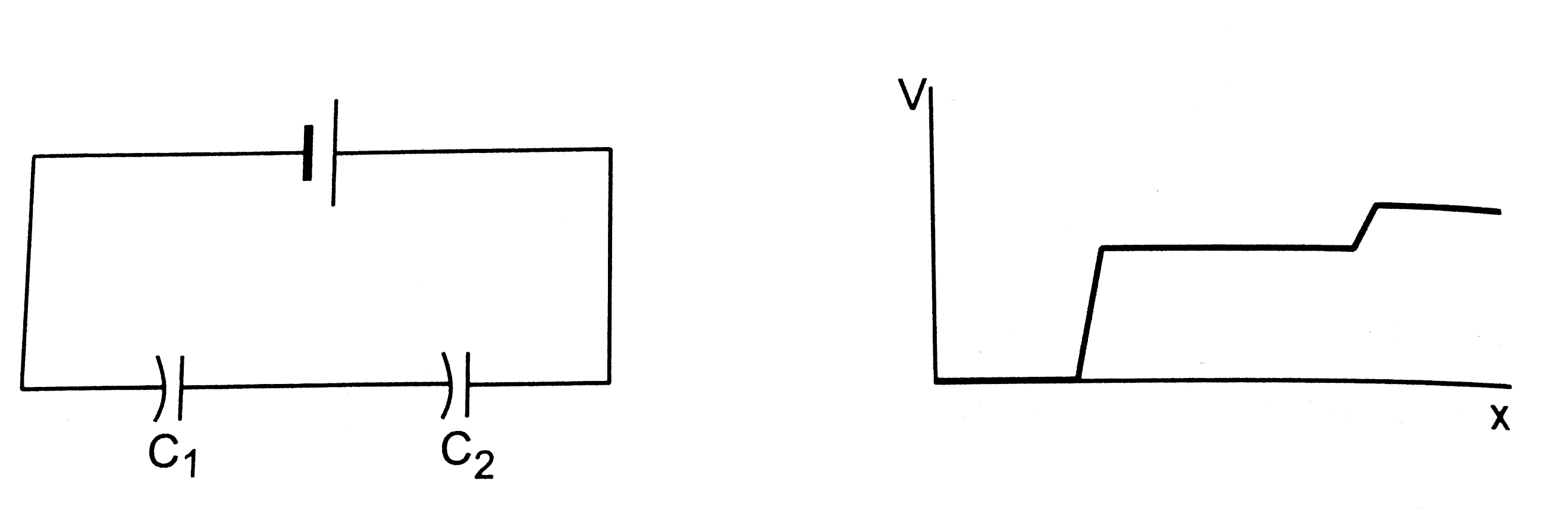
Figure show two capacitors connected in ...

Figure show two capacitors connected in series and joind to a bettery. The graph shows the variation in potential as one movies from right to left on the branch containing the capacitors.

A

`C_1gtC_2`

B

`C_1=C_2`

C

`C_1ltC_2`

D

The information is not sufficient to decide the ralation between `Q_+` and `Q_.`

Text Solution

Verified by Experts

The correct Answer is:

C
Promotional Banner

Topper's Solved these Questions

  • CAPACITORS

    HC VERMA|Exercise Objective 2|7 Videos
  • CAPACITORS

    HC VERMA|Exercise Exercises|64 Videos
  • CAPACITORS

    HC VERMA|Exercise Short Answer|7 Videos
  • BOHR'S MODEL AND PHYSICS OF THE ATOM

    HC VERMA|Exercise Exercises|46 Videos
  • DISPERSION AND SPECTRA

    HC VERMA|Exercise Exercises|11 Videos

Similar Questions

Explore conceptually related problems

The circuit in figure shows two cells connected in opposition to each other. Cell E_(1) is of emf 6 V and nternal resistance 2 Omega the cell E_(2) is of emf 4 V and internal resistance 8 Omega . Find the potential difference between the points A and B.

Figure shows the x-t plot of one-dimensional motion of a particle. Is it correct to say from the graph that the particle moves in a straight line for l lat 0 and on a parabolic path for t gt 0 ? If not, suggest a suitable physical context for this graph.

A potentiometer wire is 100 cm long and a constant potential difference is maintained across it. Two cells are connected in series first to support one another and then in opposite direction. The balance points are obtained at 64 cm and 32 cm from the positive end of the wire in the two cases. the ratio of emf's is

Figure shows a capacitor made of two circular plates each of radius 12 cm, and separated by 5.0 cm. The capacitor is being charged by an external source (not shown in the figure). The charging current is constant and equal to 0.15 A. Calculate the capacitance and the rate of change of potential difference between the plates.

Figure shows a capacitor made of two circular plates each of radius 12 cm, and separated by 5.0 cm. The capacitor is being charged by an external source (not shown in the figure). The charging current is constant and equal to 0.15 A. Is Kirchhoff's first rule (junction rule) valid at each plate of the capacitor ? Explain.

Figure shows a capacitor made of two circular plates each of radius 12 cm, and separated by 5.0 cm. The capacitor is being charged by an external source (not shown in the figure). The charging current is constant and equal to 0.15 A. Obtain the displacement current across the plates.

A circuit containing a 80 mH inductor and a 60 muF capacitor in series is connected to a 230 V, 50 Hz supply. The resistance of the circuit is negligible. (a) Obtain the current amplitude and rms values. (b) Obtain the rms values of potential drops across each element. (c) What is the average power transferred to the inductor? (d) What is the average power transferred to the capacitor? (e) What is the total average power absorbed by the circuit? [‘Average’ implies ‘averaged over one cycle’.]

Two pendulums with identical bobs and lengths are suspended from a common support such that in real position the two bobs are in contact (figure). One of the bobs is released after being displaced by 10^(@) so that it collides elastically head-on with the other bob. (a) Describe the motion of two bobs. (b) Draw a graph showing variation in energy of either pendumlum with time, for 0 le t le 2T , where T is the period of each pendulum.

A circus wishes to develop a new clown act. Fig. (1) shows a diagram of the proposed setup. A clown will be shot out of a cannot with velocity v_(0) at a trajectory that makes an angle theta=45^(@) with the ground. At this angile, the clown will travell a maximum horizontal distance. The cannot will accelerate the clown by applying a constant force of 10, 000N over a very short time of 0.24s . The height above the ground at which the clown begins his trajectory is 10m . A large hoop is to be suspended from the celling by a massless cable at just the right place so that the clown will be able to dive through it when he reaches a maximum height above the ground. After passing through the hoop he will then continue on his trajectory until arriving at the safety net. Fig (2) shows a graph of the vertical component of the clown's velocity as a function of time between the cannon and the hoop. Since the velocity depends on the mass of the particular clown performing the act, the graph shows data for serveral different masses. The slope of the line segments plotted in figure 2 is a figure constant. Which one of the following physical quantities does this slope represent?
