Home
Class 12
PHYSICS
A capacitor is made of a flat plate of a...

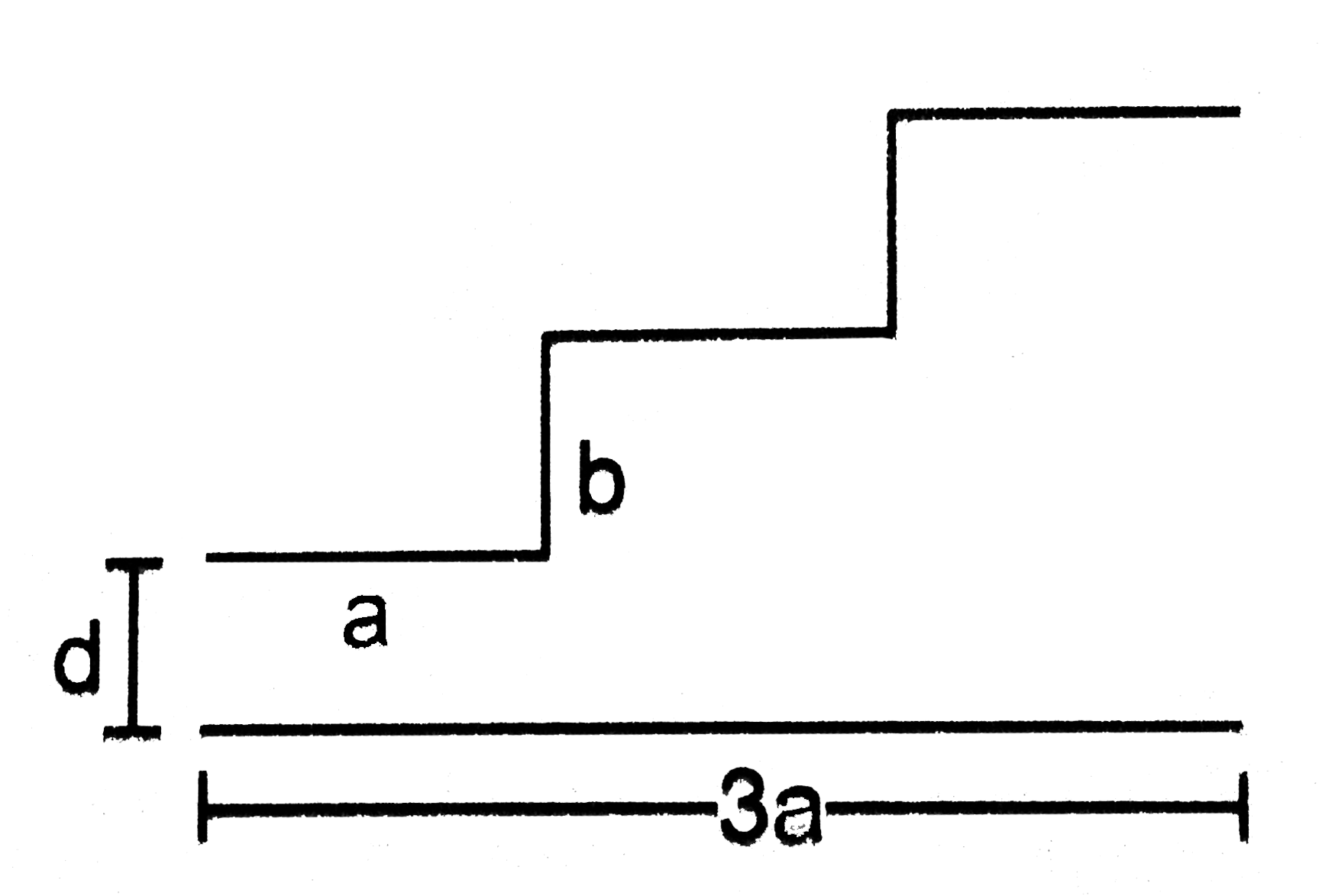
A capacitor is made of a flat plate of area A and B second plate having a stair -like structure as shown in figure (31-E9). The width of each stair is a and the height is b . Find the capacitance of the assembly.

Text Solution

Verified by Experts
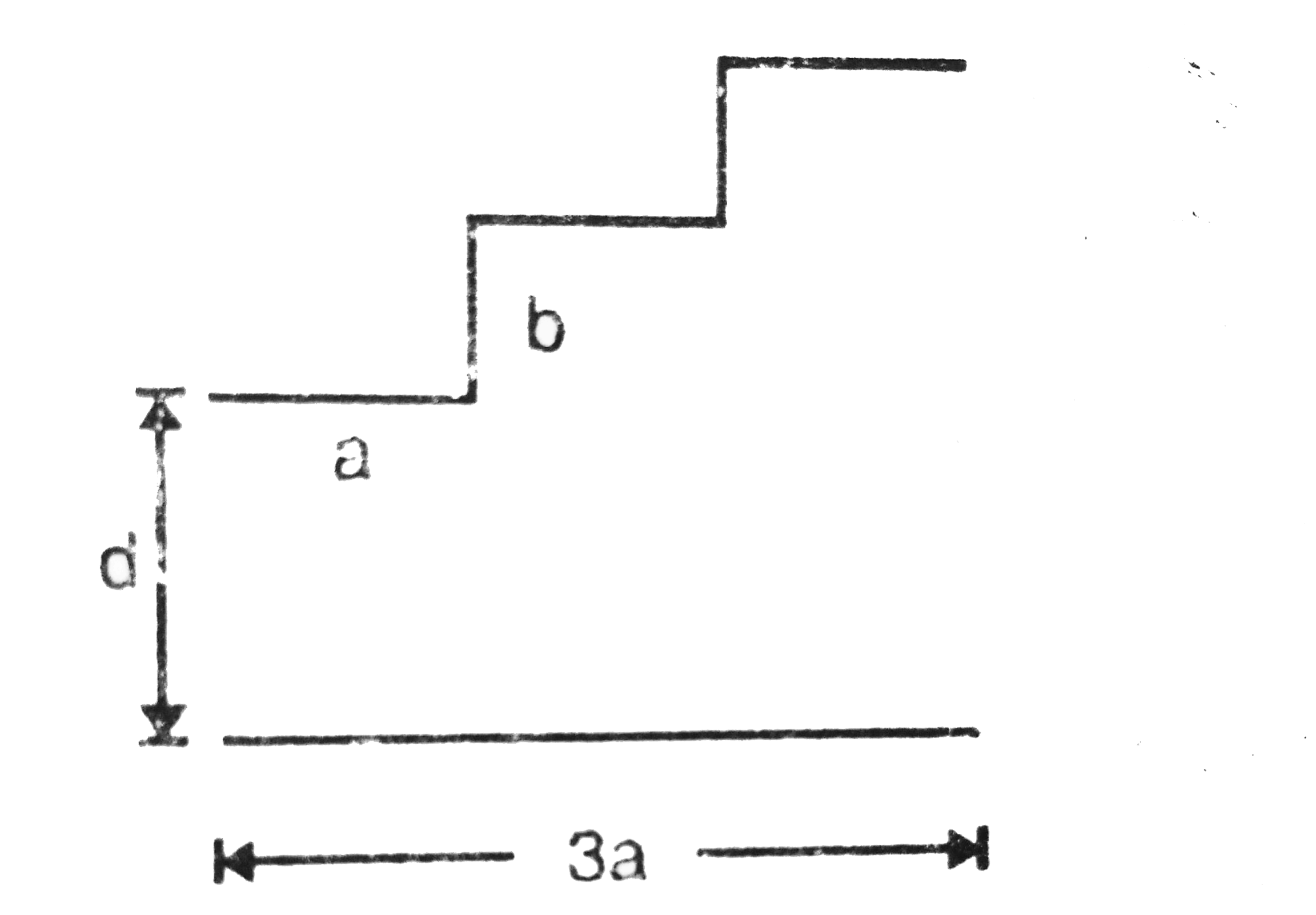
`C_1 = eplision _0 A / 3d , C_2 = eplision _0 A / (d+b) `
` C_3 = eplision_0 A / 3(d + 2b)`
The surface area at each is equal to A / 3 . Then the three capacitor is parallel combination .
` C = C_1 + C_2 + C_3 `
`= eplision_0 A / 3d + eplision_0 A / 3 (d + b ) + eplision_0 A / 3 (d + 2b) `
` = eplision_0 A / 3 (3d^(2) + 6bd + 2b^(2) ) / d ( d+ b ) (d + b) `.
Promotional Banner

Topper's Solved these Questions

  • CAPACITORS

    HC VERMA|Exercise Exercise|2 Videos
  • CAPACITORS

    HC VERMA|Exercise Objective 2|7 Videos
  • BOHR'S MODEL AND PHYSICS OF THE ATOM

    HC VERMA|Exercise Exercises|46 Videos
  • DISPERSION AND SPECTRA

    HC VERMA|Exercise Exercises|11 Videos

Similar Questions

Explore conceptually related problems

Figure 8.6 shows a capacitor made of two circular plates each of radius 12 cm, and separated by 5.0 cm. The capacitor is being charged by an external source (not shown in the figure). The charging current is constant and equal to 0.15A. (a) Calculate the capacitance and the rate of change of potential difference between the plates. (b) Obtain the displacement current across the plates. (c) Is Kirchhoff’s first rule (junction rule) valid at each plate of the capacitor? Explain.

Figure shows a capacitor made of two circular plates each of radius 12 cm, and separated by 5.0 cm. The capacitor is being charged by an external source (not shown in the figure). The charging current is constant and equal to 0.15 A. Calculate the capacitance and the rate of change of potential difference between the plates.

Figure shows a capacitor made of two circular plates each of radius 12 cm, and separated by 5.0 cm. The capacitor is being charged by an external source (not shown in the figure). The charging current is constant and equal to 0.15 A. Is Kirchhoff's first rule (junction rule) valid at each plate of the capacitor ? Explain.

Figure shows a capacitor made of two circular plates each of radius 12 cm, and separated by 5.0 cm. The capacitor is being charged by an external source (not shown in the figure). The charging current is constant and equal to 0.15 A. Obtain the displacement current across the plates.

An ant is scramping on the stairs as shown in the figure. There are 10 statirs and each stairs has width of 8" and height of "6 find out (i) Distance travelled by ant (ii) Displacement of the ant

A wooden article was made by scooping out a hemisphere from each end of a solid cylinder. As shown in the given figure. If the height of the cylinder is 10 cm, and its base is of radius 3.5 cm find the total surface area of the article.

A ring is made of a wire having a resistance R_(0) = 12 Omega . Find the point A and B , as shown in the figure, at which a current carrying conductor should be connected so that the resistance R of the subcircuit between these points is equal to (8)/(3) Omega

Two fixed, identical conducting plates (a and (3), each of surface area S are charged to - Q and q, respectively, where Q > q > 0. A third identical plate ( lambda ), free to move Is located on the other side of the plate with charge q at a distance d as per figure. The third plate is released and collides with the plate f_3 . Assume the collision is elastic and the time of collision is sufficient to redistribute charge amongst beta and gamma . (a) Find the electric field acting on the plate gamma before collision. (b) Find the charges on beta and gamma after the collision. (c) Find the velocity of the plate gamma after the collision and at a distance d from the plate beta

HC VERMA-CAPACITORS-Exercises
  1. Take the potential of the point B in figure to be zero . (a) Find the...

    Text Solution

    |

  2. Find the equivalent capacitance of the system shown in figure betwee...

    Text Solution

    |

  3. A capacitor is made of a flat plate of area A and B second plate havin...

    Text Solution

    |

  4. A cylindrical capacitor is constructed using two coaxial cylinders of ...

    Text Solution

    |

  5. A100 p F capacitor is charged o a potential difference of 24 V. It is ...

    Text Solution

    |

  6. Each capacitor shown in figure has a capacitance of 5.0n mu F , The e...

    Text Solution

    |

  7. The particle P shown in figure has a mass of 10mg and a charge of - 0....

    Text Solution

    |

  8. The plate of a capacitor are 2.00cm apert . An electron -prodon pair i...

    Text Solution

    |

  9. Convince yourself that parts (a) ,(b) and (c ) of figure are identica...

    Text Solution

    |

  10. Find the potential difference Va -Vb between the points a and b shown...

    Text Solution

    |

  11. Find the equivalent capacitances of the combinations shown in figure ...

    Text Solution

    |

  12. Find the capacitance of the combination shown in figure between A and...

    Text Solution

    |

  13. Find the equivalent capacitance of the point A and B .

    Text Solution

    |

  14. A infinite ladder is constructed by connecting several sections of 2m...

    Text Solution

    |

  15. A charge of +2.0xx 10 ^-8 C is placed on the positive place and a cha...

    Text Solution

    |

  16. A charge of 20 muC is placed on the positive plante of on isolated p...

    Text Solution

    |

  17. A charge of 1 muC is given to one plate of a parailel - plate capacito...

    Text Solution

    |

  18. Each of the plates shown in figure ( 31- E19 ) haas serface area (96/e...

    Text Solution

    |

  19. The capacitance between the adjacent plates shown in figure (31-E20 ...

    Text Solution

    |

  20. Consider the situation of the previous . If 1.0muC is placed on the ...

    Text Solution

    |

