Home
Class 12
PHYSICS
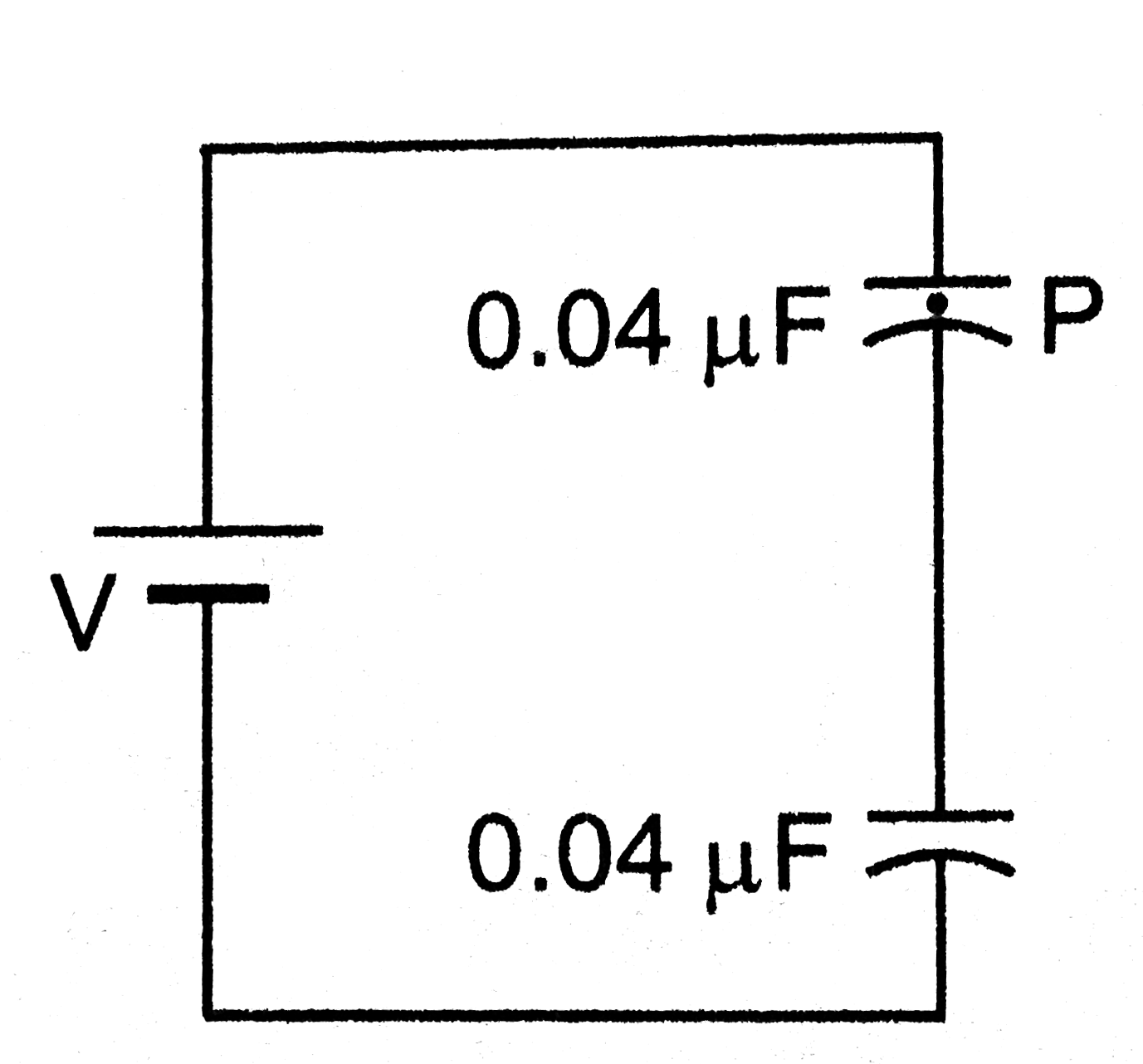
The particle P shown in figure has a mas...

The particle P shown in figure has a mass of 10mg and a charge of - 0.01μC. Each plate has a surface area 100cm2 on one side. What potential difference V should be applied to the combination to hold the particle P in equilibrium?

Text Solution

Verified by Experts

Let the velocity of elctron = V ,
mass of electron = m
Equivalent capacitance = C`
`((eplison_0a^(2)/(d_1)xx(epsilon_0 a^2))/(d_2)/((eplison_0a^(2)/d_1)+(epsilon_0 a^2))
`= eplision_0 a^(2) / (d_1 + d_2)`
(because capacitors are in series)
Horizontal distance = V xx t`
Verticle distance , `y = 1 / 2 at^(2)`
Accelertion of electron `a = qE / m`
`y = d_1`
So, `d_1 = 1 /2 qE / m t^(2) `
or ` d_1 = 1 / 2 qE / m (x /v ) ^(2) `
or, `q = CV`
Put the value of the equation (i) , q , E , we get ,
minimum velocity at electron
`= ( V qa^(2) / md_1 (d_1 - d_2) ^(1/2)`
Promotional Banner

Topper's Solved these Questions

  • CAPACITORS

    HC VERMA|Exercise Exercise|2 Videos
  • CAPACITORS

    HC VERMA|Exercise Objective 2|7 Videos
  • BOHR'S MODEL AND PHYSICS OF THE ATOM

    HC VERMA|Exercise Exercises|46 Videos
  • DISPERSION AND SPECTRA

    HC VERMA|Exercise Exercises|11 Videos

Similar Questions

Explore conceptually related problems

Two electric bulbs are connected one by one across potential difference V At that time power consumed in them are P_1 and P_2 respectively. Now, if potential difference V is applied across series combination of these bulbs, what will be total power consumed ?

Figure 8.6 shows a capacitor made of two circular plates each of radius 12 cm, and separated by 5.0 cm. The capacitor is being charged by an external source (not shown in the figure). The charging current is constant and equal to 0.15A. (a) Calculate the capacitance and the rate of change of potential difference between the plates. (b) Obtain the displacement current across the plates. (c) Is Kirchhoff’s first rule (junction rule) valid at each plate of the capacitor? Explain.

A non-conducting disc of radius a and uniform positive surface charge density sigma is placed on the ground, with its axis vertical. A particle of mass m and positive charge q is dropped, along the axis of the disc, from a height H with zero initial velocity. The particle has q//m=4 in_0 g//sigma (a) Find the value of H if the particle just reaches the disc. (b) Sketch the potential energy of the particle as a function of its height and find its equilibrium position.

For the system shown in the figure the cylinder on the left at L has a mass of 600 kg and a cross sectional area of 800cm^(2) the piston on the right at S has cross sectional area 25cm^(2) and negligible weight if the apparatus is filled with oil (rho=0.75gm//cm^(3)) find thhe force F required to hold the system in equilibrium.

A fixed thermally conducting cylinder has a radius R and height L_0 . The cylinder is open at its bottom and has a small hole at its top. A piston of mass M is held at a distance L from the top surface, as shown in the figure. The atmospheric pressure is P_0 . While the piston is at a distance 2L from the top, the hole at the top is sealed. The piston is then released, to a position where it can stay in equilibrium. In this condition, the distance of the piston from the top is

When a particle is undergoing motion, the diplacement of the particle has a magnitude that is equal to or smaller than the total distance travelled by the particle. In many cases the displacement of the particle may actually be zero, while the distance travelled by it is non-zero. Both these quantities, however depend on the frame of reference in which motion of the particle is being observed. Consider a particle which is projected in the earth's gravitational field, close to its surface, with a speed of 100sqrt(2) m//s , at an angle of 45^(@) with the horizontal in the eastward direction. Ignore air resistance and assume that the acceleration due to gravity is 10 m//s^(2) . The motion of the particle is observed in two different frames: one in the ground frame (A) and another frame (B), in which the horizontal component of the displacement is always zero. Two observers locates in these frames ill agree on :-

When a particle is undergoing motion, the diplacement of the particle has a magnitude that is equal to or smaller than the total distance travelled by the particle. In many cases the displacement of the particle may actually be zero, while the distance travelled by it is non-zero. Both these quantities, however depend on the frame of reference in which motion of the particle is being observed. Consider a particle which is projected in the earth's gravitational field, close to its surface, with a speed of 100sqrt(2) m//s , at an angle of 45^(@) with the horizontal in the eastward direction. Ignore air resistance and assume that the acceleration due to gravity is 10 m//s^(2) . Consider an observer in frame D (of the previous question), who observes a body of mass 10 kg acelerating in the upward direction at 30 m//s^(2) (w.r.t. himself). The net force acting on this body, as observed from the ground is :-

A block of mass m=2kg is resting on a rough inclined plane of inclination plane of inclination 30^(@) as shown in figure. The coefficient of friction between the block and the plane is mu=0.5 . What minimum force F should be applied perpendicular to the plane on the block, so that blocks does not slip on the plane? (g=10m//s^(2))

A mass of 6 kg is suspended by a rope of length 2 m from the ceiling. A force of 50 N in the horizontal direction is applied at the midpoint P of the rope, as shown. What is the angle the rope makes with the vertical in equilibrium ? (Take g = 10 ms-2). Neglect the mass of the rope.

A rod of length 1.05 m having negligible mass is supported at its ends by two wires of steel (wire A) and aluminium (wire B) of equal lengths as shown in figure. The cross-sectional areas of wires A and B are 1.0 mm^(2) and 2.0 mm^(2), respectively. At what point along the rod should a mass m be suspended in order to produce (a) equal stresses and (b) equal strains in both steel and aluminium wires.

HC VERMA-CAPACITORS-Exercises
  1. A100 p F capacitor is charged o a potential difference of 24 V. It is ...

    Text Solution

    |

  2. Each capacitor shown in figure has a capacitance of 5.0n mu F , The e...

    Text Solution

    |

  3. The particle P shown in figure has a mass of 10mg and a charge of - 0....

    Text Solution

    |

  4. The plate of a capacitor are 2.00cm apert . An electron -prodon pair i...

    Text Solution

    |

  5. Convince yourself that parts (a) ,(b) and (c ) of figure are identica...

    Text Solution

    |

  6. Find the potential difference Va -Vb between the points a and b shown...

    Text Solution

    |

  7. Find the equivalent capacitances of the combinations shown in figure ...

    Text Solution

    |

  8. Find the capacitance of the combination shown in figure between A and...

    Text Solution

    |

  9. Find the equivalent capacitance of the point A and B .

    Text Solution

    |

  10. A infinite ladder is constructed by connecting several sections of 2m...

    Text Solution

    |

  11. A charge of +2.0xx 10 ^-8 C is placed on the positive place and a cha...

    Text Solution

    |

  12. A charge of 20 muC is placed on the positive plante of on isolated p...

    Text Solution

    |

  13. A charge of 1 muC is given to one plate of a parailel - plate capacito...

    Text Solution

    |

  14. Each of the plates shown in figure ( 31- E19 ) haas serface area (96/e...

    Text Solution

    |

  15. The capacitance between the adjacent plates shown in figure (31-E20 ...

    Text Solution

    |

  16. Consider the situation of the previous . If 1.0muC is placed on the ...

    Text Solution

    |

  17. Two capacitors of capacitances 20 .0pF and 50.0pF are connected in se...

    Text Solution

    |

  18. Two capacitor of capacitance 4.0muF and 6.0muF are connected in series...

    Text Solution

    |

  19. Each capacitor in figure has a capacitance of 10muF . The emf of the ...

    Text Solution

    |

  20. A capacitor with stored energy 4.0J is connected with an identical ca...

    Text Solution

    |
