Home
Class 12
PHYSICS
A capacitor is formed by two square meta...

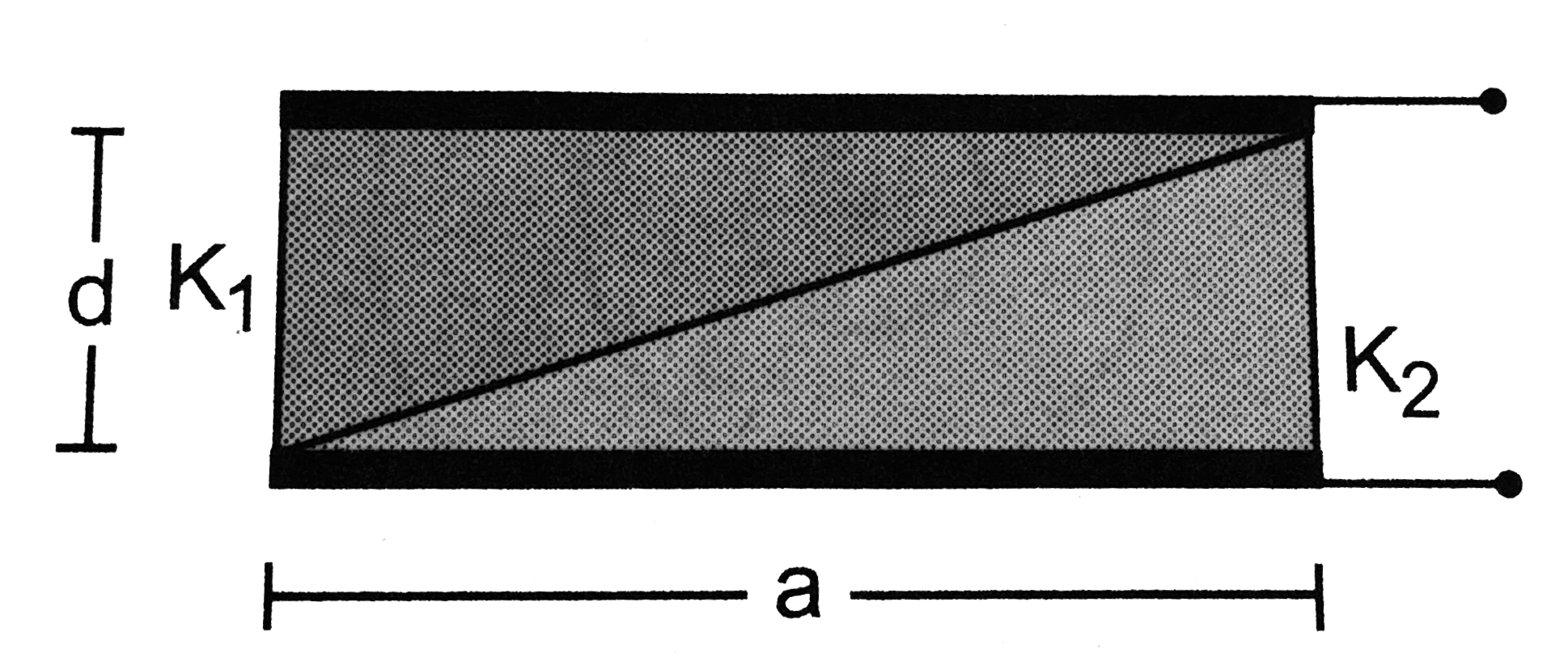
A capacitor is formed by two square metal plate of edge a,separated by a distance d.Dielectric constants`K_1 and K_2`are filled in the gap as shown in figure(31-E25).Find the capacitance.

Text Solution

Verified by Experts

Consider an elemental capacitor of which dx at a distance 'x' from one end. It is constituted of two capacitance elemnts of dielectric constants K_1 and K_2 with palte separartion x tan theata and d - x tan theata respectively in series.
Effective capacitance ` K = K_1 K_2 / K_1 - K_2 ln K_1 / K_2 `
So, `C = epsilon_0 KA / d `
` epsilon K_1 K_2 a^(2) / (K_1 - K_2 ) d in (K_1 /K_2) [where , A = a^(2)] `
Promotional Banner

Topper's Solved these Questions

  • CAPACITORS

    HC VERMA|Exercise Exercise|2 Videos
  • CAPACITORS

    HC VERMA|Exercise Objective 2|7 Videos
  • BOHR'S MODEL AND PHYSICS OF THE ATOM

    HC VERMA|Exercise Exercises|46 Videos
  • DISPERSION AND SPECTRA

    HC VERMA|Exercise Exercises|11 Videos

Similar Questions

Explore conceptually related problems

Write the formula of capacitance of capacitor having dielectric constant K = 2.

A parallel plate capacitor is made of two circular plates separated by a distanc of 5mm and with a dielectric of dielectric constant 2.2 between them . When the electric field in the dielectric is 3xx10^(4) V/m the charge density of the positive plate will be close to :

A capacitor is made of two circular plates of radius R each, separated by a dJstance d lt lt R. The capacitor is connected to a constant voltage. A th.in conducting disc of radius r lt lt R and thickness t lt lt R is placed at a centre of the bottom plate. Find the minimum voltage required to lift the disc if the mass of the disc is m.

A parallel plate air capacitor of capacitance C is connected to a cell o f emf V and then disconnected from it. A dielectric slab of dielectric constant K, which can just fill the air gap of the capacitor, is now inserted in it. Which of the following is incorrect?

Figure shows a capacitor made of two circular plates each of radius 12 cm, and separated by 5.0 cm. The capacitor is being charged by an external source (not shown in the figure). The charging current is constant and equal to 0.15 A. Calculate the capacitance and the rate of change of potential difference between the plates.

Figure shows a capacitor made of two circular plates each of radius 12 cm, and separated by 5.0 cm. The capacitor is being charged by an external source (not shown in the figure). The charging current is constant and equal to 0.15 A. Is Kirchhoff's first rule (junction rule) valid at each plate of the capacitor ? Explain.

Figure 8.6 shows a capacitor made of two circular plates each of radius 12 cm, and separated by 5.0 cm. The capacitor is being charged by an external source (not shown in the figure). The charging current is constant and equal to 0.15A. (a) Calculate the capacitance and the rate of change of potential difference between the plates. (b) Obtain the displacement current across the plates. (c) Is Kirchhoff’s first rule (junction rule) valid at each plate of the capacitor? Explain.

Figure shows a capacitor made of two circular plates each of radius 12 cm, and separated by 5.0 cm. The capacitor is being charged by an external source (not shown in the figure). The charging current is constant and equal to 0.15 A. Obtain the displacement current across the plates.

Write the capacitance of parallel plate capacitor with medium of dielectric of dielectric constant K.

A parallel plate capacitor is made of two dielectric blocks in series. One of the blocks has thickness d_(1) and dielectric constant k_(1) and the other has thickness d_(2) and dielectric constant k_(2) as shown in figure. This arrangement can be thought as a dielectric slab of thickness d = ( d_(1) + d_(2) ) and effective dielectric constant k. The k is ...... (a) (K_(1)d_(1)+K_(2)d_(2))/(d_(1)+d_(2)) (b) (K_(1)d_(1)+K_(2)d_(2))/(K_(1)+K_(2)) (c) (K_(1)K_(2)(d_(1)+d_(2)))/((K_(1)d_(2)+K_(2)d_(1))) (d) (2K_(1)K_(2))/(K_(1)+K_(2))

HC VERMA-CAPACITORS-Exercises
  1. 47-A capacitor of capacitor 5.00 muF is charged to 24.0 V and another ...

    Text Solution

    |

  2. A 5.0muF capacitor is charged to 12V. The positive plate of this capa...

    Text Solution

    |

  3. The two square faces of a rectangular dielectric slab (dielectric con...

    Text Solution

    |

  4. If the above capacitor is connected across a 6.0Vbettery , find (a)the...

    Text Solution

    |

  5. The separation between the plates of a parallel-plate capacitor is 0.5...

    Text Solution

    |

  6. A capacitor stores 50mu ccharge when connected across a battery . When...

    Text Solution

    |

  7. A parallel-plate of capacitor of capacitance 5mu F is connected in a b...

    Text Solution

    |

  8. A paller- plate capacitor has plate area 100cm^2 and plate separation ...

    Text Solution

    |

  9. A parallel -plate capacitor having plate area 400 cm ^2 and separation...

    Text Solution

    |

  10. Find the capacitances of the capacitance of the capacitors shown In f...

    Text Solution

    |

  11. A capacitor is formed by two square metal plate of edge a,separated by...

    Text Solution

    |

  12. Figure shows two indentical pallel plate capacitors connected to a swi...

    Text Solution

    |

  13. A parallel - plate capacitor of plate area Aand plate separation d is ...

    Text Solution

    |

  14. A capacitor having a capacitance of 100 mu f is changed to a potential...

    Text Solution

    |

  15. A sphercial capacitor is made of two conducting spherical shells of ra...

    Text Solution

    |

  16. Suppose the space between the two inner shells of the previous probl...

    Text Solution

    |

  17. An air -filled parallel-plate capacitor is to be constructed which can...

    Text Solution

    |

  18. A pallel -plate capacitor whith the plate area 100cm^2 and the separat...

    Text Solution

    |

  19. Concider the situation shown in figure .The width of each plate is b.T...

    Text Solution

    |

  20. Consider the situation shown in figure .The plates of the capacitor ...

    Text Solution

    |
