Home
Class 12
PHYSICS
Find the potential difference V(a)-V(b)i...

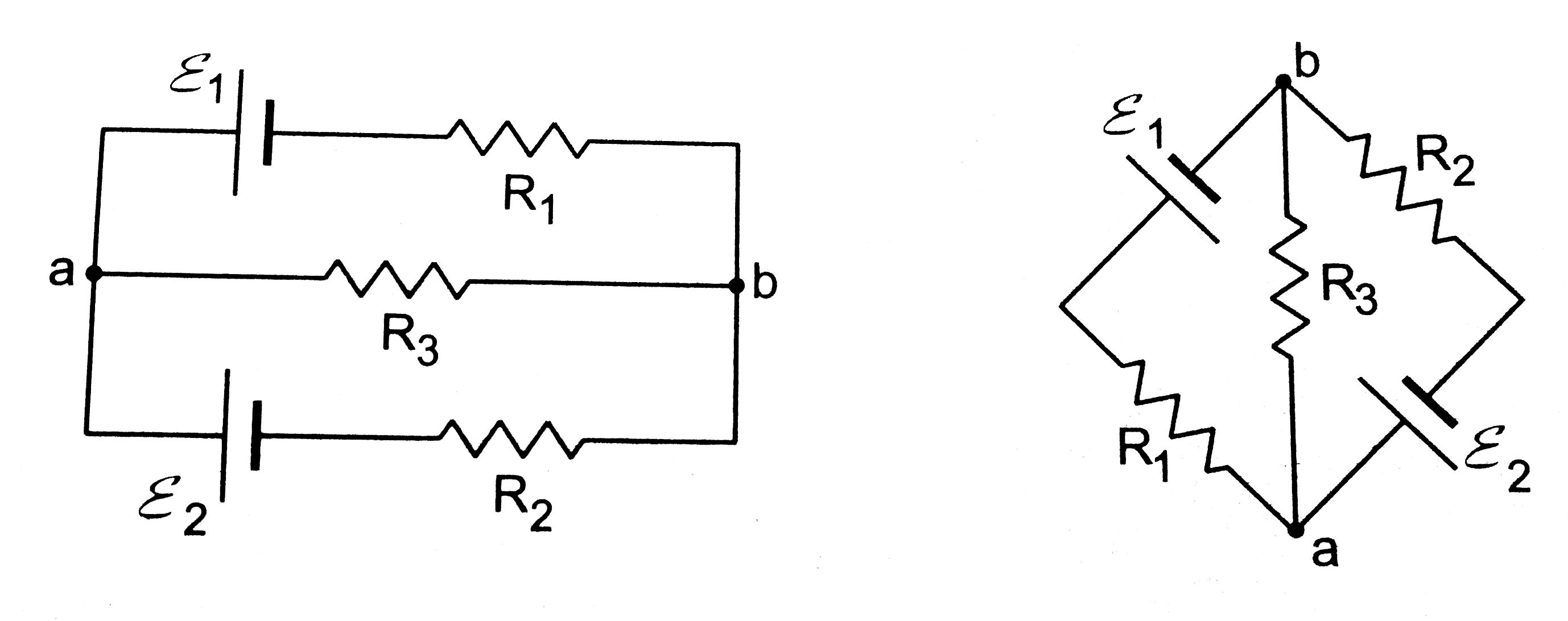
Find the potential difference `V_(a)-V_(b)`in the circutis shown in figure

Text Solution

Verified by Experts

In circuit ab baa
` E_2+iR_2+iR_3 = 0 `
` iR_2 + i_1 R_3 = -E_2`
` rArr iR_2 R_1 + iR_3 R_1 = -E_2 R_1 ` ……..(1)
` and i_1 R_3 + E_1- (i-i_1)R_1 = 0 `
` E_1 = i_1(R_1 + R_3) - iR_1 `
` rArr (E_1) (R_2) = iRi(R_2) + (i_1)(R_2)(R_3) - i(R_1) (R_2) ..........(2) `
` Adding (1) and (2) , we get `
` (i_1)(R_1)(R_2) + i_1(R_3)(R_1) + i_1 (R_2)(R-3)`
` = E_1R_2 - E_2 R_1`
` rArr i_1 ((R_3)(R_1) + (R_2)(R_1) + (R_2)(R_3))`
` (E_1)(R_2) - (E_2)(R-1) `
` i_1 = ((E_1)(R_2) - (E_2)(R_1)/(R_3)(R_1) + (R_2)(R_1) + (R_2)(R_3))`
` V_a - V_b = ((E_1)(R_2) - (E_2)(R_1)/(R_3)(R_1) + (R_2)(R_1) + (R_2)(R_3)) R_3)`
` = ((E_1)(R_2)(R_3)-(E_2)(R_1)(R_3)/(R_3)(R_1) + (R_3)(R_1) + (R_2)(R_3))`
`= [ (E_1/R_2 - E_2/R_1)/((1/R_2)+(1/R_1)+(1/R_3))]`
(b) Same as a .
Promotional Banner

Topper's Solved these Questions

  • ELECTRIC CURRENT IN CONDUCTORS

    HC VERMA|Exercise Objective 2|9 Videos
  • DISPERSION AND SPECTRA

    HC VERMA|Exercise Exercises|11 Videos
  • ELECTRIC CURRENT THROUGH GASES

    HC VERMA|Exercise Exercises|23 Videos

Similar Questions

Explore conceptually related problems

An infinite plane of charge with sigma=2 in_(0) C/m^(2) is tilted at a 37^(@) angle to the vertical direction as shown below. Find the potential difference, V_(A)-V_(B) in volts, between points A and B at 5 m distance apart. (where B is vertically above A).

The potential difference (V_(A) - V_(B)) between the points A and B in the given figure is

Assum that an electric field vecE = 30 x^(2) hati exists in space. Then the potential difference V_(A) - V_(0) , where V_(0) the potential at the origin and V_(A) the potential at x = 2 m is :

A current flows through a rectangular conductor in the presence of uniform magnetic field B pointing out of the page as shown. Then the potential difference V_(P)-V_(Q) is equal to (assume charge carriers in the conductor to be positively charged moving with a drift velocity of v )

Figures 2.8 (a) and (b) show the field lines of a positive and negative point charge respectively. (a) Give the signs of the potential difference V_(P)-V_(Q): V_(B)-V_(A) . (b) Give the sign of the potential energy difference of a small negative charge between the points Q and P, A and B. (c) Give the sign of the work done by the field in moving a small positive charge from Q to P. (d) Give the sign of the work done by the external agency in moving a small negative charge from B to A. (e) Does the kinetic energy of a small negative charge increase or decrease in going from B to A?

For a cell, the graph between the potential difference (V) across the terminals of the cells and the current I drawn from the cell is as shown in figure. Calculate the e.m.f. and the internal resistance of the cell.

In the circuit shown in figure potential difference between the points A and B in the steady state is

The potential difference between the points A and B in the following circuit shown in the figure:-

The variation of potential with distance x from a fixed point is shown in figure. Find the magnitude of the electric field (in V // m) at x=13 m .

Consider the circuit arrangement shown in figure (1) for studying input and output characteristics of n-p-n transistor in CE configuration. Select the values of R_(B) and R_(C ) for a transistor whose V_(BE)=0.7V , so that the transistor is operating at point Q as shown in the characteristics shown in figure (2). Given that the input impedance of the transistor is very small and V_(C C)=V_(BB)=16V , also find the voltage gain and power gain of circuit making appropriate assumptions.

HC VERMA-ELECTRIC CURRENT IN CONDUCTORS-Exercises
  1. Shown a part of an electric circuit, The potentials at the points a,b,...

    Text Solution

    |

  2. Each of the resistors shown in figure has a resistances of 10(Omega)an...

    Text Solution

    |

  3. Find the potential difference V(a)-V(b)in the circutis shown in figure

    Text Solution

    |

  4. In the circuit shown in figure ,(epsilon)(1)=3V,(epsilon)(2)=2V,(epsil...

    Text Solution

    |

  5. Find the current through the 10(Omega)resistor shown in figure.

    Text Solution

    |

  6. Find the current in the resistor shown in figure.

    Text Solution

    |

  7. What should be the value of R in figure fo which the current in it is ...

    Text Solution

    |

  8. Find the equivalent resistance of the circuit shown in figure between ...

    Text Solution

    |

  9. Find the current measured by the ammeter in the circuit shown in figur...

    Text Solution

    |

  10. Consider the circuit shown in figure.Find (a) the current in the circu...

    Text Solution

    |

  11. Twelve wire, each having equal resistance r, are joined to form a cube...

    Text Solution

    |

  12. Find the equivalent resistances of the network shown in figure between...

    Text Solution

    |

  13. An infinite ladder is constructed with 1(Omega)and 2(Omega)resistor as...

    Text Solution

    |

  14. The emf (epsilon)and the internal resistance r of the battery shown in...

    Text Solution

    |

  15. A voltmeter of resistances 400(Omega)is used to measure the potential ...

    Text Solution

    |

  16. The voltmeter shown in figure reads 18V across the 50(Omega)resistor. ...

    Text Solution

    |

  17. A voltmeter consists of a 25(Omega) coil connected in series with a 57...

    Text Solution

    |

  18. An ammeter is to be constructed which can read currents up to 2.0A. If...

    Text Solution

    |

  19. A voltmeter coil has resistance 50.0(Omega)and a resistor of 1.15k(Ome...

    Text Solution

    |

  20. The potentiometer wire AB shown in figure is 40 cm long. Where should ...

    Text Solution

    |
