Home
Class 12
PHYSICS
The potentiometer wire AB shown in figur...

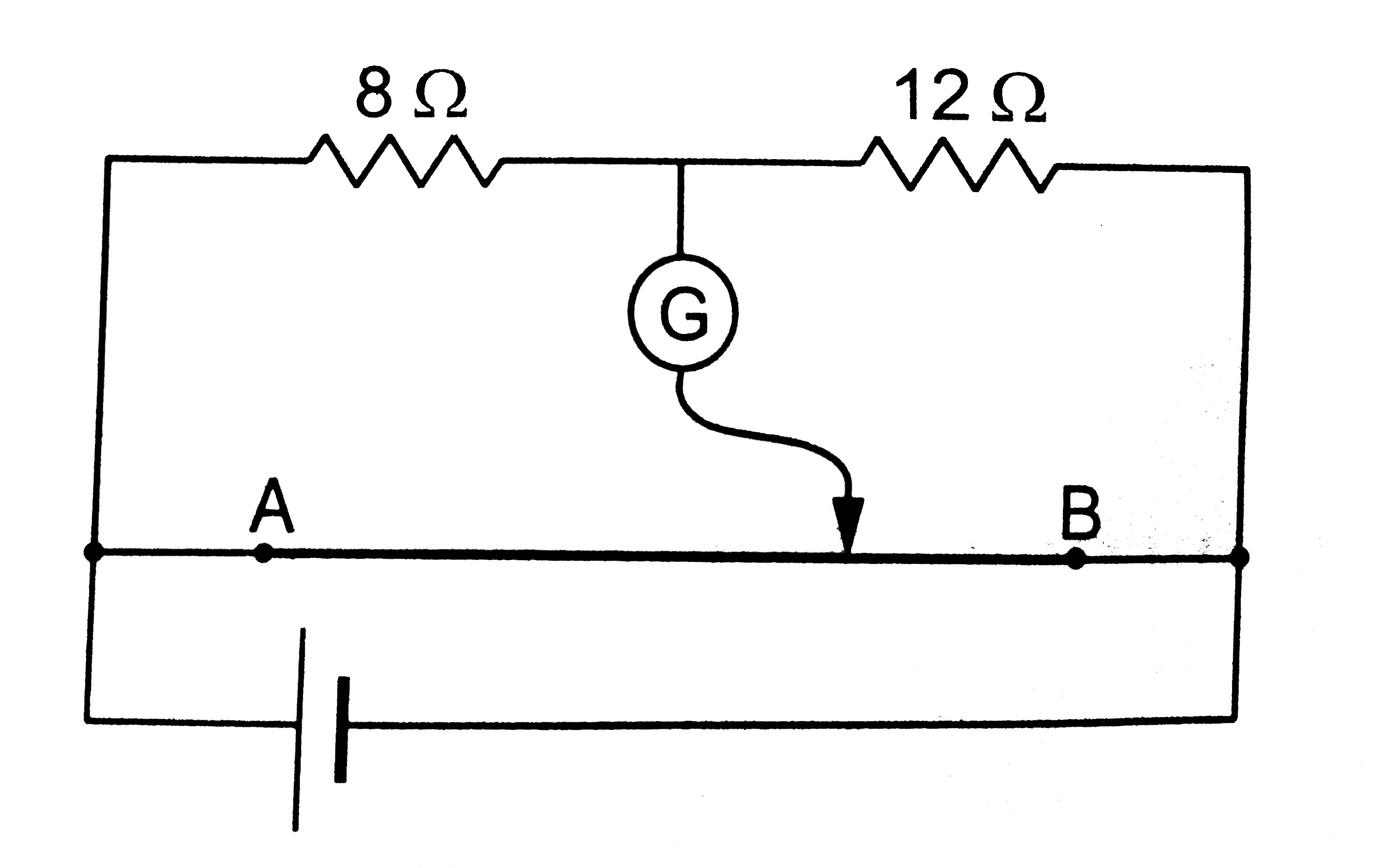
The potentiometer wire AB shown in figure is 40 cm long. Where should the free end of the galvanometer be connected on AB so that the galvanometer may show zero deflection?

Text Solution

Verified by Experts

If the wire is connected to the
potentiometer wire so that
` R_AD/R_DB = 8/12 `
then according to Whitstone's bridge, no
currrent will flow through galvano meter.
` R_AD/R_DB = L_AD/L_DB = 8/12 = 2/3 `
(Acc.to principle of potentio meter)
` L_DB+L_DB = 40 cm `
` rArr L_B 2/3 + L_DB = 40 cm `
` rArr 5/3 L_DB = 40 cm `
` rArr L_DB = 40 xx 5/3 `
= 24 cm from B.
Promotional Banner

Topper's Solved these Questions

  • ELECTRIC CURRENT IN CONDUCTORS

    HC VERMA|Exercise Objective 2|9 Videos
  • DISPERSION AND SPECTRA

    HC VERMA|Exercise Exercises|11 Videos
  • ELECTRIC CURRENT THROUGH GASES

    HC VERMA|Exercise Exercises|23 Videos

Similar Questions

Explore conceptually related problems

If deflection in galvanometer in above circuit is zero then find value of R. Internal resistance of 12 V source is negligible. Will the galvanometer show some deflection if cold air is passed on 10 k Omega wire wound resistor ?

A potentiometer wire is 100 cm long and a constant potential difference is maintained across it. Two cells are connected in series first to support one another and then in opposite direction. The balance points are obtained at 64 cm and 32 cm from the positive end of the wire in the two cases. the ratio of emf's is

In a potenliomcter experiment, it is found that no current passes through the galvanometer when the terminals of the cell are connected across 52 cm of the potentiometer wire. If the cells is shunted by a resistance of 5 Omega , a balance is found when the cells is connected across 40 cm of the wire. Find the internal resistance of the cell.

While doing an experiment with potcntiometc as shown in figure in was found that th deflection is one sided and (i) the detlectio, decreased while moving from one end A of the wire to the end B, (ii) the deflection increase while the jockey was moved towards the end (i) Which terminal + or - ve Of the cell E_(1) connected at X in case (i) and how is related to E ? (ii) Which terminal of the cell E_(1) is connected at X in case (ii) ?

A ring is made of a wire having a resistance R_(0) = 12 Omega . Find the point A and B , as shown in the figure, at which a current carrying conductor should be connected so that the resistance R of the subcircuit between these points is equal to (8)/(3) Omega

An experimental setup of verification of photoelectric effect is shown in the diagram. The voltage across the electrode is measured with the help of an ideal voltmetar, and which can be varied by moving jockey 'J' on the potentiometer wire. The battery used in potentiometer circuit is of 20 V and its internal resistance is 2omega . The resistance of 100 cm long potentiometer wire is 8 omega . The photo current is measured with the help of an ideal ammeter. Two plates of potassium oxide of area 50 cm^(2) at separation 0.5 mm are used in the vacuum tube. Photo current in the circuit is very small so we can treat potentiometer circuit an indepdent circuit. The wavelength of various colours is as follows : |{:("Light",underset("Violet")(1),underset("Blue")(2),underset("Green")(3),underset("Yellow")(4),underset("Orange")(5),underset("Red")(6)),(lambda "in" Årarr,4000-4500,4500-5000,5000-5500,5500-6000,6000-6500,6500-7000):}| When other light falls on the anode plate the ammeter reading remains zero till, jockey till, jockey is moved from the end P to the middle point on the wire PQ. Thereafter the deflection is recorded in the ammeter. The maximum kinetic energy of the emitted electron is :

An experimental setup of verification of photoelectric effect is shown in the diagram. The voltage across the electrode is measured with the help of an ideal voltmetar, and which can be varied by moving jockey 'J' on the potentiometer wire. The battery used in potentiometer circuit is of 20 V and its internal resistance is 2omega . The resistance of 100 cm long potentiometer wire is 8 omega . The photo current is measured with the help of an ideal ammeter. Two plates of potassium oxide of area 50 cm^(2) at separation 0.5 mm are used in the vacuum tube. Photo current in the circuit is very small so we can treat potentiometer circuit an indepdent circuit. The wavelength of various colours is as follows : |{:("Light",underset("Violet")(1),underset("Blue")(2),underset("Green")(3),underset("Yellow")(4),underset("Orange")(5),underset("Red")(6)),(lambda "in" Årarr,4000-4500,4500-5000,5000-5500,5500-6000,6000-6500,6500-7000):}| The number of electrons appeared on the surface of the cathode plate, when the jockey is connected at the ened 'P' of the potentiometer wire. Assume that no radiation is falling on the plates.

An experimental setup of verification of photoelectric effect is shown in the diagram. The voltage across the electrode is measured with the help of an ideal voltmetar, and which can be varied by moving jockey 'J' on the potentiometer wire. The battery used in potentiometer circuit is of 20 V and its internal resistance is 2omega . The resistance of 100 cm long potentiometer wire is 8 omega . The photo current is measured with the help of an ideal ammeter. Two plates of potassium oxide of area 50 cm^(2) at separation 0.5 mm are used in the vacuum tube. Photo current in the circuit is very small so we can treat potentiometer circuit an indepdent circuit. The wavelength of various colours is as follows : |{:("Light",underset("Violet")(1),underset("Blue")(2),underset("Green")(3),underset("Yellow")(4),underset("Orange")(5),underset("Red")(6)),(lambda "in" Årarr,4000-4500,4500-5000,5000-5500,5500-6000,6000-6500,6500-7000):}| It is found that ammeter current remians unchanged (2muA) even when the jockey is moved from the 'P' to the middle point of the potentiometer wire. Assuming all the incident photons eject electron and the power of the light incident is 4 xx 10^(-6) W . Then colour of the incident light is :

An experimental setup of verification of photoelectric effect is shown in the diagram. The voltage across the electrode is measured with the help of an ideal voltmetar, and which can be varied by moving jockey 'J' on the potentiometer wire. The battery used in potentiometer circuit is of 20 V and its internal resistance is 2omega . The resistance of 100 cm long potentiometer wire is 8 omega . The photo current is measured with the help of an ideal ammeter. Two plates of potassium oxide of area 50 cm^(2) at separation 0.5 mm are used in the vacuum tube. Photo current in the circuit is very small so we can treat potentiometer circuit an indepdent circuit. The wavelength of various colours is as follows : |{:("Light",underset("Violet")(1),underset("Blue")(2),underset("Green")(3),underset("Yellow")(4),underset("Orange")(5),underset("Red")(6)),(lambda "in" Årarr,4000-4500,4500-5000,5000-5500,5500-6000,6000-6500,6500-7000):}| When radiation falls on the cathode plate a current of 2muA is recorded in the ammeter. Assuming that the vecuum tube setup follows ohm's law, the equivalent resistance of vacuum tube operating in this case when jockey is at end P.

AB is a potentiometer wire of length 100cm and its resistance is 10ohm. It is connected in series with a resistance R=40 ohm and a battery of e.m.f. wV and negigible internal resistance. If a source of unknown e.m.f. E is balanced by 40cm length of the potentiometer wire, the value of E is:

HC VERMA-ELECTRIC CURRENT IN CONDUCTORS-Exercises
  1. An ammeter is to be constructed which can read currents up to 2.0A. If...

    Text Solution

    |

  2. A voltmeter coil has resistance 50.0(Omega)and a resistor of 1.15k(Ome...

    Text Solution

    |

  3. The potentiometer wire AB shown in figure is 40 cm long. Where should ...

    Text Solution

    |

  4. The potentiometer wire AB shown in figure is 50cm long.When AD=30cm, n...

    Text Solution

    |

  5. A 6-volt battery of negligible internal resistance is connected across...

    Text Solution

    |

  6. Consider the potentiometer circuit arranged as in figure.The petentiom...

    Text Solution

    |

  7. Find the charge on the capacitor shown in figure

    Text Solution

    |

  8. (a) Find the current in the 20(Omega)resistor shown in figure.(b)If a ...

    Text Solution

    |

  9. Find the charge on the four capacirtors of capacitances 1(mu)F,2(mu)F,...

    Text Solution

    |

  10. find the potential difference between th point A and B and between the...

    Text Solution

    |

  11. A capacitance C, a resistance R and an emf (epsilon)are connected in s...

    Text Solution

    |

  12. A parallel-plate capacitor with plate are 20cm^(2)and plate separation...

    Text Solution

    |

  13. A capacitor of capacitance 10(mu)F is connected to a battery of emf 2V...

    Text Solution

    |

  14. A 20(mu)Fcapacitor is joined to a battery of emf 6.0V through a resist...

    Text Solution

    |

  15. The plates of a capacitor of capacitance 10(mu)F,charged to 60(mu)C,ar...

    Text Solution

    |

  16. A capacitor of capacitance 8.0(mu)F is connected to a bettery of emf 6...

    Text Solution

    |

  17. A parallel-plate capacitor of plate area 40 cm^2 and separation betwee...

    Text Solution

    |

  18. A parallel-plate capacitor has plate area 20cm^(2),plate separation 1....

    Text Solution

    |

  19. A 100(mu)F capacitor is joined to a 24 V battery through a 1.0 M(Omega...

    Text Solution

    |

  20. How many time constants will elapse before the current in a charging R...

    Text Solution

    |
