Home
Class 12
PHYSICS
A constant current i is passed through a...

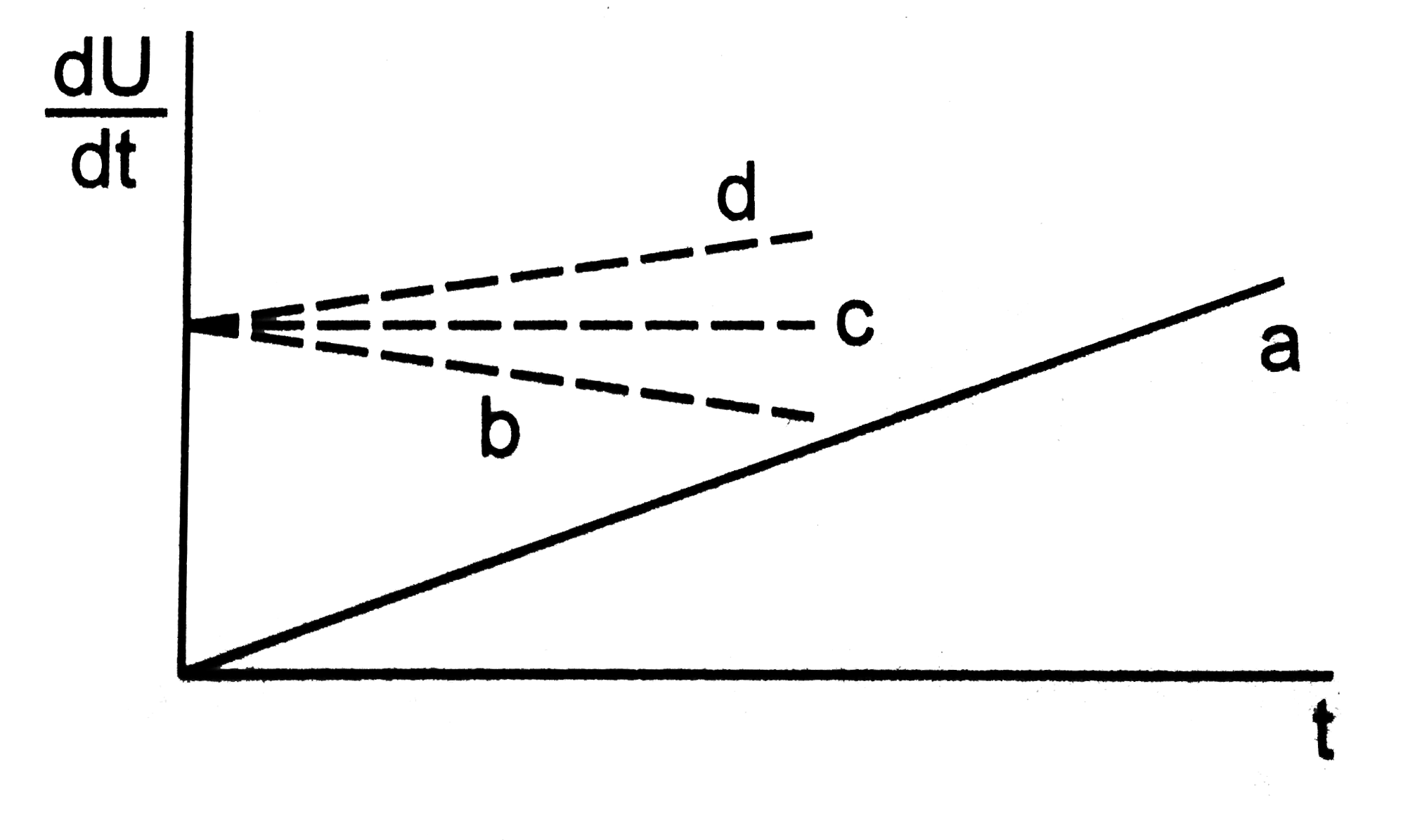
A constant current `i` is passed through a resistor. Taking the temperature coefficient of resistance into account, indicate which of the plots shown in Figure best represents the rate of production of thermal energy in the resistor

Text Solution

Verified by Experts

The correct Answer is:

D
Promotional Banner

Topper's Solved these Questions

  • THERMAL AND CHEMICAL EFFECT OF ELECTRIC CURRENT

    HC VERMA|Exercise Objective 2|5 Videos
  • THERMAL AND CHEMICAL EFFECT OF ELECTRIC CURRENT

    HC VERMA|Exercise Exercises|24 Videos
  • THERMAL AND CHEMICAL EFFECT OF ELECTRIC CURRENT

    HC VERMA|Exercise Short Answer|9 Videos
  • THE SPECIAL THEORY OF RELATIVITY

    HC VERMA|Exercise Exercises|27 Videos
  • X-Rays

    HC VERMA|Exercise Exercises|27 Videos

Similar Questions

Explore conceptually related problems

Which option is correct for the following statements A and B? Statement A: The current passing through each resistor is the same in a series combination of resistors. Statement B: The voltage between two ends of each resistor is the same in a parallel combination of resistors.

If, the current I, through a resistor is increased by 100.% (assume that the temperature of the resistor remains unchanged), find the percentage increase in power dissipated.

When current passes through resistor due to its resistive property heat is produced. Error in measurement of resistance, current and time is 1%, 2% and 1% respectively, then what will be percentage error in measurement of heat energy ?

Heat produced in a current carrying conducting wire depends on current I, resistance R of the wire and time t for which current is passed. Using these facts, obtain the formula for heat energy

A constant current I flows in a horizontal wire in the plane of paper from east to west as shown in the following figure : At which poit will the direction of the magnetic field be from north to south ?

Two stones are thrown up simultaneously from the edge of a cliff 240 m high with initial speed of 10 m//s and 40 m//s respectively . Which of the following graph best represents the time variation of relative position of the speed stone with respect to the first ? ( Assume stones do not rebound after hitting the groumd and neglect air resistance , take g = 10 m//s^(2)) ( The figure are schematic and not drawn to scale )

Each phase of a material can exits only in certain regions of pressure and temperature . P-T phase diagrams, in which pressure is plotted versus temperature, show the regions corresponding to various phases and phase transformations . P-V diagrams, on the other hand , can be used to study pressure volume relationship at a constant temperature. If the liquid and gaseous phases of a pure substances are heated together in a closed container, both the temperature and the vapor pressure will increase until a point is reached at which the two phases can no longer be distinguished from one another. The temperature and pressure at which this occurs are called the critical temperature and pressure. Exceeding either of these parameters, by itself ,will cause the "gas"//"liguid" phase transition to disappear. if the other variable is then changed as well, while the first variable is maintained above its critical point , a gradual transition will occur between the gaseous and liquid phases, with no clear boundary.(The liquid and solid phases, on the other hand , maintain a distinct boundary at all pressure above the triple point). Shown in figure is a combined P-T phase diagram for material A and B . Which is true about the substance in figure?

Each phase of a material can exits only in certain regions of pressure and temperature . P-T phase diagrams, in which pressure is plotted versus temperature, show the regions corresponding to various phases and phase transformations . P-V diagrams, on the other hand , can be used to study pressure volume relationship at a constant temperature. If the liquid and gaseous phases of a pure substances are heated together in a closed container, both the temperature and the vapor pressure will increase until a point is reached at which the two phases can no longer be distinguished from one another. The temperature and pressure at which this occurs are called the critical temperature and pressure. Exceeding either of these parameters, by itself ,will cause the "gas"//"liguid" phase transition to disappear. if the other variable is then changed as well, while the first variable is maintained above its critical point , a gradual transition will occur between the gaseous and liquid phases, with no clear boundary.(The liquid and solid phases, on the other hand , maintain a distinct boundary at all pressure above the triple point). Shown in figure is a combined P-T phase diagram for material A and B . If heat is added to solids A and B , each in a container that is open to the atmosphere :-

A potentiometer having the potential gradient of 2 mV//cm is used to measure the difference of potential across a resistance of 10 ohm . If a length of 50 cm of the potentiometer wire is required to get null point, the current passing through the 10 ohm resistor is (in mA )

A radioactive sample consists of two distinct species having equal number of atoms initially. The mean life of one species is tau and that of the other is 5 tau . The decay products in both cases are stable. A plot is made of the total number of radioactive nuclei as a function of time. Which of the following figure best represents the form of this plot? (a), (b), (c), (d)
