Home
Class 12
PHYSICS
Figure, shows an electrolyte of AgCI thr...

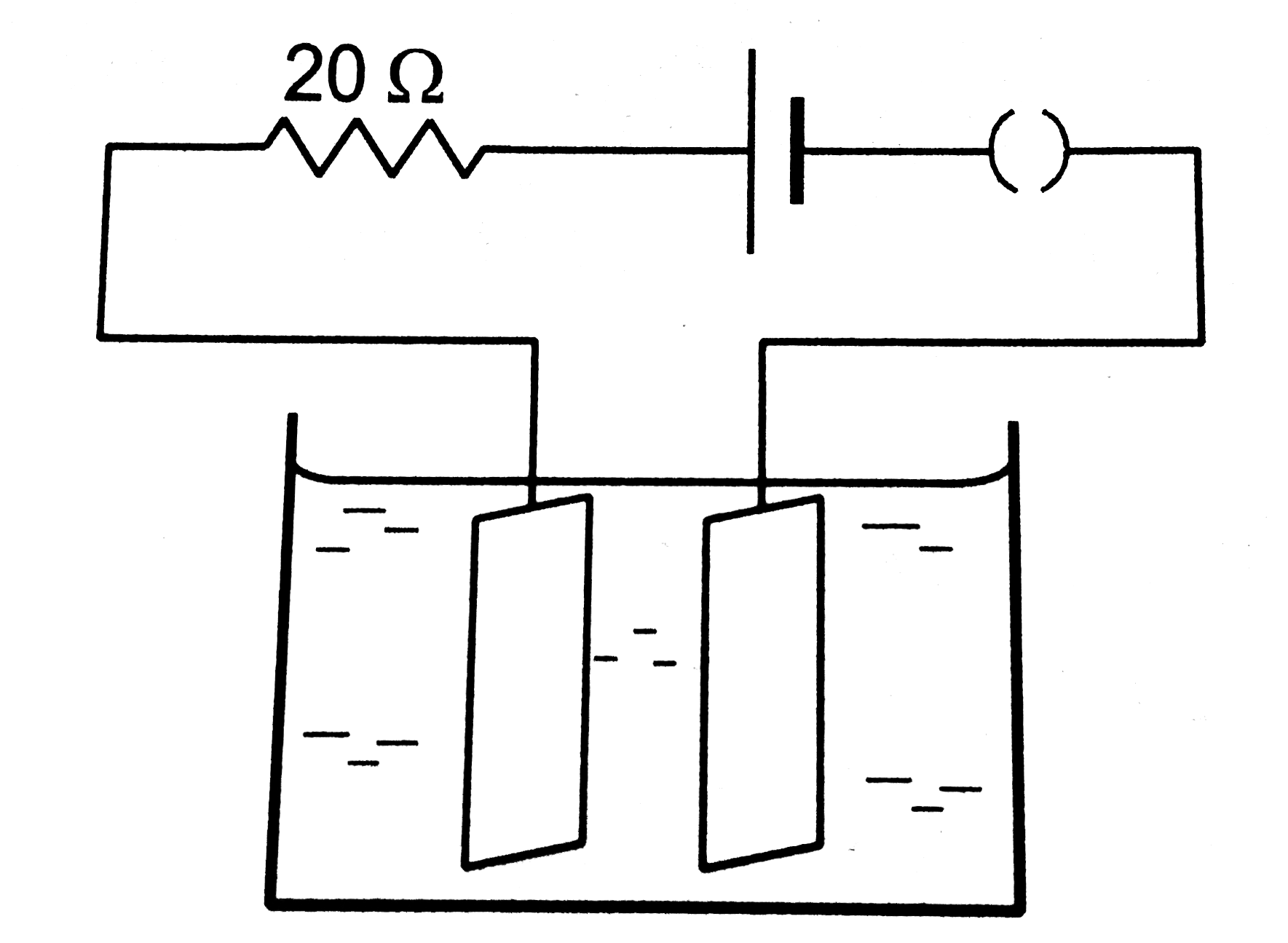
Figure, shows an electrolyte of `AgCI` through which a current is passed. It is observed that `2.68g` of silver is deposited in 10 minutes on the cathode. Find the heat developed in the `20 Omega` resistor during this period. Atomic weight of silver is `107.9 g mol^(-1)`. (Figure)

Text Solution

Verified by Experts

The correct Answer is:

A

`w= Zit`
`2.68 = (107.9)/(96500)xxixx15xx60`
` rArr i=3.99 = 4 amp`
`. Heat developed in the 20Omega resistor = (4)^2xx20xx10xx60`
`=16xx200xx60`
` =3200xx60 = 192000 J = 192 KJ`
Promotional Banner

Topper's Solved these Questions

  • THERMAL AND CHEMICAL EFFECT OF ELECTRIC CURRENT

    HC VERMA|Exercise Objective 2|5 Videos
  • THE SPECIAL THEORY OF RELATIVITY

    HC VERMA|Exercise Exercises|27 Videos
  • X-Rays

    HC VERMA|Exercise Exercises|27 Videos

Similar Questions

Explore conceptually related problems

A steady current is passed for 25minutes through a silver voltameter and ammeter in series and 0.059g of silver of deposited. The ammeter reads 0.3A. Find the errror, if any, in the ammeter reading, given that the E.C.E. of silver =11.18xx10^(-7) kg C^(-1) .

The same current if passed through solution of silver nitrate and cupric salt connected in series. If the weights of silver deposited is 1.08g . Calculate the weight of copper deposited

3A current was passed through an aqueous solution of an unknown salt of Pd for 1hr. 2.977 g of Pd^(+n) was deposited at cathode. Find n.

Figure shows a string of linear mass density 1.0g cm^(-1) on which a wave pulse is travelling. Find the time taken by pulse in travelling through a distance of 50 cm on the string. Take g = 10 ms^(-2)

A circus wishes to develop a new clown act. Fig. (1) shows a diagram of the proposed setup. A clown will be shot out of a cannot with velocity v_(0) at a trajectory that makes an angle theta=45^(@) with the ground. At this angile, the clown will travell a maximum horizontal distance. The cannot will accelerate the clown by applying a constant force of 10, 000N over a very short time of 0.24s . The height above the ground at which the clown begins his trajectory is 10m . A large hoop is to be suspended from the celling by a massless cable at just the right place so that the clown will be able to dive through it when he reaches a maximum height above the ground. After passing through the hoop he will then continue on his trajectory until arriving at the safety net. Fig (2) shows a graph of the vertical component of the clown's velocity as a function of time between the cannon and the hoop. Since the velocity depends on the mass of the particular clown performing the act, the graph shows data for serveral different masses. From figure 2, approximately how much time will it take for clown with a mass of 60 kg to reach the safety net located 10 m below the height of the cannot?

An electric current is passed through three cells in series containing respectively solutions of copper sulphate, silver nitrate and potassium iodide. What weights of silver and iodine will be liberated while 1.25 g of copper is being deposited ?

A circus wishes to develop a new clown act. Fig. (1) shows a diagram of the proposed setup. A clown will be shot out of a cannot with velocity v_(0) at a trajectory that makes an angle theta=45^(@) with the ground. At this angile, the clown will travell a maximum horizontal distance. The cannot will accelerate the clown by applying a constant force of 10, 000N over a very short time of 0.24s . The height above the ground at which the clown begins his trajectory is 10m . A large hoop is to be suspended from the celling by a massless cable at just the right place so that the clown will be able to dive through it when he reaches a maximum height above the ground. After passing through the hoop he will then continue on his trajectory until arriving at the safety net. Fig (2) shows a graph of the vertical component of the clown's velocity as a function of time between the cannon and the hoop. Since the velocity depends on the mass of the particular clown performing the act, the graph shows data for serveral different masses. The slope of the line segments plotted in figure 2 is a figure constant. Which one of the following physical quantities does this slope represent?

Figure shows a metal rod PQ resting on the smooth rails AB and positioned between the poles of a permanent magnet. The rails, the rod, and the magnetic field are in three mutual perpendicular directions. A galvanometer G connects the rails through a switch K. Length of the rod =15 cm, B =0.50 T, resistance of the closed loop containing the rod 9.0 m Omega . Assume the field to be uniform. (a) Suppose K is open and the rod is moved with a speed of 12 "cm s"^(-1) in the direction shown. Give the polarity and magnitude of the induced emf. (b) Is there an excess charge built up at the ends of the rods when K is open ? What if K is closed ? (c) With K open and the rod moving uniformly, there is no net force on the electrons in the rod PQ even though they do experience magnetic force due to the motion of the rod. Explain. (d) What is the retarding force on the rod when K is closed ? How much power is required (by an external agent) to keep the rod moving at the same speed (= 12 cm s^(-1) ) when K is closed ? How much power is required when K is open? (f)How much power is dissipated as heat in the closed circuit ? What is the source of this power ? (g) What is the induced emf in the moving rod if the magnetic field is parallel to the rails instead of being perpendicular ?

A metal is know to form fluoride MF_(2) . When 10A of electricity is passed through a molten sat for 330sec, 1.95g of metal is deposited. Find the atomic weight of M. what will be the quantity electricity required to deposit the same mass of Cu form CuSO_(4) ?

HC VERMA-THERMAL AND CHEMICAL EFFECT OF ELECTRIC CURRENT-Exercises
  1. A bulb with rating 250V, 100W is connected to a power supply of 220 V ...

    Text Solution

    |

  2. An electric bulb, when connected across a power supply of 220V, consum...

    Text Solution

    |

  3. A servo voltage stabiliser restricts the voltage output to 220 V +- 1%...

    Text Solution

    |

  4. An electric bulb marked 220 V, 100 W will get fused if it is made to c...

    Text Solution

    |

  5. An immersion heater rated 1000 W, 220 V is used to heat 0.01 m^3 of wa...

    Text Solution

    |

  6. An electric kettle used to prepare tea, takes 2 minutes to boil 4 cups...

    Text Solution

    |

  7. The coil of an electric bulb takes 40 watts to start glowing. If more ...

    Text Solution

    |

  8. The 2.0 Omega resistor show in figure is dipped into a calorimeter con...

    Text Solution

    |

  9. The temperatures of the junctions of a biamuth-silver thermocouple are...

    Text Solution

    |

  10. Find the thermo-emf developed in a copper-silver thermocopule when the...

    Text Solution

    |

  11. Find the neutral temperatuer and inversion temperature of copper-iron ...

    Text Solution

    |

  12. Find the charge required to flow through an electrolyte to liberate on...

    Text Solution

    |

  13. Find the amount of silver liberated at cathode if 0.500 A of current i...

    Text Solution

    |

  14. An electroplating unit plates 3.0 g of silver on a brass plate in 3.0 ...

    Text Solution

    |

  15. Find the time requried to liberate 1.0 litre of hydrogen at STP in an...

    Text Solution

    |

  16. Two voltameters, one having a solution of silver salt and the other of...

    Text Solution

    |

  17. A brass plate having surface area 200 cm^2 on one side is electroplate...

    Text Solution

    |

  18. Figure, shows an electrolyte of AgCI through which a current is passed...

    Text Solution

    |

  19. The potential difference across the terminals of a battery of emf 12 V...

    Text Solution

    |

  20. A plate of area 10 cm^2 is to be electroplated with copper (density 90...

    Text Solution

    |
