

Home
Class 12
PHYSICS
An electron is emitted with negligible s...

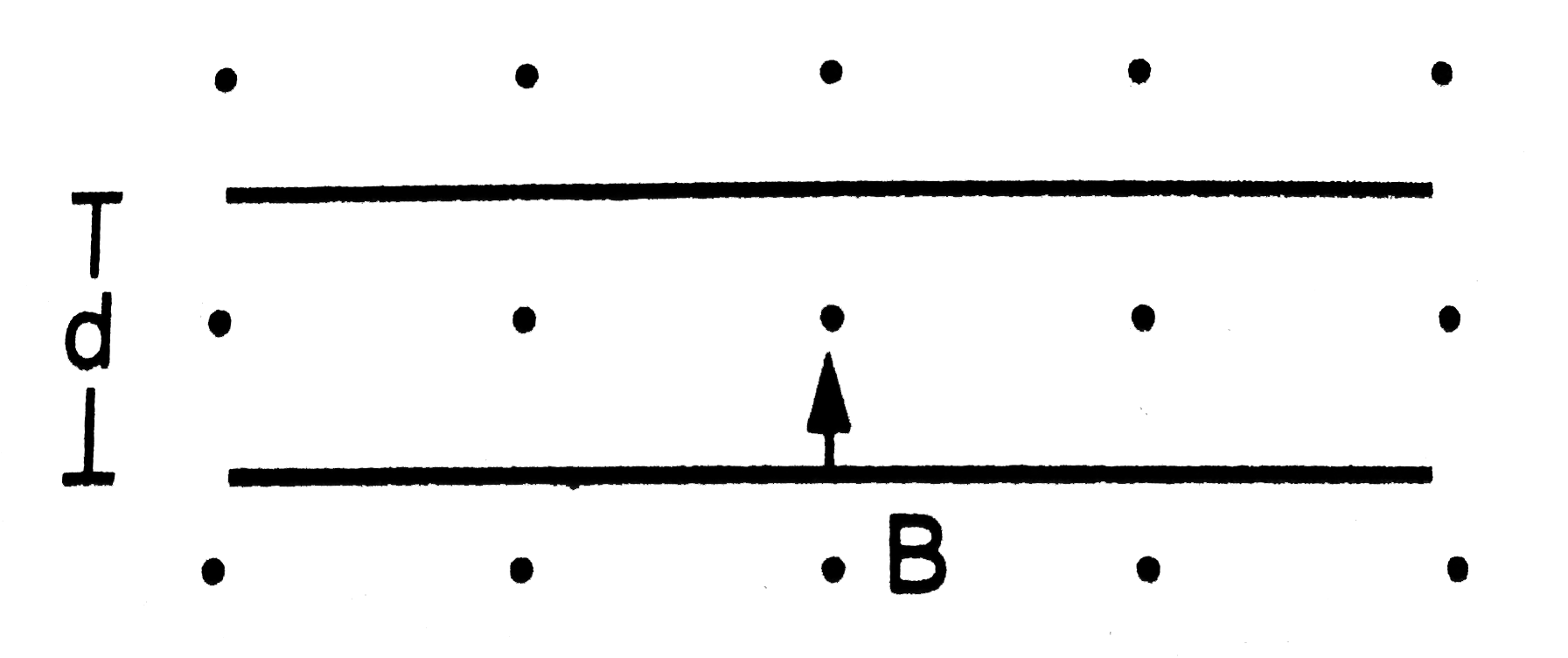
An electron is emitted with negligible speed from th nagative plate of a parallel plate capacitor charged ot a potential difference V. The separtion between the plates is d and a magnetic field B exists in the space as shown in . Show that the electron will fail to strike the upper plate if ltdgt `((2m_e V)/(eB_0^2))^(1/2)`.

Text Solution

Verified by Experts

The force experienced first is due to the electric field due to the capacitor
`Since F. d = eV rArr q = (F)/(m) = (ev)/(m_(e) d)`
[where `e = charge of electron m_(e) = mass of electron]`
`v^(2) = u^(2) + 2` as
`rArr v_(2) = 2 xx ((eV)/(m_(e)) xx d`
`or v = sqrt((eV)/(m_(e))`
Force due to magnetic field product
`V = (eB_(0)d)/(m_(e))`
Now the electron will field strike upper plate only when `V` is greater then the `v`
Then `(eB_(0)d)/(m_(e)) gtsqrt((2m_(e)V)/(eB_(0) ^(2))`
Promotional Banner

Topper's Solved these Questions

  • MAGNETIC FIELD

    HC VERMA|Exercise Objective 2|9 Videos
  • LIGHT WAVES

    HC VERMA|Exercise Exercises|41 Videos
  • MAGNETIC FIELD DUE TO CURRENT

    HC VERMA|Exercise Exercises|61 Videos

Similar Questions

Explore conceptually related problems

A parallel plate air capacitor has capacity 'C' distance of separation between plates is 'd' and potential difference 'V' is applied between the plates force of attraction between the plates of the parallel plate air capacitor is :

Inside a parallel plate capacitor the electric field E varies with time as t^2 . The variation of induced magnetic field with time is given by ......

A slab of material of dielectric constant K has the same area as the plates of a parallel plate capacitor but has a thickless (1/2)d . Where d is the separation of the plates . How is the capacitance changed when the slab is inserted between the plates

Show that the force on each plate of a parallel plate capacitor has a magnitude equal to (1//2) QE, where Q is the charge on the capacitor, and E is the magnitude of electric field between the plates. Explain the origin of the factor 1//2 .

An electron is projected as in figure with kinetic energy K, at an angle theta=45^(@) between two charged plates. The magnitude of the electric field so that the electron just fails to strike the upper plate, should be greater than:

Show that the force on each plate of a parallel plate capacitor has a magnitude equal to (½) QE, where Q is the charge on the capacitor, and E is the magnitude of electric Held between the plates. Explain the origin of the factor 1//2

You are given a 2 mu F parallel plate capacitor. How would you establish an instantaneous displacement current of 1mA in the space between its plates ?

An electron emitted by a heated cathode and accelerated through a potential difference of 2.0 kV, enters a region with uniform magnetic field of 0.15 T. Determine the trajectory of the electron if the field (a) is transverse to its initial velocity, (b) makes an angle of 30º with the initial velocity.

An electron passes between two parallel plate of a capacitor as shown in the diagram. The electron enters the plate at t=0 and it comes out of the plates at time t=T. The electron hits the screen at A, as shown. Now a time varying potential difference V is applied between the plates, as shown in the graph. (Neglect the gravity). The point where the electron now will strike (as compared to point A) will be

A particle of mass m and charge (-q) enters the region between the two charged plates initially moving along x-axis with speed v_x (like particle 1 in figure. The length of plate is L and an uniform electric field E is maintained between the plates. Show that the vertical deflection of the particle at the far edge of the plate is qEL^(2)//(2m v_(x)^(2)) . Compare this motion with motion of a projectile in gravitational field discussed in Section 4.10 of Class XI Textbook of Physics.

HC VERMA-MAGNETIC FIELD-Exercises
  1. A nerrow beam of singly charged potassium ions of kinetic energy 32ke...

    Text Solution

    |

  2. Shows a convex lens of focal length 12 cm lying in a uniform magnetic...

    Text Solution

    |

  3. Electrons emitted with negligible speed from an electron gun are accel...

    Text Solution

    |

  4. Two particles, each having a mass m are placed at a separation d in a ...

    Text Solution

    |

  5. A uniform magnetic field of magnitude 0.20 T exists in space from e...

    Text Solution

    |

  6. A particle moves in a circle of diamater 1.0 cm under the action of ma...

    Text Solution

    |

  7. A proton goes undflected in a crossed electric and magnetic field (th...

    Text Solution

    |

  8. A particle having a charge of 5.0 mu C and a mass of 5.0x 10^(-12)kg ...

    Text Solution

    |

  9. A proton projected in a magnetic field of 0.020 T travels along a heli...

    Text Solution

    |

  10. A particle having mass m and charge q is released from the origin in a...

    Text Solution

    |

  11. An electron is emitted with negligible speed from th nagative plate of...

    Text Solution

    |

  12. A rectangular coil of 100 turns has length 5 cm and width 4 cm. it is ...

    Text Solution

    |

  13. A 50 turn circular coil of radius 2.0 cm carrying a current of 5.0 A ...

    Text Solution

    |

  14. A rectangular loop of sides 20 cm and 10 cm carries a current of 5.0 ...

    Text Solution

    |

  15. A circular coil of radius 2.0 cm has 500 turns in it and carries a cu...

    Text Solution

    |

  16. A circular loop carrting a current a current I has wire of total leng...

    Text Solution

    |

  17. A square coil of edge I having n turns carries a curent i. it is kept ...

    Text Solution

    |

  18. consider a nonconducting ring of radius r and mass m which has a toto...

    Text Solution

    |

  19. Consider a non conducting plate of radius a and mass m which has a cha...

    Text Solution

    |

  20. Consider a non conducting plate of radius a and mass m which has a cha...

    Text Solution

    |