Home
Class 12
PHYSICS
Shows a horizontal magnetic field which ...

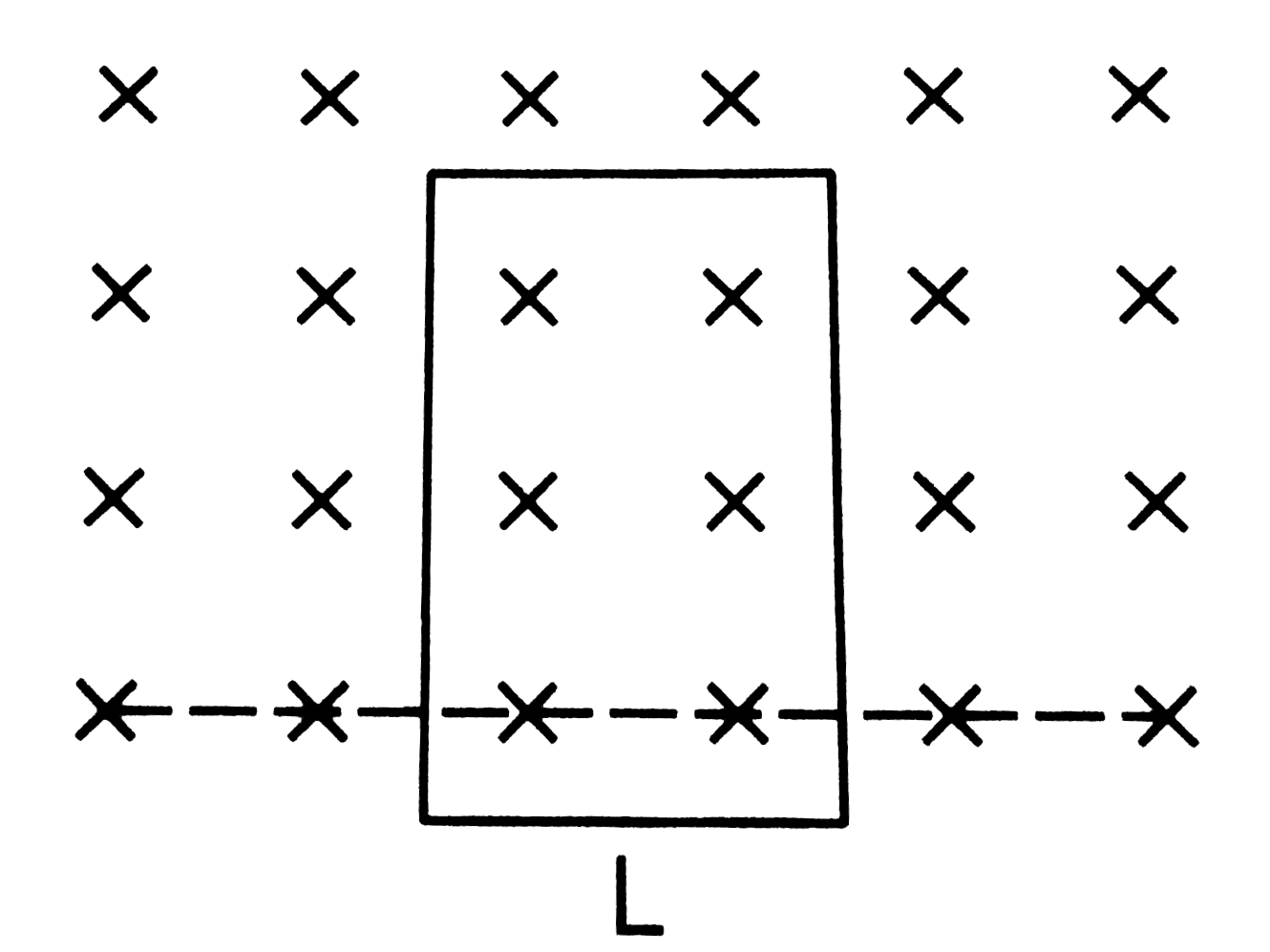
Shows a horizontal magnetic field which is uniform above the dotted line and is zero below it. A long, rectangualr, conducting loop of width L, mass m and resistance R is placed partly above and partly below the dotted line with the lower edge parallel to it . with what velocity should it be pushed downwards so that it may continue ot fall without any acceleration?

Text Solution

Verified by Experts

Let the uniform velocity of fall be v
The emf is indcued across the upper wire and its magnitude is `epsilon = vBl
The current induced in the frame is ` i=(vBl)/(R )` so that, the magnetic force on the upper arm is `F = ilB = (vB^2l^2)/(R )
This force is in the upward direction
As the frame falls uniformly, this force should balance its weight
Thus, `mg=(vB^2 l^2)/(R )` or, `v=(mgR)/(B^2l^2)`
Promotional Banner

Topper's Solved these Questions

  • ELECTROMAGNETIC INDUCTION

    HC VERMA|Exercise Short Answer|13 Videos
  • ELECTROMAGNETIC INDUCTION

    HC VERMA|Exercise Objective 1|12 Videos
  • ELECTROMAGNETIC INDUCTION

    HC VERMA|Exercise EXERCISE|9 Videos
  • ELECTRIC FIELD AND POTENTIAL

    HC VERMA|Exercise Exercises|75 Videos
  • ELECTROMAGNETIC WAVES

    HC VERMA|Exercise Exercises|9 Videos

Similar Questions

Explore conceptually related problems

A small ball of mass m and charge q is attached to the bottom end of a piece of negligible mass thread of length l, whose top end is fixed. The system formed by the thread and ball is in vertical plane and is in uniform horizontal magnetic field B, which is perpendicular to the plane of figure and points into the paper The ball is started with a velocity v_(0) from lower most point of circle in a direction perpendicular both to the magnetic induction and to direction of thread. The ball moves along a circular path such that thread remains tight during the whole motion. Neglect any loss of enery. By what factor is the force acting on the thread (tension in thread) at point A is greater than at point C, when speed of the ball is the above stated one?

One U shaped conducting frame is placed in a plane perpendicular to uniform magnetic field B. One conducting rod of mass m and length l is kept perpendicular to parallel sides of this frame. At time t = 0, this rod is pushed perpendicular to its length with initial velocity v_g . Prove that its velocity at the end of time t is v_t=v_0 "exp" ((-B^2l^2)/(mR)t) where R=resistance of external circuit and l=perpendicular distance between two parallel slides .

A loop is formed by two parallel conductors connected by a solenoid with inductance L=2H and a conducting rod of mass m=80g, which can freely (without fricition) slide over the conductors. The conductors are located in a horizontal plane in a uniform vertical magnetic field with induction B=4T. The distance between the conductors is equal to l=4cm. At the moment t=0 the rod is imparted an initial velocity v_(0)=2 cm//s directed to the right. Find the amplitude (in cm) for the oscillations of conducting rod, if the electric resistance of the loop is negligible.

A circus wishes to develop a new clown act. Fig. (1) shows a diagram of the proposed setup. A clown will be shot out of a cannot with velocity v_(0) at a trajectory that makes an angle theta=45^(@) with the ground. At this angile, the clown will travell a maximum horizontal distance. The cannot will accelerate the clown by applying a constant force of 10, 000N over a very short time of 0.24s . The height above the ground at which the clown begins his trajectory is 10m . A large hoop is to be suspended from the celling by a massless cable at just the right place so that the clown will be able to dive through it when he reaches a maximum height above the ground. After passing through the hoop he will then continue on his trajectory until arriving at the safety net. Fig (2) shows a graph of the vertical component of the clown's velocity as a function of time between the cannon and the hoop. Since the velocity depends on the mass of the particular clown performing the act, the graph shows data for serveral different masses. From figure 2, approximately how much time will it take for clown with a mass of 60 kg to reach the safety net located 10 m below the height of the cannot?

A circus wishes to develop a new clown act. Fig. (1) shows a diagram of the proposed setup. A clown will be shot out of a cannot with velocity v_(0) at a trajectory that makes an angle theta=45^(@) with the ground. At this angile, the clown will travell a maximum horizontal distance. The cannot will accelerate the clown by applying a constant force of 10, 000N over a very short time of 0.24s . The height above the ground at which the clown begins his trajectory is 10m . A large hoop is to be suspended from the celling by a massless cable at just the right place so that the clown will be able to dive through it when he reaches a maximum height above the ground. After passing through the hoop he will then continue on his trajectory until arriving at the safety net. Fig (2) shows a graph of the vertical component of the clown's velocity as a function of time between the cannon and the hoop. Since the velocity depends on the mass of the particular clown performing the act, the graph shows data for serveral different masses. The slope of the line segments plotted in figure 2 is a figure constant. Which one of the following physical quantities does this slope represent?

A circus wishes to develop a new clown act. Fig. (1) shows a diagram of the proposed setup. A clown will be shot out of a cannot with velocity v_(0) at a trajectory that makes an angle theta=45^(@) with the ground. At this angile, the clown will travell a maximum horizontal distance. The cannot will accelerate the clown by applying a constant force of 10, 000N over a very short time of 0.24s . The height above the ground at which the clown begins his trajectory is 10m . A large hoop is to be suspended from the celling by a massless cable at just the right place so that the clown will be able to dive through it when he reaches a maximum height above the ground. After passing through the hoop he will then continue on his trajectory until arriving at the safety net. Fig (2) shows a graph of the vertical component of the clown's velocity as a function of time between the cannon and the hoop. Since the velocity depends on the mass of the particular clown performing the act, the graph shows data for serveral different masses. If the clown's mass is 80 kg , what initial velocity v_(0) will have as he leaves the cannot?

A circus wishes to develop a new clown act. Fig. (1) shows a diagram of the proposed setup. A clown will be shot out of a cannot with velocity v_(0) at a trajectory that makes an angle theta=45^(@) with the ground. At this angile, the clown will travell a maximum horizontal distance. The cannot will accelerate the clown by applying a constant force of 10, 000N over a very short time of 0.24s . The height above the ground at which the clown begins his trajectory is 10m . A large hoop is to be suspended from the celling by a massless cable at just the right place so that the clown will be able to dive through it when he reaches a maximum height above the ground. After passing through the hoop he will then continue on his trajectory until arriving at the safety net. Fig (2) shows a graph of the vertical component of the clown's velocity as a function of time between the cannon and the hoop. Since the velocity depends on the mass of the particular clown performing the act, the graph shows data for serveral different masses. If a clown holds on to hoop instead of passing through it, what is the position of the cable so that he doesn't hit his head on the ceiling as he swings upward?

HC VERMA-ELECTROMAGNETIC INDUCTION-Worked Out Examples
  1. A square loop of edge a having n turns Is rotated with a unifrom angul...

    Text Solution

    |

  2. A conducting circular loop of raidus r is rotated about its diameter a...

    Text Solution

    |

  3. Shows a horizontal magnetic field which is uniform above the dotted li...

    Text Solution

    |

  4. Shows a wire of length l which can slide on a U- shaped rail of neglig...

    Text Solution

    |

  5. A rod of length l is translating at a velocity v making an angle theta...

    Text Solution

    |

  6. The horizontal component of the earth's magnetic field at a place is 3...

    Text Solution

    |

  7. An angle aob made of a conducting wire moves along its bisector throu...

    Text Solution

    |

  8. Shows a wire ab of length l and resistance R which can slide on a smoo...

    Text Solution

    |

  9. A square loop of side 10 cm and resistance 1 Omega is moved towards ri...

    Text Solution

    |

  10. A metal rod length l rotates about on end with a uniform angular velo...

    Text Solution

    |

  11. Shows a conducting circular loop radius a placed in a uniform, perpend...

    Text Solution

    |

  12. shows a conducitng loop abcdefa made of six segment ab, bc cd, de, ef ...

    Text Solution

    |

  13. A wire of mass m and length I can freely slide on a pair of parallel, ...

    Text Solution

    |

  14. An inductor coil stores 32 J of magnetic field energy and dissiopates ...

    Text Solution

    |

  15. A 12 V battery connected ot a 6 Omega, 10 H coil through a switch driv...

    Text Solution

    |

  16. A solenoid of inductance 50 mH and resistance 10 Omega is connected ...

    Text Solution

    |

  17. An LR circuit having L = 4.0 H, R = 1.0 Omega and epsilon = 6.0 V is s...

    Text Solution

    |

  18. An LR combination is connected to an idal battery. If l = 10 mH, R = ...

    Text Solution

    |

  19. An inductor-resistance -battery circuit is switched on at t = 0. If th...

    Text Solution

    |

  20. A coil of inductance 1.0 H and resistance 100 Omega is connected to a...

    Text Solution

    |
