

Home
Class 12
PHYSICS
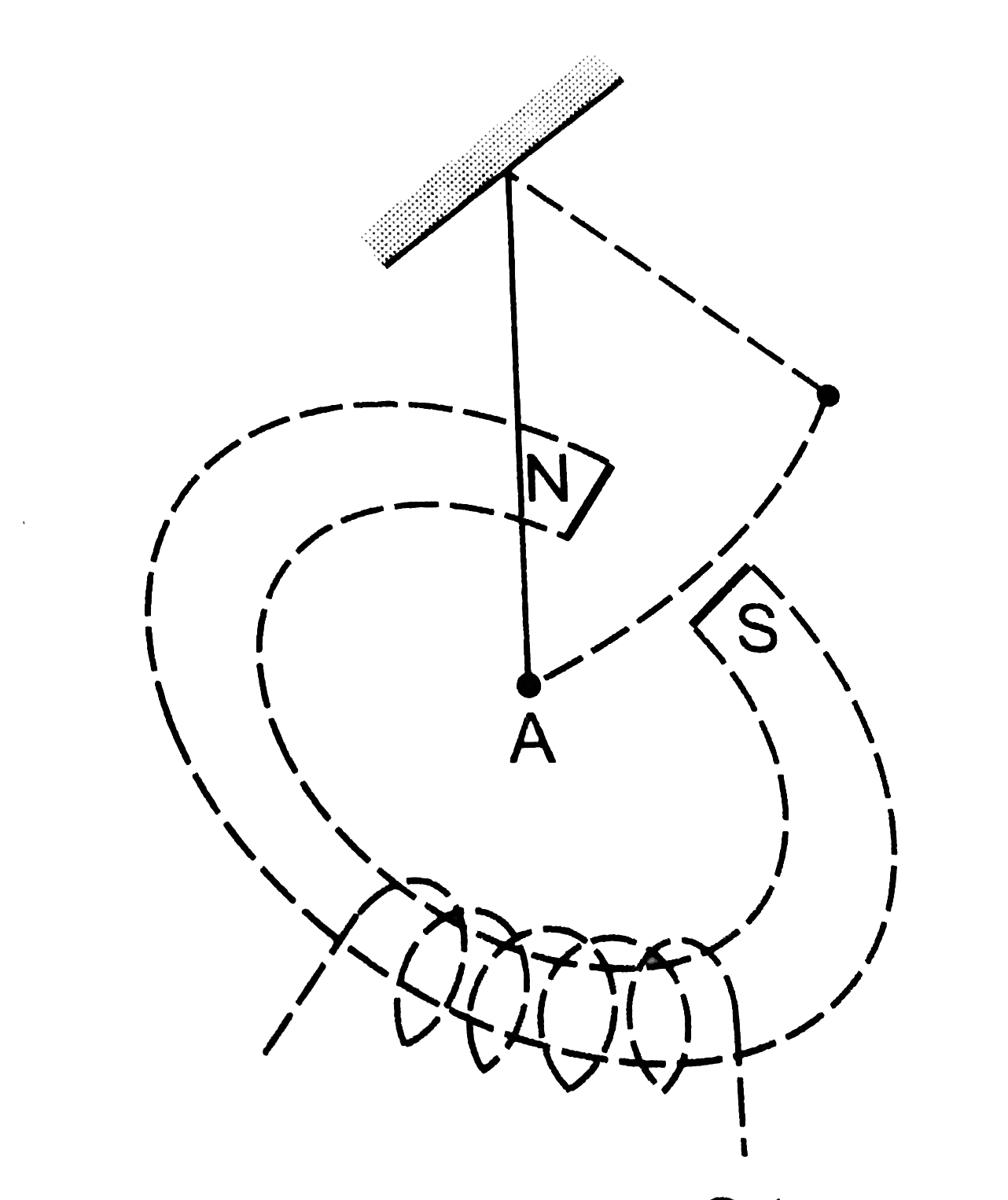
A metallic bob A oscillates throgh the s...

A metallic bob A oscillates throgh the space between the poles of an electromagnet . The oscillation are more quickly damped when the circuit is on, as compared to the case when the circuit is off. Explain.

Promotional Banner

Topper's Solved these Questions

  • ELECTROMAGNETIC INDUCTION

    HC VERMA|Exercise Objective 1|12 Videos
  • ELECTROMAGNETIC INDUCTION

    HC VERMA|Exercise Objective 2|10 Videos
  • ELECTROMAGNETIC INDUCTION

    HC VERMA|Exercise Worked Out Examples|29 Videos
  • ELECTRIC FIELD AND POTENTIAL

    HC VERMA|Exercise Exercises|75 Videos
  • ELECTROMAGNETIC WAVES

    HC VERMA|Exercise Exercises|9 Videos

Similar Questions

Explore conceptually related problems

Figure shows a metal rod PQ resting on the smooth rails AB and positioned between the poles of a permanent magnet. The rails, the rod, and the magnetic field are in three mutual perpendicular directions. A galvanometer G connects the rails through a switch K. Length of the rod =15 cm, B =0.50 T, resistance of the closed loop containing the rod 9.0 m Omega . Assume the field to be uniform. (a) Suppose K is open and the rod is moved with a speed of 12 "cm s"^(-1) in the direction shown. Give the polarity and magnitude of the induced emf. (b) Is there an excess charge built up at the ends of the rods when K is open ? What if K is closed ? (c) With K open and the rod moving uniformly, there is no net force on the electrons in the rod PQ even though they do experience magnetic force due to the motion of the rod. Explain. (d) What is the retarding force on the rod when K is closed ? How much power is required (by an external agent) to keep the rod moving at the same speed (= 12 cm s^(-1) ) when K is closed ? How much power is required when K is open? (f)How much power is dissipated as heat in the closed circuit ? What is the source of this power ? (g) What is the induced emf in the moving rod if the magnetic field is parallel to the rails instead of being perpendicular ?

(i) A poor emitter has a large reflectivity . Explain why. (ii) A copper tumbler feels much colder than a wooden block on a cold day. Explain why. (iii) The earth would become so cold that life is not possible on it in the absence of the atmosphere. Explain why? (iv) Why clear nights are cooler than cloudy nights? Why does a piece of red glass when heated and taken out glow with green light? (vi) Why does the earth not become as hot as the sun although it has been receiving heat from the sun for ages? (vii) Animals curl into a ball when they are very cool. Why? (viii) Heat is generated continuously in an electric heater but its temperature becomes constant after some time. Explain why? (ix) A piece of paper wrapped tightly on a wooden rod is observed to get charred quickly when held over a flame as compared to a similar piece of paper when wrapped on a brass rod. Explain why? (x) Liquid in a metallic pot boils quickly whose base is made black and rough than in a pot whose base is highly polished . Why?

Shalini is a student of class X. Her mother was preparing tea in an old electric kettle having metal case. When she switched on the electric kettle. she got a severe electric shock. Shalini put off the main switch qUickly and found that the connecting cord was torn, where her mother touched the metal case of the kettle. She also found that the red and black wires of the connecting cord were firmly connected to the two lower terminals of the power plug but the green wire of the cord was not connected to the upper terminal of the plug. Shalini replaced the torn connecting cord and also connected the three wires of the cord firmly to the power plug terminals. On the basis of the above passage, answer the following questions: Why did Shalini switch off the main switch qUickly?

Shalini is a student of class X. Her mother was preparing tea in an old electric kettle having metal case. When she switched on the electric kettle. she got a severe electric shock. Shalini put off the main switch qUickly and found that the connecting cord was torn, where her mother touched the metal case of the kettle. She also found that the red and black wires of the connecting cord were firmly connected to the two lower terminals of the power plug but the green wire of the cord was not connected to the upper terminal of the plug. Shalini replaced the torn connecting cord and also connected the three wires of the cord firmly to the power plug terminals. On the basis of the above passage, answer the following questions: What values are displayed by Shalini in this incident?

Explain the behaviour of the oscillator when the driving frequency is close to natural frequency in small damped oscillation and define the resonance.

Shalini is a student of class X. Her mother was preparing tea in an old electric kettle having metal case. When she switched on the electric kettle. she got a severe electric shock. Shalini put off the main switch qUickly and found that the connecting cord was torn, where her mother touched the metal case of the kettle. She also found that the red and black wires of the connecting cord were firmly connected to the two lower terminals of the power plug but the green wire of the cord was not connected to the upper terminal of the plug. Shalini replaced the torn connecting cord and also connected the three wires of the cord firmly to the power plug terminals. On the basis of the above passage, answer the following questions: Which wire red. black or green, touched the metal case of electric kettle when Shalini.s mother got electric shock?

Explain the behaviour of the oscillator when the driving frequency is far from natural frequency in small damped oscillations.

In an oscillating L-C circuit the maximum charge on the capacitor is Q. What will be the charge on the plate of the capacitor, when energy stored in magnetic field and electric field are equal ?

A potentiometer circuit is setup as shown. The potential gradient across the potentiometer wire is k "volt"//cm and the ammeter present in the circuit reads. 1.0 A When two-way key is switched off. The balance point, when the key between the terminals (i) 1 and 2 (ii) 1 and 3, is plugged in, are found to be at lengths l_(2) cm and l_(2) cm respectively. The magnitudes, of the resistors R and X , in ohm, are then, equal, respectively, to