Home
Class 12
PHYSICS
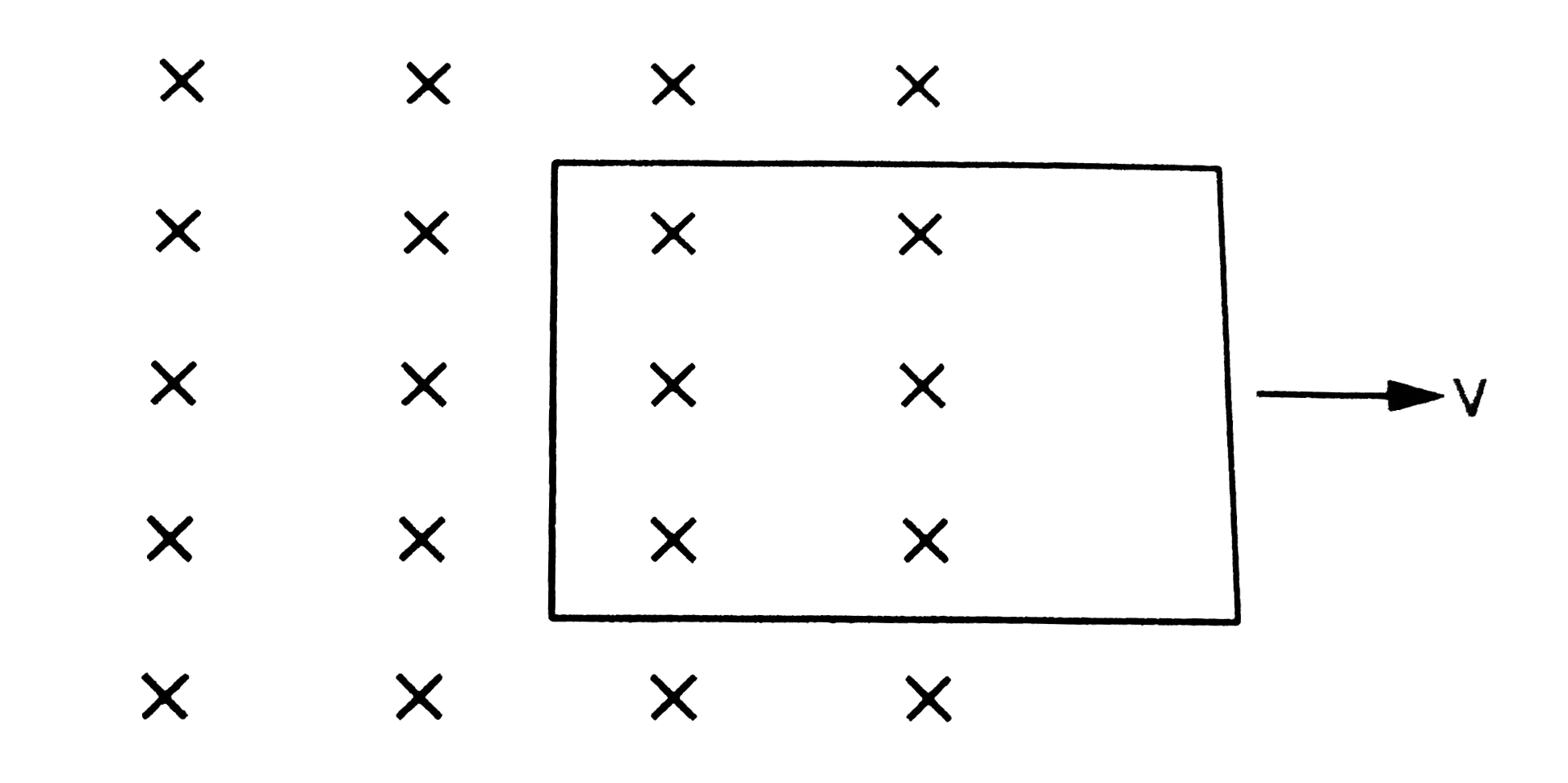
shows a conducting loop being pulled out...

shows a conducting loop being pulled out of a magnetic field with a speed v. Which of lthe four plots shown in may represent the power delivered by the pulling agent as a function of the speed v ?

Text Solution

Verified by Experts

The correct Answer is:

B
Promotional Banner

Topper's Solved these Questions

  • ELECTROMAGNETIC INDUCTION

    HC VERMA|Exercise Objective 2|10 Videos
  • ELECTROMAGNETIC INDUCTION

    HC VERMA|Exercise Exercises|89 Videos
  • ELECTROMAGNETIC INDUCTION

    HC VERMA|Exercise Short Answer|13 Videos
  • ELECTRIC FIELD AND POTENTIAL

    HC VERMA|Exercise Exercises|75 Videos
  • ELECTROMAGNETIC WAVES

    HC VERMA|Exercise Exercises|9 Videos

Similar Questions

Explore conceptually related problems

(a) A closed loop is held stationary in the magnetic field between the north and south poles of two permanent magnets held fixed. Can we hope to generate current in the loop by using very strong magnets ? (b) A closed loop moves normal to the constant electric field between the plates of a large capacitor. Is a current induced in the loop (i) when it is wholly inside the region between the capacitor plates (ii) when it is partially outside the plates of the capacitor? The electric field is normal to the plane of the loop. (c) A rectangular loop and a circular loop are moving out of a uniform magnetic field region (Figure) to a field-free region with a constant velocity v. In which loop do you expect the induced emf to be constant during the passage out of the field region? The field is normal to the loops.

A rectangular conducting loop consists of two wires on two opposite sides of length 1 joined together by rods of length d. The wires are each of the same material but with cross sections differing by a factor of 2. The thicker wire has a resistance R and the rods are of low resistance, which in turn are connected to a constant voltage source V_(0) . The loop is placed in uniform a magnetic field vecB at 45^(@) to its plane. Find the torque exerted by the magnetic field on the loop about an axis through the centres of rods.

One conducing U tube can be slide inside another as shown in figure, maintaining electrical contacts between the tubes. The magnetic field B is perpendicular to the plane of the figure. If each tube moves towards the other at a constant speed v, then the emf induced in the circuit in terms of B, l and v where l is the width of each tube, will be ........

A small ball of mass m and charge q is attached to the bottom end of a piece of negligible mass thread of length l, whose top end is fixed. The system formed by the thread and ball is in vertical plane and is in uniform horizontal magnetic field B, which is perpendicular to the plane of figure and points into the paper The ball is started with a velocity v_(0) from lower most point of circle in a direction perpendicular both to the magnetic induction and to direction of thread. The ball moves along a circular path such that thread remains tight during the whole motion. Neglect any loss of enery. What is the magnitude of magnetic induction B, if the minimum initial speed at which the described motion of ball (complete vertical circular motion) occurs is V_(0)=(1)/(2)sqrt(17gL)

A graph shown in the figure represents the variation of uniform magnetic field with time. If this field linked with a conducting loop completely and its perpendicular to the plane of the coil. In which time interval of induced emf in the coil is maximum ?

Two identical discs of same radius R are rotating about their axes in opposite directions with the same constant angular speed omega . The discs are in the same horizontal plane. At time t = 0 , the points P and Q are facing each other as shown in the figure. The relative speed between the two points P and Q is v_(r) . In one time period (T) of rotation of the discs , v_(r) as a function of time is best represented by

Figure shows a metal rod PQ resting on the smooth rails AB and positioned between the poles of a permanent magnet. The rails, the rod, and the magnetic field are in three mutual perpendicular directions. A galvanometer G connects the rails through a switch K. Length of the rod =15 cm, B =0.50 T, resistance of the closed loop containing the rod 9.0 m Omega . Assume the field to be uniform. (a) Suppose K is open and the rod is moved with a speed of 12 "cm s"^(-1) in the direction shown. Give the polarity and magnitude of the induced emf. (b) Is there an excess charge built up at the ends of the rods when K is open ? What if K is closed ? (c) With K open and the rod moving uniformly, there is no net force on the electrons in the rod PQ even though they do experience magnetic force due to the motion of the rod. Explain. (d) What is the retarding force on the rod when K is closed ? How much power is required (by an external agent) to keep the rod moving at the same speed (= 12 cm s^(-1) ) when K is closed ? How much power is required when K is open? (f)How much power is dissipated as heat in the closed circuit ? What is the source of this power ? (g) What is the induced emf in the moving rod if the magnetic field is parallel to the rails instead of being perpendicular ?

A small ball of mass m and charge q is attached to the bottom end of a piece of negligible mass thread of length l, whose top end is fixed. The system formed by the thread and ball is in vertical plane and is in uniform horizontal magnetic field B, which is perpendicular to the plane of figure and points into the paper The ball is started with a velocity v_(0) from lower most point of circle in a direction perpendicular both to the magnetic induction and to direction of thread. The ball moves along a circular path such that thread remains tight during the whole motion. Neglect any loss of enery. By what factor is the force acting on the thread (tension in thread) at point A is greater than at point C, when speed of the ball is the above stated one?

Refer to figure the arm PQ of the rectangular conductor is moved from x = 0, outwards. The uniform magnetic field is perpendicular to the plane and extends from x = 0 to x = b and is zero for x gt b. Only the arm PQ possesses substantial resistance r. Consider the situation when the arm PQ is pulled outwards from x = 0 to x = 2b and is then moved back to x = 0 with constant speed v. Obtain expressions for the flux, the induced emf, the force necessary to pull the arm and the power dissipated as Joule heat. Sketch the variation of these quantities with distance.

Two identical small elastic conducting balls of mass m and radius r have charges of oppsite signs Q and -q. Inditially they are held in free space with their centres at separation lgt 2r and then released Their speeds v long after their collision is v=sqrt((1)/(axxpiepsilon_(0)m){((Q+q)^(2))/(bxxr)-(Qq)/(l)}) (Ignore non-uniformity in charge distributuion when ball come close to each other, magnetic field produced by motion of charges and the gravitational interaction between them). Find ((6xxaxxbxx)/(48) ? (a and b are lowest possible integers)
