Home
Class 12
PHYSICS
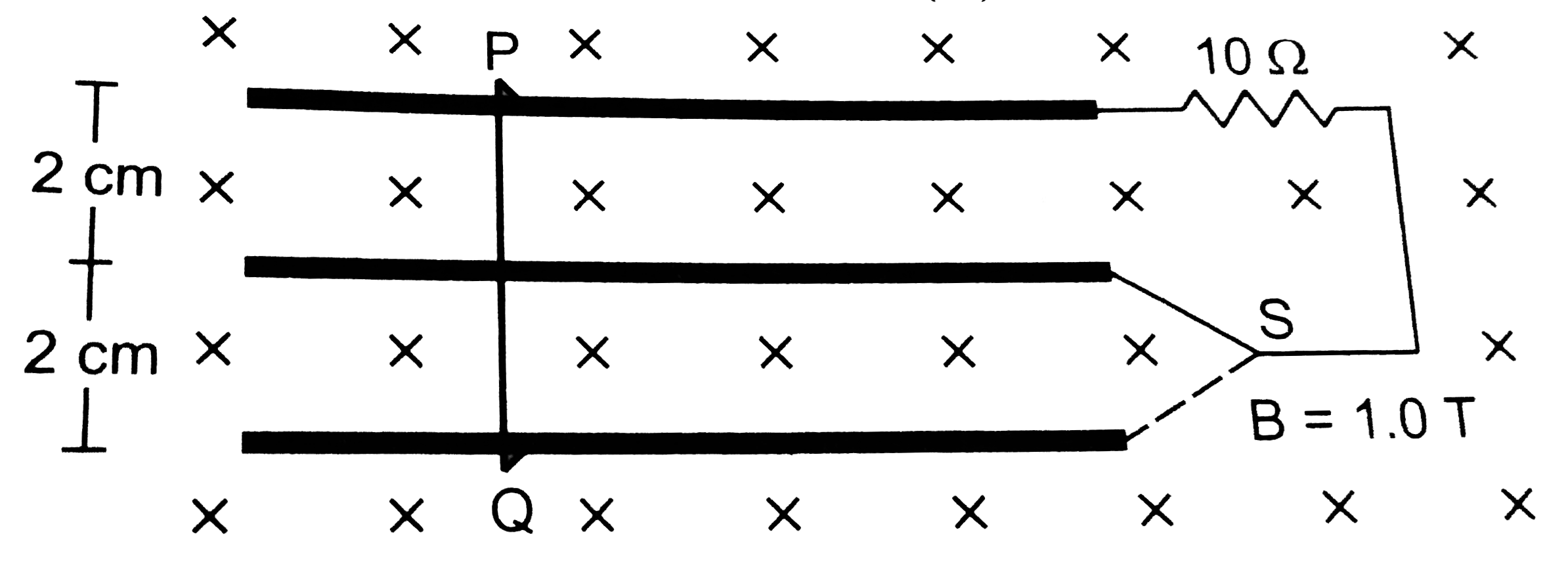
Consider the situation shown in . The wi...

Consider the situation shown in . The wire PQ has a negligible resistance and is made to slide on the three rails with a constant speed of `5 cm s^(-1) . Find the current in the `10 Omega` resistor when the switch S is thrown to (a) the middle rail (b) the bottom rail.

Text Solution

Verified by Experts

Here B=1T
`v=5xx10^(-2)m//s R+10 Omega`
`(a) When the switch is thrown to the middle rail `
`E=Bvl`
`=1xx5xx10^(-2)xx2xx10^(-2)V`
`=10xx10^(-4)=10^(-3) V.`
`Current in the 10 Omega resistor `
`=(E/R)`
`=10^(-3)/(10)=10^(-4)=0.1 mA.`
`(b) The switch is thrown to the lower rail`
`E=Blv`
`=1xx5xx10^(-2)xx4xx10^(-2)`
`=20xx10^(-4)V`
`Current =(20xx10^(-4))/(10)`
`=2xx10^(-4)V=0.2mA.`
Promotional Banner

Topper's Solved these Questions

  • ELECTROMAGNETIC INDUCTION

    HC VERMA|Exercise EXERCISE|9 Videos
  • ELECTROMAGNETIC INDUCTION

    HC VERMA|Exercise Objective 2|10 Videos
  • ELECTRIC FIELD AND POTENTIAL

    HC VERMA|Exercise Exercises|75 Videos
  • ELECTROMAGNETIC WAVES

    HC VERMA|Exercise Exercises|9 Videos

Similar Questions

Explore conceptually related problems

The network shown in figure is a part of the circuit. (The battery has negligible resistance) At a certain instant the current I = 5A and is decreasing at a rate of 10^3 As^(-1) . What is the potential difference between point B and A ?

Figure shows a metal rod PQ resting on the smooth rails AB and positioned between the poles of a permanent magnet. The rails, the rod, and the magnetic field are in three mutual perpendicular directions. A galvanometer G connects the rails through a switch K. Length of the rod =15 cm, B =0.50 T, resistance of the closed loop containing the rod 9.0 m Omega . Assume the field to be uniform. (a) Suppose K is open and the rod is moved with a speed of 12 "cm s"^(-1) in the direction shown. Give the polarity and magnitude of the induced emf. (b) Is there an excess charge built up at the ends of the rods when K is open ? What if K is closed ? (c) With K open and the rod moving uniformly, there is no net force on the electrons in the rod PQ even though they do experience magnetic force due to the motion of the rod. Explain. (d) What is the retarding force on the rod when K is closed ? How much power is required (by an external agent) to keep the rod moving at the same speed (= 12 cm s^(-1) ) when K is closed ? How much power is required when K is open? (f)How much power is dissipated as heat in the closed circuit ? What is the source of this power ? (g) What is the induced emf in the moving rod if the magnetic field is parallel to the rails instead of being perpendicular ?

Find the current in the wire for the configuration shown in figure. Wire PQ has negligible resistance. vecB , the magnetic field is coming out of the paper. theta is a fixed angle made by PQ travelling smoothly over two conducting parallel wires separated by a distance d.

In the potentiometer circuit shown in the figure the balance length AJ=60cm when switch S is open. When switch S is closed and the value of R= 5Omega , the b alance length AJ=50cm. The internal resistance of the cell C' is

(a) Obtain an expression for the mutual inductance between a long straight wire and a square loop of side a as shown in figure. (b) Now assume that the straight wire carries a current of 50 A and the loop is moved to the right with a constant velocity, v = 10 m/s. Calculate the induced emf in the loop at the instant when x = 0.2 m. Take a = 0.1 m and assume that the loop has a large resistance.

When a particle is undergoing motion, the diplacement of the particle has a magnitude that is equal to or smaller than the total distance travelled by the particle. In many cases the displacement of the particle may actually be zero, while the distance travelled by it is non-zero. Both these quantities, however depend on the frame of reference in which motion of the particle is being observed. Consider a particle which is projected in the earth's gravitational field, close to its surface, with a speed of 100sqrt(2) m//s , at an angle of 45^(@) with the horizontal in the eastward direction. Ignore air resistance and assume that the acceleration due to gravity is 10 m//s^(2) . The motion of the particle is observed in two different frames: one in the ground frame (A) and another frame (B), in which the horizontal component of the displacement is always zero. Two observers locates in these frames ill agree on :-

When a particle is undergoing motion, the diplacement of the particle has a magnitude that is equal to or smaller than the total distance travelled by the particle. In many cases the displacement of the particle may actually be zero, while the distance travelled by it is non-zero. Both these quantities, however depend on the frame of reference in which motion of the particle is being observed. Consider a particle which is projected in the earth's gravitational field, close to its surface, with a speed of 100sqrt(2) m//s , at an angle of 45^(@) with the horizontal in the eastward direction. Ignore air resistance and assume that the acceleration due to gravity is 10 m//s^(2) . Consider an observer in frame D (of the previous question), who observes a body of mass 10 kg acelerating in the upward direction at 30 m//s^(2) (w.r.t. himself). The net force acting on this body, as observed from the ground is :-

On a frictionless horizontal surface , assumed to be the x-y plane , a small trolley A is moving along a straight line parallel to the y-axis ( see figure) with a constant velocity of (sqrt(3)-1) m//s . At a particular instant , when the line OA makes an angle of 45(@) with the x - axis , a ball is thrown along the surface from the origin O . Its velocity makes an angle phi with the x -axis and it hits the trolley . (a) The motion of the ball is observed from the frame of the trolley . Calculate the angle theta made by the velocity vector of the ball with the x-axis in this frame . (b) Find the speed of the ball with respect to the surface , if phi = (4 theta )//(4) .

Find the current in the sliding rod AB (resistance = R) for the arrangement shown in figure. vecB is constant and is out of the paper. Parallel wires have no resistance, v is constant. Switch S is closed at time t = 0.

HC VERMA-ELECTROMAGNETIC INDUCTION-Exercises
  1. Consider the situation shown in . The wires P1Q1 and P2 Q2 are made ...

    Text Solution

    |

  2. Suppose the 19 Omega resistor of the previous problem is disconnected....

    Text Solution

    |

  3. Consider the situation shown in . The wire PQ has a negligible resist...

    Text Solution

    |

  4. The current generator I g, shown in . Sends a constant current I throu...

    Text Solution

    |

  5. The current generator ig, shown in , sends a constant current I throu...

    Text Solution

    |

  6. The system containing the rails and the wire of the previous problem i...

    Text Solution

    |

  7. The rectangualr wire- frame, shown in has a width d, mass m, resist...

    Text Solution

    |

  8. Shows a smooth pair of thick metallic rails connected across a battery...

    Text Solution

    |

  9. A conducting wire ab of length l, resistance r and mass m starts slidi...

    Text Solution

    |

  10. A bicycle is resting on its stand in the east - west direction and the...

    Text Solution

    |

  11. A conducting disc of radius r rotaes with a small but constant angul...

    Text Solution

    |

  12. shows a conducting disc rotating about its axis in a perpendicular ma...

    Text Solution

    |

  13. The magnetic field inn a region is given by vec B = (B0)/(L) y overse...

    Text Solution

    |

  14. shows a straight, long wire carrying a current I and a rod of length l...

    Text Solution

    |

  15. Consider a situation similar ot that of the previous problem except th...

    Text Solution

    |

  16. Shows a square frame of wire having a total resistance r placed coplan...

    Text Solution

    |

  17. A rectangular metallic loop of length l and width b is placed coplan...

    Text Solution

    |

  18. Shows a conducting circular loop of radius a placed in a uniform, perp...

    Text Solution

    |

  19. Consider the situation shown in the figure o fthe previous problem. Su...

    Text Solution

    |

  20. Consider a variation of the previous problem. Suppose the circular loo...

    Text Solution

    |
