

Home
Class 12
PHYSICS
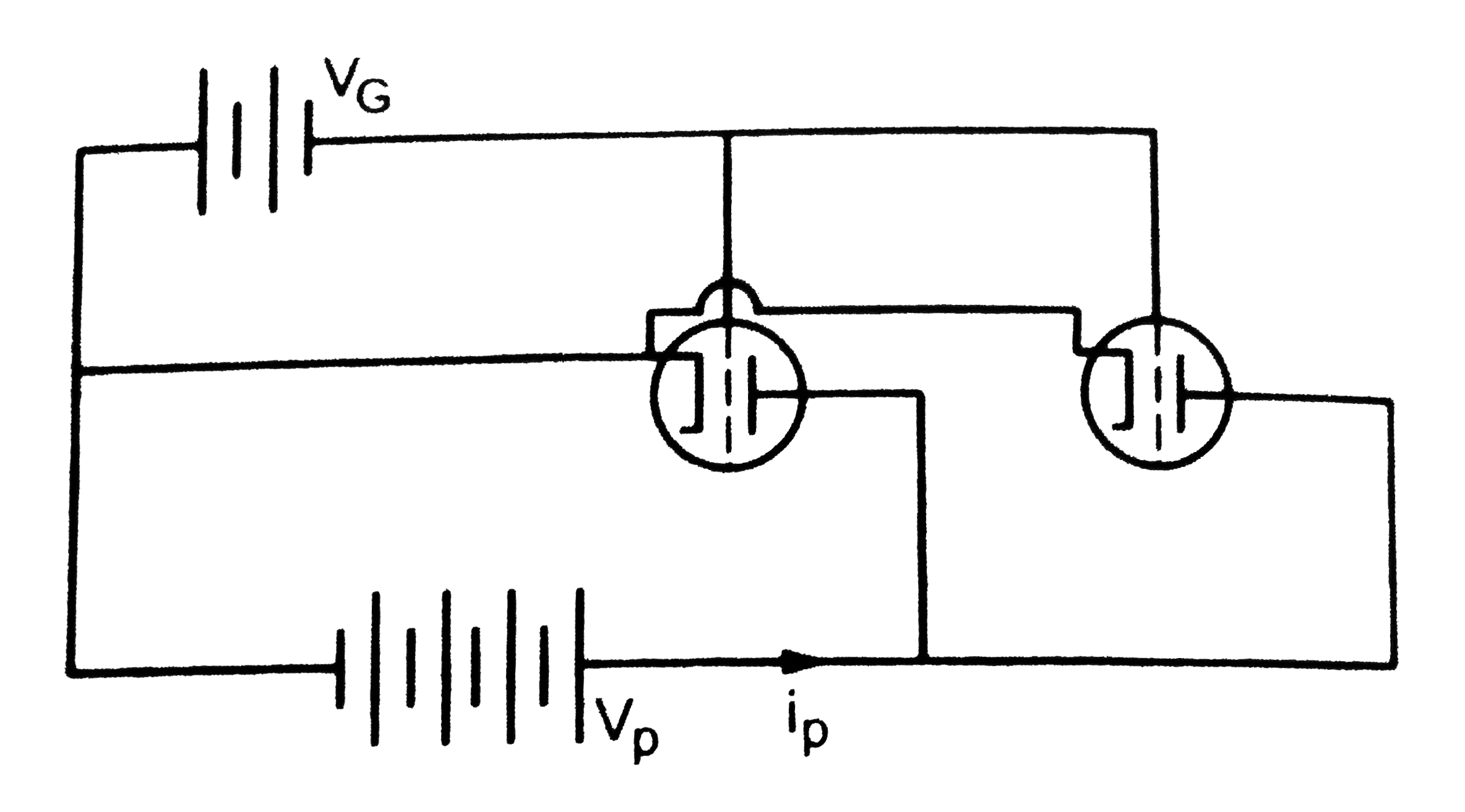
Figure shows two identical triode tubes ...

Figure shows two identical triode tubes connected in paralle. The anodes are connected together, the grids are connected together and the cathodes are connected together. Show that the equivalent plate resistance is half of the individual plate resistance, the equivalent mutual conductance is double the individual mutual conductance and the equivalent amplification factor is the same as the individual amplification factor.

Promotional Banner

Topper's Solved these Questions

  • ELECTRIC CURRENT THROUGH GASES

    HC VERMA|Exercise Objective 2|7 Videos
  • ELECTRIC CURRENT IN CONDUCTORS

    HC VERMA|Exercise Exercises|84 Videos
  • ELECTRIC FIELD AND POTENTIAL

    HC VERMA|Exercise Exercises|75 Videos

Similar Questions

Explore conceptually related problems

N identical cells whether joined together in series or in parallel, give the same current, when connected to an external resistance of 'R'. The internal resistance of each cell is:-

Four resistors, each of 10 Omega are connected to form a square as shown in the given figure. Find the eqUivalent resistance between the opposite corner A and C and between two points on anyone side (AB).

A compound slab is made up two slabs. If thermal conductivity of their material are k_(1) and k_(2) respectively of their cross-sectional areas are the same, the equivalent thermal conductivity of the slab is . . . . . (consider series connection)

Show four different ways in which three resistors of .r. ohm, each may be connected in a circuit. In which case is the eqUivalent resistance of the combination: ( 1 )Maximum? ( 2 ) Minimum?

Statement I: Two solid cylindrical rods of identical size and different thermal conductivity K_1 and K_2 are connected in series. Then the equivalent thermal conductivity of two rods system is less than that value of thermal conductivity of either rod. Statement II: For two cylindrical rods of identical size and different thermal conductivity K_1 and K_2 connected in series, the equivalent thermal conductivity K is given by (2)/(K)=(1)/(K_1)+(1)/(K_2)

Figure shows a metal rod PQ resting on the smooth rails AB and positioned between the poles of a permanent magnet. The rails, the rod, and the magnetic field are in three mutual perpendicular directions. A galvanometer G connects the rails through a switch K. Length of the rod =15 cm, B =0.50 T, resistance of the closed loop containing the rod 9.0 m Omega . Assume the field to be uniform. (a) Suppose K is open and the rod is moved with a speed of 12 "cm s"^(-1) in the direction shown. Give the polarity and magnitude of the induced emf. (b) Is there an excess charge built up at the ends of the rods when K is open ? What if K is closed ? (c) With K open and the rod moving uniformly, there is no net force on the electrons in the rod PQ even though they do experience magnetic force due to the motion of the rod. Explain. (d) What is the retarding force on the rod when K is closed ? How much power is required (by an external agent) to keep the rod moving at the same speed (= 12 cm s^(-1) ) when K is closed ? How much power is required when K is open? (f)How much power is dissipated as heat in the closed circuit ? What is the source of this power ? (g) What is the induced emf in the moving rod if the magnetic field is parallel to the rails instead of being perpendicular ?

A rectangular conducting loop consists of two wires on two opposite sides of length 1 joined together by rods of length d. The wires are each of the same material but with cross sections differing by a factor of 2. The thicker wire has a resistance R and the rods are of low resistance, which in turn are connected to a constant voltage source V_(0) . The loop is placed in uniform a magnetic field vecB at 45^(@) to its plane. Find the torque exerted by the magnetic field on the loop about an axis through the centres of rods.

An experimental setup of verification of photoelectric effect is shown in the diagram. The voltage across the electrode is measured with the help of an ideal voltmetar, and which can be varied by moving jockey 'J' on the potentiometer wire. The battery used in potentiometer circuit is of 20 V and its internal resistance is 2omega . The resistance of 100 cm long potentiometer wire is 8 omega . The photo current is measured with the help of an ideal ammeter. Two plates of potassium oxide of area 50 cm^(2) at separation 0.5 mm are used in the vacuum tube. Photo current in the circuit is very small so we can treat potentiometer circuit an indepdent circuit. The wavelength of various colours is as follows : |{:("Light",underset("Violet")(1),underset("Blue")(2),underset("Green")(3),underset("Yellow")(4),underset("Orange")(5),underset("Red")(6)),(lambda "in" Årarr,4000-4500,4500-5000,5000-5500,5500-6000,6000-6500,6500-7000):}| The number of electrons appeared on the surface of the cathode plate, when the jockey is connected at the ened 'P' of the potentiometer wire. Assume that no radiation is falling on the plates.

HC VERMA-ELECTRIC CURRENT THROUGH GASES-Exercises
  1. Two discharge tubes have identical material structure and the same gas...

    Text Solution

    |

  2. Calcuate n(T)//n (1000 K) for tungsten emitter at T = 300 K, 2000 K an...

    Text Solution

    |

  3. The saturation current from a thoriated-tungsten cathode at 2000 K is ...

    Text Solution

    |

  4. A Tungsten cathode and a thoriated-tungsten cathode have the same geom...

    Text Solution

    |

  5. If the temperature of a tungsten filament is raised from 2000 K to 201...

    Text Solution

    |

  6. The constant A in the Richardson-Dushman equation for tungsten is 60 x...

    Text Solution

    |

  7. A plate current of 10 mA is obtained when 60 volts are applied across ...

    Text Solution

    |

  8. The plate current in a diode is 20 mA when the plate voltage is 50 V o...

    Text Solution

    |

  9. The power delivered in the plate circuit of a diode is 1.0 W when the ...

    Text Solution

    |

  10. A triode valve operates at Vp = 225 V and Vg = - 0.5 V. The plate curr...

    Text Solution

    |

  11. Calculate the amplification factor of a triode valve which has plate r...

    Text Solution

    |

  12. The dynamic plate resistance of a triode valve is 10 kOmega. Find the ...

    Text Solution

    |

  13. Find the values of rp, mu and gm of a triode operating at plate voltag...

    Text Solution

    |

  14. The plate resistance of a triode is 8 kOmega and the transconductiance...

    Text Solution

    |

  15. The plate resistance and the amplification factor of a triode are 10 k...

    Text Solution

    |

  16. The plate current, plate voltage and grid voltage of a 6F6 triode tube...

    Text Solution

    |

  17. The plate current in a triode can be written as ip = k ((Vg + (Vp)/(...

    Text Solution

    |

  18. A triode has mutual conductance = 2.0 millimho and plate resistance =...

    Text Solution

    |

  19. The gain factor of an amplifier is increased from 10 to 12 as the load...

    Text Solution

    |

  20. Figure shows two identical triode tubes connected in paralle. The anod...

    Text Solution

    |