Home
Class 12
PHYSICS
Find the equivalent resistance of the ne...

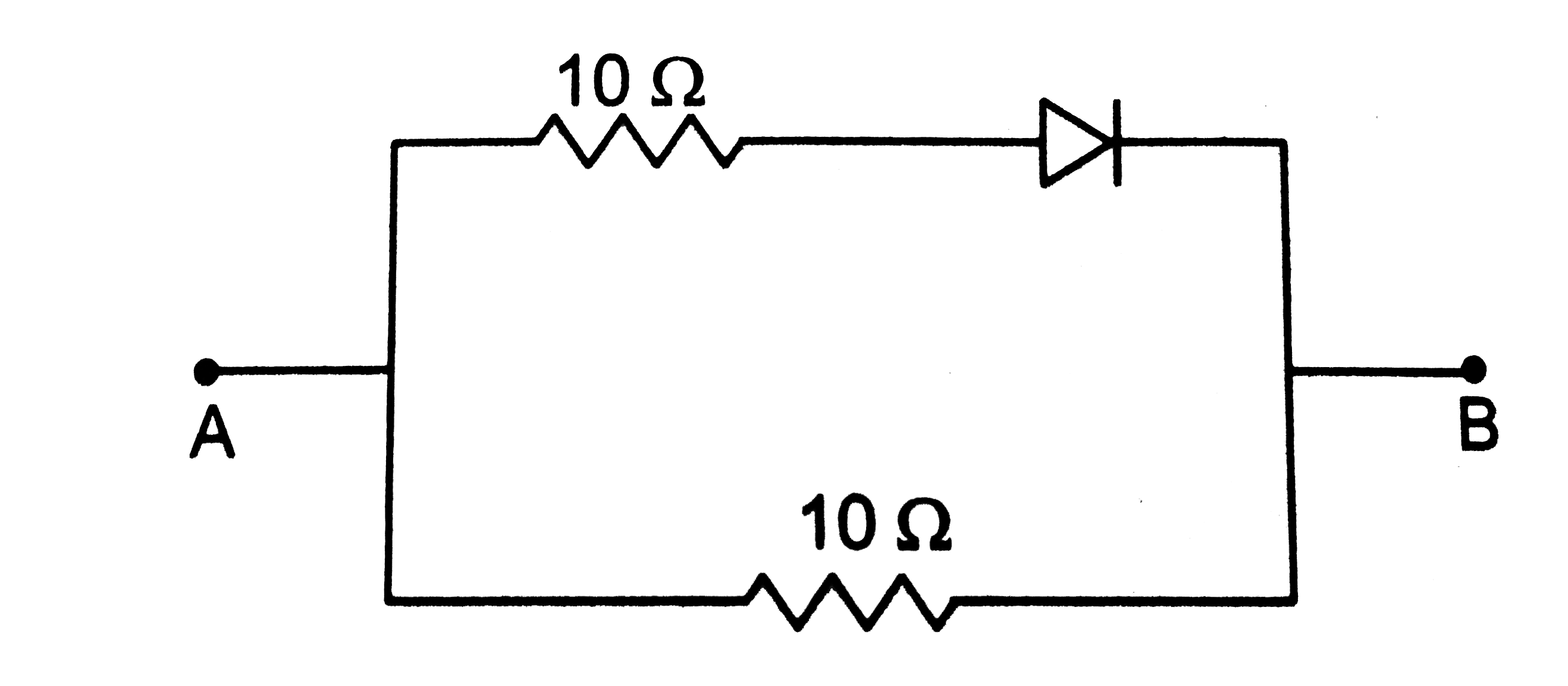
Find the equivalent resistance of the network shown in figure

Text Solution

Verified by Experts

Let the potential at `A and B` be `V_A and V_B` respectively.
(i) If `V_A gt V_B`
Then current flow from `A to B` and the diode is in forwad biased.
Equivalent Resistance `= (10)/(2) = 5Omega`
(ii) If `V_A lt V_B`
The current flow from B to A and the diode is reverse biased.
Hence Equivalent resistance `= 10 Omega`
Promotional Banner

Topper's Solved these Questions

  • SEMICONDUCTOR AND SEMICONDUCTOR DEVICES

    HC VERMA|Exercise objective II|1 Videos
  • PHOTOMETRY

    HC VERMA|Exercise Exercises|16 Videos
  • SPEED OF LIGHT

    HC VERMA|Exercise Exercises|3 Videos

Similar Questions

Explore conceptually related problems

Determine the equivalent resistance of networks shown in figure.

Find the equivalent resistance across AB :

Find the equivalent resistance of the circuit shown in the following figure: Also find the total current flowing in this circuit.

A bettery of 10 V and negligible internal resistance is connected across the diagonally opposite corners of a cubical network consisting of 12 resistors each of resistance 1Omega Determine the equivalent resistance of the network and the current along each edge of the cube.

For the network of resistance shown in the figure the equivalent resistance of the network between the points A and B is 18 ohm. The value of unknown resistance R is :

A network of resistore is connected to a 16 V battery with internal resistance of 1Omega, as shown in (a) Compute the equivalent resistance of the network. (b) Obtain the current in each resistor. (c ) obtain the voltage drops V _(AB), V _(BC) and V _(CD)

(a) Given n resistores each of resistance R. how will you combine them to get the (i) maximum (ii) minimum effective resistance? (b) Given the resistances of 1 Omega, 2 Omega, 3 Omega. how will be combine them to get an equivalent resistance of (i) (11//3) Omega (ii) (11//5) Omega, (iii) 6 Omega, (iv) (6//11) Omega ? (c ) Determine the equivalent resistance of networks shown in

HC VERMA-SEMICONDUCTOR AND SEMICONDUCTOR DEVICES-Exercises
  1. In a p-n junction, the depletion region is 400nm wide and and electric...

    Text Solution

    |

  2. The potential barrier exists across the junction is 0.2volt.What minim...

    Text Solution

    |

  3. In a p-n junction,a potential barrier of 250 mev exsists across the ju...

    Text Solution

    |

  4. When a p-n junction is reverse-biased,the current becomes almost const...

    Text Solution

    |

  5. The drift current in a p-n junction is 2.0(mu)A. Estimate the number o...

    Text Solution

    |

  6. The current-voltage characteristic of an ideal p-n junction diode is g...

    Text Solution

    |

  7. Consider a p-n junction diode having the characterstic i=i0(e^eV//kT-1...

    Text Solution

    |

  8. Calculate the current through the circuit and the petential difference...

    Text Solution

    |

  9. Each of the resistance shown in figure has a value of 20 Omega.Find th...

    Text Solution

    |

  10. Find the current through the resistance in the circuits shown in figur...

    Text Solution

    |

  11. What are the readings of the ammeterA1and A2shown in figure.Neglect th...

    Text Solution

    |

  12. Find the curent through the battery in each of the circuit shown in fi...

    Text Solution

    |

  13. Find the current through the resistance R in figure.If (a)R=12 Omega(b...

    Text Solution

    |

  14. Draw the current-voltage characteristics for the device shown in figur...

    Text Solution

    |

  15. Find the equivalent resistance of the network shown in figure

    Text Solution

    |

  16. When the base current in a transistor is changed from 30 mu Ato 80 mu ...

    Text Solution

    |

  17. A load resistor of 2 k Omega is connected in the collector branch of a...

    Text Solution

    |

  18. Let X=A bar(BC)+B bar(CA)+C bar(AB).Evalute X for (a)A=1,B=0,C=1 ...

    Text Solution

    |

  19. Design a logical circuit using AND, OR and NOT gates to evaluate A bar...

    Text Solution

    |

  20. Show that AB+bar(AB)is always 1.

    Text Solution

    |
