Home
Class 10
PHYSICS
State Ohm's law ? How can it be verified...

State Ohm's law ? How can it be verified experimentally ? Does it hold good under all conditions ? Comment.

Text Solution

Verified by Experts
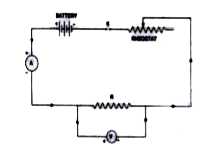
Ohm.s law: At constant temperature, the current flowing through a conductor is directly proportional to the potential difference across its ends. Experiment to verify ohm.s law:
(i) Close the key, so that current begins to flow in the circuit. (ii) Note down the potential difference (V) across the conductor PQ of resistance R shown by the voltmeter and the corresponding current (I) shown by the ammeter.

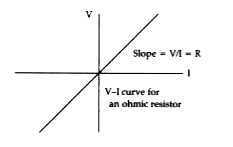
(iii) Now move the knob of rheostat so that the current in the circuit increases. (iv) Again note down the potential difference (V) across the conductor R in the voltmeter and current in the circuit shown by ammeter. (v) Repeat the experiment five times by increasing the current in the circuit by moving the knob of the rheostat in steps. Plot a graph between V and I by taking V along X- axis along. We get a straight line passing through From orgin

From the graph between V and I, we conclude that I = V, which is Ohm.s law. Hence Ohm.s law is verified experimentally. Ohm.s law does not hold under all conditions. Ohm.s law does not hold for non-ohmic material such as electrolyte.
Promotional Banner

Similar Questions

Explore conceptually related problems

State Hooke’s law. How can it be verified experimentally ?

State Ohm's law. How can it be verified experimentally ? Explain with the help of a circuit diagram. Express the result graphically.

State Pascal's law. How can it be demonstrated?

State Archimedas' principle. How can it be experimentally verified ?

State and explain Lenz's law. Give one exmple to illustrate the law. How will you verify it experimentally ? Does it obey the principle of energy consevartion ?

State the law of conservation of mass. How is it verified experimentally ?

(a) Water boils in an electric kettle in 15 minutes after being swiched on. Using the same mains supply, should the length of the heating element be increased or decreased if the water is to boiled in 10 minutes ? Why ? Does Ohm's law hold good under all conditions ?

How can laws of reflection be experimentally verified?

Ideal gas equation strictly obeys gas laws under all conditions of