Home
Class 10
PHYSICS
How will you conclude that the same pote...

How will you conclude that the same potential difference (voltage) exists across three resistors connected in a parallel arrangement to a battery ?

Text Solution

Verified by Experts
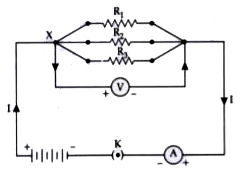
Suppose 3 resistances are `R_(1), R_(2)` and `R_(3)`. We will connect these resistances in parallel with an ammeter (A), a voltmeter (V), a plug key (K)and a battery of known voltage as shown in figure given below. We will close the key K and record the ammeter and voltmeter readings.

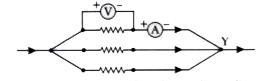
Now, we will open the key and switch the position of voltmeter and ammeter as show in the figure given below.

We will close the switch and note the readings. Similarly, we will switch the position of voltmeter to resistances `R_(2)` and `R_(3)` and observe the readings. We will find that readings of ammeter keeps on changing but readings of voltmeter in all cases almost remain same in all cases.
Promotional Banner

Similar Questions

Explore conceptually related problems

A 2.0 mu F capacitor and a 4.0 mu F , capacitor are connected in parallel across in 300V potential difference (a) What is the total energy stored by them? (b) They are next connected in series across that potential difference. What is the ratio of the total energy stored by them in the parallel arrangement to that in the series arrangement?

Potential difference across the terminal of a non ideal battery is

Potential different across the terminals of the battery shown in figure is

Draw a circuit diagram of an electric circuit containing a cell, a key, an ammeter, a resistance of 2 Omega in series with a combination of two resistors ( 4 Omega each) in parallel and a voltmeter across the parallel combination. Will the potential difference across the 2 Omega resistor be the same as that across the parallel combination of 4 Omega resistors ? Give reason.

An inductor is connected in series with a resistor of resistance 1000 Omega and a capacitor of capacitance 2 mu F. Potential difference of 100 V exists across the resistor . Angular frequency of source is 200 rad/s, and the same is equal to resonant frequency of the circuit find the rms voltage across inductor .