Home
Class 10
PHYSICS
Draw an appropriate schematic diagram sh...

Draw an appropriate schematic diagram showing common domestic circuits and discuss the importance of fuse. Why is it that a burnt out fuse should be replaced by another fuse of identical ratting?

Text Solution

Verified by Experts
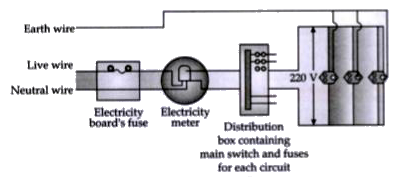

Important of fuse :
(i) Fuse is an important safety device in household wiring and in electrical appliance.
(ii) Fuse prevents any damage to the circuit and appliance which may happen due to overload.
(iii) Fuse prevents accidental fire which may happen because of short circuit.
Fuse of a particular rating is used with a particular appliance. A fuse with lower rating would result in lot of inconveniences because of frequent need of changing the fuse. A fuse with higher rating would not serve the purpose because it will not melt even if the current exceeds the limit of the device. Hence, a burnt-out fuse should be replaced by another fuse of identical rating.
Promotional Banner

Similar Questions

Explore conceptually related problems

Give reasons for the following: The burnt out fuse should be replaced by another fuse of identical rating.

In the circuit diagram shown in figure,a fuse bulb can cause all other bulbs to go out. Identify the bulb

What is the role of fuse, used in series with any electrical appliance? Why should a fuse with defined rating not be replaced by one with a larger rating?

(a) Which is the better way to connect lights and other electrical appliances in domestic wiring: series circuits or parallel circuits? Why? (b) Christmas tree lamps are usually wired in series. What happens if one lamp breaks? (c) An electrician has wired a house in such a way that if a lamp gets fused in one room of the house, all the lamps in other rooms of the house stop working. What is the defect in the wiring? (d) Draw a circuit diagram showing two electric lamps connected in parallel together with a cell and a switch that works both lamps. Mark an A on your diagram to show where an ammeter should be placed to measure the current.

