Home
Class 12
PHYSICS
The coefficient of friction between the ...

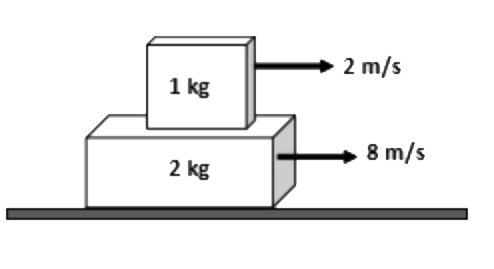
The coefficient of friction between the two blocks shown in the figure is `mu = 0.4` and between the lower block and the ground is zero. The blocks are given velocities of `2 ms^(-1)` and `8 ms^(-1)` respectively in the direction shown in the figure. In how much time (in seconds) the slipping between the blocks will stops ?

Text Solution

Verified by Experts

The correct Answer is:

1

The common velocity of the blocks can be calculated as follows `3v=1xx2+2xx8 v=6 " ms"^(-1)`
The acceleration of the 1 kg block is
`a=mu g=4" ms"^(-2)`
`v=2+4t`
`implies t=1 s`
Promotional Banner

Topper's Solved these Questions

  • NTA TPC JEE MAIN TEST 98

    NTA MOCK TESTS|Exercise Physics (SUBJECTIVE NUMERICAL) |10 Videos
  • NTA TPC JEE MAIN TEST 94

    NTA MOCK TESTS|Exercise PHYSICS |30 Videos

Similar Questions

Explore conceptually related problems

Find the force of friction acting between both the blocks shown in the figure.

If coefficient of friction between both the block is mu- (1)/(2) . Find friction force acting between both block.

The friction coefficient between the table and the block shown in figure is 0.2. Find the tension in the two strings.

The friction coefficient between the blocks is mu . If force F is applied on the lower block , analyse motion of two blocks.

Coefficient of friction between two block shown in figure ia mu = 0.4 . The blocks are given velocities of 2 m//s and 8 m//s in the directions figure. Find (a) The time when relative motion between them will stop (b) the common velocities of blocks upto that instant. (c) Displacement of 1 kg and 2 kg block upto that instant (g = 10 m//s^(2)) .

The coefficient of static friction between the two blocks shown in figure is mu and the table is smooth. What maximum horizontal forced F can be applied to he block of mass M so that the block move together?

coefficient of friction between two blocks shown in figure is mu =0.6 . The blocks are given velocities in the direction shown in figure. Find (a) the time when relative motion between them is slopped. (b) the common velocity of the two blocks. (c) the displocement of 1kg and 2kg blocks upto that instant. (Take g =10m//s^(2))

A small block of mass m is projected on a larger block of mass 10 m and length l with a velocity v as shown in the figure. The coefficient of friction between the two block is mu_(2) while that between the lower block and the ground is mu_(1) . Given that mu_(2) gt 11 mu_(1) . (a) Find the minimum value of v , such that the mass m falls off the block of mass 10 m . (b) If v has minimum value, find the time taken by block m to do so.

A block of mass m is kept on an another block of mass M. The coefficient of friction between the blocks varies as mu=(mu_(0)+kx) while friction between lower block and ground is zero. A time varying force F = 10t is applied horizontally on the upper block. Find time t_(0) when relative motion will start between the blocks. (x is relative displacement between the blocks.)
