Home
Class 12
PHYSICS
vec (E) due to uniformly charged sphere ...

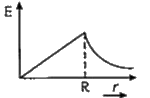
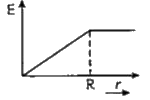
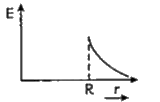
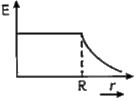
`vec (E)` due to uniformly charged sphere of radius R as a function of distance from its centre is represented by:

A

B

C

D

Text Solution

AI Generated Solution

The correct Answer is:

To determine the electric field \(\vec{E}\) due to a uniformly charged sphere of radius \(R\) as a function of distance from its center, we can analyze the situation in two distinct regions: inside the sphere (for \(r < R\)) and outside the sphere (for \(r \geq R\)). ### Step-by-Step Solution: 1. **Identify the Charge Distribution**: - Consider a uniformly charged sphere with total charge \(Q\) and radius \(R\). 2. **Electric Field Inside the Sphere (\(r < R\))**: - According to Gauss's Law, the electric field inside a uniformly charged sphere is zero. This is because any Gaussian surface inside the sphere encloses no charge. - Therefore, for \(r < R\): \[ E = 0 \] 3. **Electric Field Outside the Sphere (\(r \geq R\))**: - For points outside the sphere, we can treat the entire charge \(Q\) as if it were concentrated at the center of the sphere. - Using Gauss's Law, the electric field at a distance \(r\) from the center (where \(r \geq R\)) is given by: \[ E = \frac{kQ}{r^2} \] - Here, \(k\) is Coulomb's constant. 4. **Summary of the Electric Field**: - The electric field \(\vec{E}\) as a function of distance \(r\) from the center of the uniformly charged sphere can be summarized as: \[ E(r) = \begin{cases} 0 & \text{if } r < R \\ \frac{kQ}{r^2} & \text{if } r \geq R \end{cases} \] ### Final Answer: The electric field \(\vec{E}\) due to a uniformly charged sphere of radius \(R\) is: \[ E(r) = \begin{cases} 0 & \text{if } r < R \\ \frac{kQ}{r^2} & \text{if } r \geq R \end{cases} \]

To determine the electric field \(\vec{E}\) due to a uniformly charged sphere of radius \(R\) as a function of distance from its center, we can analyze the situation in two distinct regions: inside the sphere (for \(r < R\)) and outside the sphere (for \(r \geq R\)). ### Step-by-Step Solution: 1. **Identify the Charge Distribution**: - Consider a uniformly charged sphere with total charge \(Q\) and radius \(R\). 2. **Electric Field Inside the Sphere (\(r < R\))**: ...
Promotional Banner

Topper's Solved these Questions

  • SAMPLE PAPER 5

    EDUCART PUBLICATION|Exercise SECTION - C|6 Videos
  • SAMPLE PAPER 5

    EDUCART PUBLICATION|Exercise SECTION - C|6 Videos
  • SAMPLE PAPER 3

    EDUCART PUBLICATION|Exercise SECNTION -C|6 Videos
  • SAMPLE PAPER 6

    EDUCART PUBLICATION|Exercise Section-C|6 Videos

Similar Questions

Explore conceptually related problems

The electric field due to uniformly charged sphere of radius R as a function of the distance from its centre is represented graphically by

If the potential at the center of a uniformly charged sphere of radius R is V then electric field at a distance r from the center of sphere will be ( r lt R ) : -

If the potential at the centre of a uniformly charged hollow sphere of radus R is V, then electric field at a distance r from the centre of sphere will be (rgtR) .

The electric intensity due to a uniformly charged infinite cylinder of radius R , at a distance r(gt R) , from its axis is proportional to

A nonconducting sphere with radius a is concentric with and surrounded by a conducting spherical shell with inner radius b and outer radius c. The inner sphere has a negative charge uniformly distributed throughout its volume, while the spherical shell has no net charge. The potential V (r) as a function of distance from the center is given by

The maximum electric field intensity on the axis of a uniformly charged ring of charge q and radius R is at a distance x from the centre of the ring.The value of x is

Assertion: Electric potential on the surface of a charged sphere of radius R is V. Then electric field at distance r=R/2 from centre is V/(2R) . Charge is distributed uniformly over the volume. Reason: From centre to surface, electric field varies linearly with r. Here r is distance from centre.

EDUCART PUBLICATION-SAMPLE PAPER 5-SECTION - B
  1. What is the dipole moment of a dipole consisting two equal and opposit...

    Text Solution

    |

  2. What is inherent characteristic of matter:

    Text Solution

    |

  3. vec (E) due to uniformly charged sphere of radius R as a function of d...

    Text Solution

    |

  4. Electric field at a point is:

    Text Solution

    |

  5. Condition for step-down transformer is:

    Text Solution

    |

  6. The flux through the surface:

    Text Solution

    |

  7. Effective capacitance of (10)/(11) is required to obtain from such cap...

    Text Solution

    |

  8. Two plates, one at 300 V, other at - 100 V are 4 cm apart. The voltage...

    Text Solution

    |

  9. The circuit has total resistance of:

    Text Solution

    |

  10. If a bar magnet is cut in half, then new magnetic moment m and pole st...

    Text Solution

    |

  11. Value of earth's magnetic field inside a metallic cage is:

    Text Solution

    |

  12. Relation between earth's magnetic field is given by:

    Text Solution

    |

  13. Due to orbital motion, magnetic moment is:

    Text Solution

    |

  14. At a point on the right bisector of a magnetic dipole the magnetic pot...

    Text Solution

    |

  15. At a certain B(H) = (1)/(sqrt(3)) B dip, angle is:

    Text Solution

    |

  16. The condition of minimum impedance is:

    Text Solution

    |

  17. The natural frequency of given circuit is shown by:

    Text Solution

    |

  18. Assertion (A): Current should not be passed through potentiometer for ...

    Text Solution

    |

  19. Assertion (A): Resistivity of a conductor, increases on increasing tem...

    Text Solution

    |

  20. Assertion (A): As the relaxation time Increases drift velocity increas...

    Text Solution

    |
