Home
Class 10
CHEMISTRY
An organic compound contains carbon , hy...

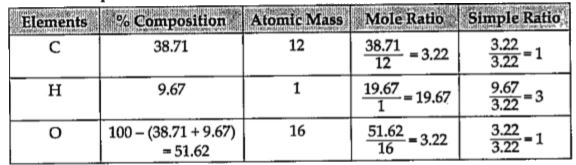
An organic compound contains carbon , hydrogen and oxygen . Its elemental analysis gave C ,`38.41`% and `H , 9.67`% . The empirical formula of the compound would be

A

`CH_3O`

B

`CH_2O`

C

CHO

D

`CH_4O`

Text Solution

Verified by Experts

The correct Answer is:
A

The empirical formula is to be calculated as:
Promotional Banner

Topper's Solved these Questions

  • SAMPLE PAPER 2020

    ICSE|Exercise SECTION-II (40 Marks) Attempt any four questions from this Section|47 Videos
  • SAMPLE QUESTION PAPER -4

    ICSE|Exercise SECTION - II |85 Videos

Similar Questions

Explore conceptually related problems

An organic compound contains carbon, hydrogen and oxygen. Its elemental analysis gave C,38.71% and H,9.67% . The empirical formula of the compound would be :

An organic compound contains carbon, hydrogen and oxygen. If the ratio percentage of C and H is 6:1 calculate the simplest formula of the compound, given that one molecule of the compound contains half as much oxygen as would be required to burn all the carbon and hydrogen atoms in it to CO_2 and H_2O

0.246 gm of an organic compound containing 58.53% carbon and 4.06% hydrogen gave 22.4 ml of nitrogen at STP. What is the empirical formula of the compound?

An organic compound of carbon, hydrogen and nitrogen contains these elements having mass percentage 66.67%, 7.41% and 25.92% respectively. Calculate empirical formula

A compound contains C=90% and H=10% Empirical formula of the compound is:

An organic compound contains 49.3% carbon, 6.84% hydrogen and 43.86% of oxygen and its vapour density is 73 . Molecular formula of the compound is

A compound contains C=40%,O=53.5% , and H=6.5% the empirical formula formula of the compound is:

An organic compound contains 40% carbons atom 6.67% hydrogen atoms and remaining oxygen atoms by mass. The empirical formula will be-

An organic compound containing carbon hydrogen and oxygen contains 52 .2 % carbon and 13.04 % hydrogen .Vapour density of the compound is 23 .Its molecular formula will be

An organic compound containes C=74.0%, H=8.65% and N=17.3% . Its empirical formul ais

ICSE-SAMPLE PAPER 3 -MULTIPLE CHOICE QUESTION
  1. An element having atomic number 17 and belongs to halogens is

    Text Solution

    |

  2. How many valence electrons are present in Mg?

    Text Solution

    |

  3. Write the name of a non-metal of group 15.

    Text Solution

    |

  4. When fused lead bromide is electrolysed we observe:

    Text Solution

    |

  5. Arrange the following as per the instructions given in the brackets: ...

    Text Solution

    |

  6. A chloride which forms a precipitate that is soluble in excess of ammo...

    Text Solution

    |

  7. Sodium carbonate is a basic salt because it is a salt of a:

    Text Solution

    |

  8. A polar covalent bond will be formed in which one of these pair of ato...

    Text Solution

    |

  9. Sodium carbonate is a basic salt because it is a salt of a:

    Text Solution

    |

  10. The vessel in which electrolysis of lead bromide is carried out is:

    Text Solution

    |

  11. Arrange the following as per instructions given in the brackets: Cl,...

    Text Solution

    |

  12. A solution of the compound which gives a dirty green precipitate with ...

    Text Solution

    |

  13. Alkalis are :

    Text Solution

    |

  14. Aluminium has a tendency to loose ......... electrons.

    Text Solution

    |

  15. An organic compound contains carbon , hydrogen and oxygen . Its elemen...

    Text Solution

    |

  16. Which soln. becomes a deep/inky blue colour when excess of ammonium hy...

    Text Solution

    |

  17. The diagram given below is a part of Periodic Table. Study the table a...

    Text Solution

    |

  18. The diagram given below is a part of Periodic Table. Study the table a...

    Text Solution

    |

  19. The diagram given below is a part of Periodic Table. Study the table a...

    Text Solution

    |

  20. The diagram given below is a part of Periodic Table. Study the table a...

    Text Solution

    |

