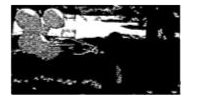
The figure shows a girl pulling 5 balloons in her hand for 12m with a force of 1N at an angle of `60^@` below horizontal. How much work does the girl do on the balloons?
A
`-10J`
B
6 J
C
`-6J`
D
12J
Text Solution
Verified by Experts
The correct Answer is:
B
work done is `Fcos theta xx` S here f =1N, angle is `60^@` so cos `theta` = cos 60 = 1/2 and S is 12m substitute and calculate.
Topper's Solved these Questions
WORK,POWER AND ENERGY
ICSE|Exercise NUMERICAL BASED MCQ|17 Videos
SPECTRUM
ICSE|Exercise TYPE 3 DIAGRAM BASED MCQ:|5 Videos
Similar Questions
Explore conceptually related problems
A car comes to a sliding stop in 5 m. During this process, the force on the car due to road is 100 N and is directed opposite to the motion. (a) How much work done the road do on the car? (b) How much work done the car do on the road?
A cyclist comes to a skidding stop in 10m . During this process, the force on the cycle due to the road is 200N and is directly opposite to the motion. a. How much work does the road do on the cycle? b. How much work does the cycle do on the road?
A cyclist comes to a skidding stop in 10m . During this process, the force on the cycle due to the road is 200N and is directly opposite to the motion. a. How much work does the road do on the cycle? b. How much work does the cycle do on the road?
A 10-kg block moves in a straight line under the action of a force that varies with position as shown in figure. How much work does the force do as the block moves from origin to x=8m ?
A balloon is moving up in air vertically above a point A on the ground. When it is at a height h_1 , a girl standing at a distance (point B) from A (see figure) sees it at an angle 45^@ with respect to the vertical. When the balloon climbs up a further height h_2 , it is seen at an angle 60^@ with respect to the vertical if the girl moves further by a distance 2.464d (point C). Then the height h_2 is (give tan 30^@ = 0.5774 )
A force of 15 N is required to pull up a body of mass 2 kg through a distance 5 m along an inclined plane making an angle of 30^(@) with horizontal as shown in fig calculate : (i)the work done by the force in pulling the body. (ii)The force due to gravity on the body, (iii)the work done against by the force due to gravity Take :g=9.8 m s^(-2) . (iv)Account for the difference in answers of part (i) and part (iii).
A rod of length 1.0 m and mass 0.5 kg fixed at ond is initially hanging vertical. The other end is now raised until it makes an angle 60^@ with the vertical. How much work is required?
A plank of mass 10 kg and a block of mass 2 kg are placed on a horizontal plane as shown in the figure. There is no friction between plane and plank. The coefficient of friction between block and plank is 0.5 .A force of 60 N is applied on plank horizontally. In first 2 s the work done by friction on the block is
A block of mass 5 kg is (i) pushed in case (A) and (ii) pulled in case (B), by a force F=20 N , making an angle of 30^(@) with the horizontal, as shown in the figures. The coefficient of friction between the block and floor is mu = 0.2 . The difference between the accelerattion of the block, in case (B) and case (A) will be : (g = 10 ms^(-2)) . .