Home
Class 14
PHYSICS
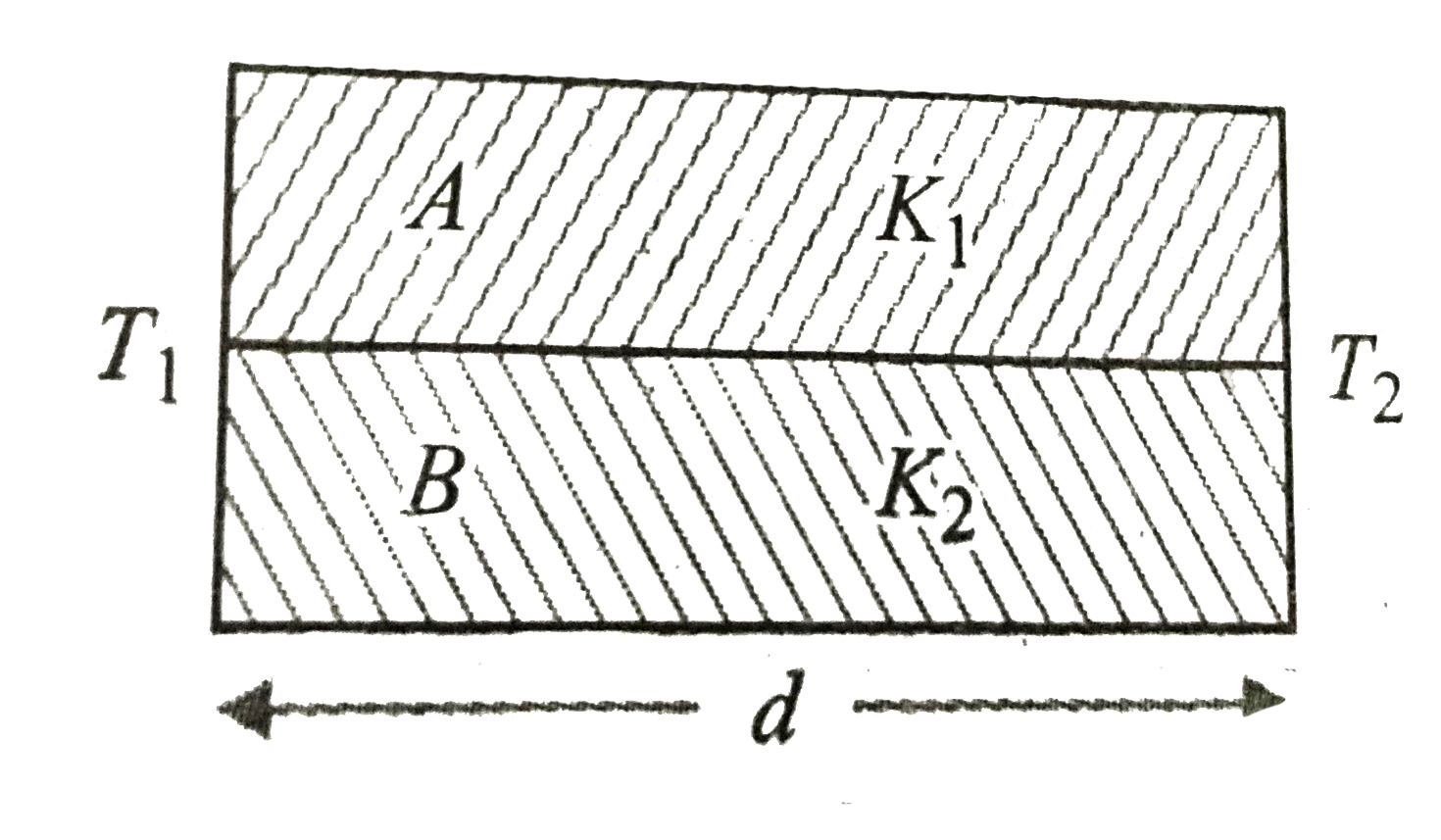
Two rods A and B of different materials ...

Two rods A and B of different materials are welded together as shown in figure. Their thermal conductivities are `K_(1)` and `K_(2)`. The thermal conductivity of the composite rod will be

A

`(K_1+K_2)/2`

B

`(3(K_1+K_2))/2`

C

`K_1 + K_2`

D

`2(K_1 + K_2)`

Text Solution

Verified by Experts

The correct Answer is:

A
Promotional Banner

Similar Questions

Explore conceptually related problems

The thermal conductivity of a rod depends on

A slab consists of two layers of different materials of the same thickness and having thermal conductivities K_(1) and K_(2) . The equivalent thermal conductivity of the slab is

A slab consists of two parallel layers of two different materials of same thickness having thermal conductivities K_(1) and K_(2) . The equivalent conductivity of the combination is

Two rods of the same length and diameter, having thermal conductivities K_(1) and K_(2) , are joined in parallel. The equivalent thermal conductivity to the combinationk is

A composite slab consists of two slabs A and B of different materials but of the same thickness placed one on top of the other. The thermal conductivities of A and B are k_(1) and K_(2) respectively. A steady temperature difference of 12^(@)C is maintained across the composite slab. If k_(1) = K_(2)//2 , the temperature difference across slab A will be:

Two slabs A and B of different materials but of the same thicknesss are joined end to end to form a composite slab. The thermal conductivities of A and B are K_(1) and K_(2) respectively. A steady temperature difference of 12^(@) C is maintained across the composite slab. If K_(1) = K_(2)/2 , the temperature difference across slabs A is

A wall has two layers A and B each made of different materials. The thickness of both the layers is the same. The thermal conductivity of A, K_(A) = 3K_(B) . The temperature different across the wall is 20^(@)C in thermal equilibrium
