Home
Class 12
CHEMISTRY
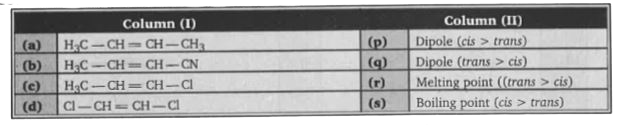
Match the column I and II. (Matrix)...

Match the column I and II. (Matrix)

Text Solution

Verified by Experts

The correct Answer is:
`a- p, r, s; b - q, r; c- q, r; d-p, r, s`

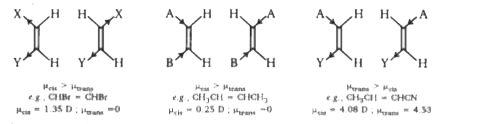
As shown in fig. the relation of dipole moment to configuration is quite direct. If in a 1, 2 -disubstituted alkene (XCH = CHY) X and Y are both electron donating or both electron withdrawing, the dipole moment of the cis isomer will generally be sizeable, whereas that of the trans isomer will be small or zero (i.e. `mu_("cis")gtmu_("trans")`). If, on the other hand, X is electron donating and Y is electron withdrawing, or vice versa, .`mu_("trans") gtmu_("cis")` . In tribustituted alkenes XCH = CYZ the situation is less clear cut, though if Z is alkyl and X and Y are halogen or other strongly electron withdrawing groups, the disposition (cis or trans)

of X and Y will be decisive. Except for the case of cyclooctene, configuration can be inferred from dipole moment where known, though in some cases the differences are perhaps uncomfortably small. In the case of 1-chloro-2-iodoethylene the original, seemingly unreasonable order of dipole moments was later reversed. In trans-cyclooctene, the normal `C_(2h)` symmetry of trans-XCH = CHX is reduced to at most `C_2`, therefore the compound can have a dipole moment, whereas compounds of `C_(2h)` symmetry cannot. That the moment is so large may be related to the highly twisted nature of the double bond (torsion angle between `136^@` and `157^@` )
Dipole Moments and the Dipole `"Rule"^(a)`:
As for as the question is concerned, melting point of (trans > cis)because trans form is more symmetrical than cis form.
Promotional Banner

Topper's Solved these Questions

  • GENERAL ORGANIC CHEMISTRY

    MS CHOUHAN|Exercise LEVEL - 2 (SUBJECTIVE PROBLEMS )|13 Videos
  • GENERAL ORGANIC CHEMISTRY

    MS CHOUHAN|Exercise LEVEL - 2 (SUBJECTIVE PROBLEMS )|13 Videos
  • CARBOXYLIC ACID AND THEIR DERIVATIVES

    MS CHOUHAN|Exercise LEVEL-2( SUBJECTIVE PROBLEMS)|1 Videos
  • GRIGNARD REAGENT

    MS CHOUHAN|Exercise Level-2 (Subjective Problems)|6 Videos

Similar Questions

Explore conceptually related problems

Match the column of I and II

This section contains question each with two columns I and II. Match the items given in column -I with in the column -II.

This section contains question each with two columns I and II. Match the items given in column -I with in the column -II.

Match the column II and mark the appropriate choice

Match the column I with column II and frind the correct option

Match the columns and select the correct option {:("Column-I(Animals)","Column-II (Locomotor organs)"),((a)"Octopus",(i)"Limbs"),((b)"Crocodile",(ii)"Comb plates "),((c )"Catla",(ii)"Tentacles"),((d)"Ctenoplana",(iv)"Fins"):}

Match the Column-I with Column-II {:(" Column-I "," Column-II "),("a) Pyrolysis ","i) Methimoglobinemia "),("b) Carbon monoxide ","ii) Arsenic "),("c) Blue baby ","iii) Asphyxia "),("d) Black foot disease ","iv) Disposal of hospital waste "):}

Match the terms in column I with those in column II:

MS CHOUHAN-GENERAL ORGANIC CHEMISTRY -LEVEL - 2
  1. Select the most stable structure in each of the following

    Text Solution

    |

  2. Match the column I and II. (Matrix)

    Text Solution

    |

  3. Match the column I and II. (Matrix)

    Text Solution

    |

  4. Identify the most stable structure in each of the following:

    Text Solution

    |

  5. Identify the most basic compound in the following.

    Text Solution

    |

  6. Identify the most acidic hydrogen containing compound from the followi...

    Text Solution

    |

  7. Give the type of hybridization present at each atom. (i) C1 - ……...

    Text Solution

    |

  8. Predict the direction of the following equilibrium. Write your answer ...

    Text Solution

    |

  9. Match the column I and II. (Matrix)

    Text Solution

    |

  10. Match the column I and II.

    Text Solution

    |

  11. Match the column I and II.

    Text Solution

    |

  12. Sum of molecular mass of gas (A + C) is :

    Text Solution

    |

  13. Ph-overset(O)overset(||)C-O-Hoverset(NaHCO3)rarr(A) gas Ph - C-=CHo...

    Text Solution

    |

  14. Match the column I and II.

    Text Solution

    |

  15. Consider the following reaction of boron trifluoride (BF3) and aceton...

    Text Solution

    |

  16. Consider the following reaction of boron trifluoride (BF3) and aceton...

    Text Solution

    |

  17. Consider the following reaction of boron trifluoride (BF3) and aceton...

    Text Solution

    |

  18. Rank the following carbocations according to stability (1 = most stabl...

    Text Solution

    |

  19. Consider the following reaction of boron trifluoride (BF3) and aceton...

    Text Solution

    |

  20. Among the given pairs, which is more reactive towards AgNO3 (or) towa...

    Text Solution

    |

