Home
Class 12
CHEMISTRY
Allegra, a common prescription drug with...

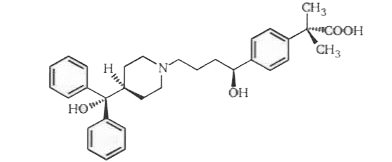
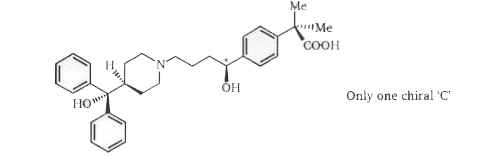
Allegra, a common prescription drug with the structure shown below, is given for the treatment of seasonal allergies. How many stereogenic carbon does Allegra possess ?

A

1

B

2

C

3

D

4

Text Solution

Verified by Experts

The correct Answer is:
A

Promotional Banner

Topper's Solved these Questions

  • ISOMERISM (STRUCTURAL & STEREOISOMERISM)

    MS CHOUHAN|Exercise LEVEL 2|66 Videos
  • ISOMERISM (STRUCTURAL & STEREOISOMERISM)

    MS CHOUHAN|Exercise LEVEL 2 (SUBJECTIVE PROBLEMS)|17 Videos
  • HYDROCARBONS (ALKYNES)

    MS CHOUHAN|Exercise Level -1|32 Videos
  • IUPAC NAME

    MS CHOUHAN|Exercise LEVEL-2 (SUBJECTIVE PROBLEMS ) |1 Videos

Similar Questions

Explore conceptually related problems

The common point of the tangent and the circle is called the point of contact and the tangents is said to touch the circle at the common point. Observe the tangents to the circle in the figures given below. How many tangents can you obtain to the circle.in all?See the points of contact. Draw radii from the points of contact. Do you see any thing special about the angle between the tangents and radii at the points of contact. All appear to be perpendicular to the corresponding tangents. How many tangents can you draw to a circle at a point?

The common point of the tangent and the circle is called the point of contact and the tangents is said to touch the circle at the common point. Observe the tangents to the circle in the figures given below. How many tangents can you obtain to the circle.in all?See the points of contact. Draw radii from the points of contact. Do you see any thing special about the angle between the tangents and radii at the points of contact. All appear to be perpendicular to the corresponding tangents. How many tangents can you obtain to the circle in all?

The common point of the tangent and the circle is called the point of contact and the tangents is said to touch the circle at the common point. Observe the tangents to the circle in the figures given below. How many tangents can you obtain to the circle.in all?See the points of contact. Draw radii from the points of contact. Do you see any thing special about the angle between the tangents and radii at the points of contact. All appear to be perpendicular to the corresponding tangents. Draw radii from the points of contact. Do you see any thing special about the angle between the tangents and radii at the points of contact. All appear to be perpendicular to the corresponding tangents.

The products of bond breaking, shown below, are not stable, and cannot be isolated for prolonged study. Such species are referred to as reactive intermediate, and are belived to be transient intermediates in many reactions. The general structures and names of four such intermediates are, Charged Intermediates Uncharged Intermediates Carbocations (called carbonium ions in the older literature) are electrophiles and carbananions are nucleophiles. Carbenes have only a valence shell sextet of electrons and are therefore electron deficient. In this sense they are elecrophiles, but the non-bonding electron pair also gives carbenes nucleophilic character. As a rule, the electrophilic character dominates carbene reactivity. Carbon radicals have only seven valence electrons, and may be considered electron deficient, however, they do not in general bond to nucleophilic electron pair, so their chemistry exhibits differences from that of conventional electrophiles. Radical intermediates are often called free radicals. Intermediates are in general stabilised with conjugation, electron donating and electron with drawing groups. Which of the following is relatively an unstable intermediate compared to rest ?

The products of bond breaking, shown below, are not stable, and cannot be isolated for prolonged study. Such species are referred to as reactive intermediate, and are belived to be transient intermediates in many reactions. The general structures and names of four such intermediates are, Charged Intermediates Uncharged Intermediates Carbocations (called carbonium ions in the older literature) are electrophiles and carbananions are nucleophiles. Carbenes have only a valence shell sextet of electrons and are therefore electron deficient. In this sense they are elecrophiles, but the non-bonding electron pair also gives carbenes nucleophilic character. As a rule, the electrophilic character dominates carbene reactivity. Carbon radicals have only seven valence electrons, and may be considered electron deficient, however, they do not in general bond to nucleophilic electron pair, so their chemistry exhibits differences from that of conventional electrophiles. Radical intermediates are often called free radicals. Intermediates are in general stabilised with conjugation, electron donating and electron with drawing groups. Which of the following carbo cations is more stable?

The products of bond breaking, shown below, are not stable, and cannot be isolated for prolonged study. Such species are referred to as reactive intermediate, and are belived to be transient intermediates in many reactions. The general structures and names of four such intermediates are, Charged Intermediates Uncharged Intermediates Carbocations (called carbonium ions in the older literature) are electrophiles and carbananions are nucleophiles. Carbenes have only a valence shell sextet of electrons and are therefore electron deficient. In this sense they are elecrophiles, but the non-bonding electron pair also gives carbenes nucleophilic character. As a rule, the electrophilic character dominates carbene reactivity. Carbon radicals have only seven valence electrons, and may be considered electron deficient, however, they do not in general bond to nucleophilic electron pair, so their chemistry exhibits differences from that of conventional electrophiles. Radical intermediates are often called free radicals. Intermediates are in general stabilised with conjugation, electron donating and electron with drawing groups. R-N^(+) equiv N" "Cl^(-) rarr R^(+)+N_(2)+Cl^(-) based on the above, which of the following from R^(+) most readily

The products of bond breaking, shown below, are not stable, and cannot be isolated for prolonged study. Such species are referred to as reactive intermediate, and are belived to be transient intermediates in many reactions. The general structures and names of four such intermediates are, Charged Intermediates Uncharged Intermediates Carbocations (called carbonium ions in the older literature) are electrophiles and carbananions are nucleophiles. Carbenes have only a valence shell sextet of electrons and are therefore electron deficient. In this sense they are elecrophiles, but the non-bonding electron pair also gives carbenes nucleophilic character. As a rule, the electrophilic character dominates carbene reactivity. Carbon radicals have only seven valence electrons, and may be considered electron deficient, however, they do not in general bond to nucleophilic electron pair, so their chemistry exhibits differences from that of conventional electrophiles. Radical intermediates are often called free radicals. Intermediates are in general stabilised with conjugation, electron donating and electron with drawing groups. R-N^(+) equiv N" "Cl^(-) rarr R^(+)+N_(2)+Cl^(-) based on the above, which of the following from R^(+) most readily

Butaclamol is potent antipsychotic that has been used clinically in the treatment of schizophrenia. Although patients are given a racemic mixture of the drug, only the (+)-enantiomer has pharmacological activity. How many chirality centres does butaclamol have ?

How many structures in the list given below are haploid? Spermatid, secondary oocyte, primary spermatocyte, ovum, sperm, oogonia, spermatogonia, polar body

The sale of television sets of different companies on a day is shown in the pictograph given below. Answer the following questions: How many TVs of company A were sold?

MS CHOUHAN-ISOMERISM (STRUCTURAL & STEREOISOMERISM)-LEVEL 2 (SUBJECTIVE PROBLEMS)
  1. Allegra, a common prescription drug with the structure shown below, is...

    Text Solution

    |

  2. Number of chiral isomers are:

    Text Solution

    |

  3. Number of stereoisomer are

    Text Solution

    |

  4. Sum of number of stereoisomer (C) Degree of unsaturations in (D).

    Text Solution

    |

  5. How many 5 membered parent chain alkane are possible for C7H16?

    Text Solution

    |

  6. Theoretical possible geometrical isomer of

    Text Solution

    |

  7. The number of structural isomers possible for C5H11Br is

    Text Solution

    |

  8. Total number of plane of symmetry present in given compound is

    Text Solution

    |

  9. Total number of isomers for C4H6Br2 containing cyclobutane ring are ( ...

    Text Solution

    |

  10. Total number of structural isomers of C9H18 containing cyclohexane rin...

    Text Solution

    |

  11. How many structural isomers exist with the formula C(4)H(10)O?

    Text Solution

    |

  12. Write structures of different chain isomers of alkanes corresponding t...

    Text Solution

    |

  13. (a) to (x) ( Number of plane of symmetry) (b) to (y) (Number of me...

    Text Solution

    |

  14. Find out the total number of stereocentre in the given compound. CH3...

    Text Solution

    |

  15. Write the name of the organic compound which have the following struct...

    Text Solution

    |

  16. Find the total number of isomers of C7H14 (only 5-membered ring).

    Text Solution

    |

  17. x = number of compounds which undergoes Tautomerisation to form an Aro...

    Text Solution

    |

  18. If molecule is pyramidal, X stereoisomers are possible for : C(abcd)...

    Text Solution

    |

