Home
Class 12
CHEMISTRY
Examine the following formulas and selec...

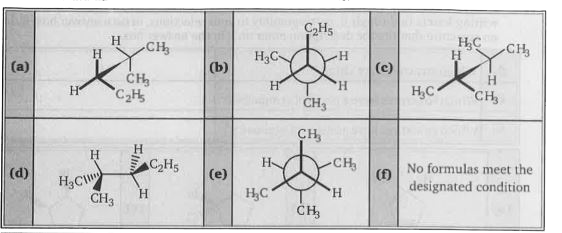
Examine the following formulas and select those pairs that satisfy the following conditions: Be sure to write two letters (and only two) in each answer box, unless you select f. In the second and third parts more than one answer is possible.

Which are constitutional isomers?

Text Solution

Verified by Experts

The correct Answer is:

(c & e), (b & d)
Promotional Banner

Topper's Solved these Questions

  • ISOMERISM (STRUCTURAL & STEREOISOMERISM)

    MS CHOUHAN|Exercise LEVEL 2 (SUBJECTIVE PROBLEMS)|17 Videos
  • ISOMERISM (STRUCTURAL & STEREOISOMERISM)

    MS CHOUHAN|Exercise LEVEL 2 (SUBJECTIVE PROBLEMS)|17 Videos
  • HYDROCARBONS (ALKYNES)

    MS CHOUHAN|Exercise Level -1|32 Videos
  • IUPAC NAME

    MS CHOUHAN|Exercise LEVEL-2 (SUBJECTIVE PROBLEMS ) |1 Videos

Similar Questions

Explore conceptually related problems

Read the given information and answer the following questions. A survey was conducted in two villages, Vanaparthy and Vaddicherla of Warangal district in Telangana State. The first with no scarcity and the second with scarce groundwater. Well census was carried out in the villages in order to get a complete picture of well irrigation and its status as well as availability of water. There are no alternative sources of supply as against wells in Vaddicherla, where there is an existing tank that has been converted into a percolation tank, so that the water situation is much better in Vanaparthy. In which village, do you suggest drip irrigation ?

Which of the following substituted benzene derivative would furnish three isomers when one more electrophilic substituent is introduced? Select the correct answer using the codes given below.

Which of the following substituted benzene derivative would furnish three isomers when one more electrophilic substituent is introduced? Select the correct answer using the codes given below.

It is tempting to think that all possible transitions are permissible, and that an atomic spectrum arises from the transition of the electron from any initial orbital to any other orbital. However, this is not so, because a photon has an intrinsic spin angular momentum of sqrt2 (h)/(2pi) corresponding to S = 1 although it has no charge and no rest mass. On the other hand, an electron has got two types of angular momentum : Orbital angular momentum, L=sqrt(l(l+1))h/(2pi) and spin angular momentum, arising from orbital motion and spin motion of electron respectively. The change in angular momentum of the electron during any electronic transition mush compensate for the angular momentum carries away by the photon. to satisfy this condition the difference between the azimuthal quantum numbers of the orbital within which transition takes place must differ by one. Thus, an electron in a d-orbital (1 = 2) cannot make a transition into an s = orbital (I = 0) because the photon cannot carry away enough angular momentum. An electron as is well known, possess four quantum numbers n, I, m and s. Out of these four I determines the magnitude of orbital angular momentum (mentioned above) while (2n m determines its z-components as m((h)/(2pi)) the permissible values of only integers right from -1 to + l. While those for I are also integers starting from 0 to (n − 1). The values of I denotes the sub shell. For I = 0, 1, 2, 3, 4,..... the sub-shells are denoted by the symbols s, p, d, f, g, .... respectively The spin-only magnetic moment of free ion is sqrt(8) B.M. The spin angular momentum of electron will be

It is tempting to think that all possible transitions are permissible, and that an atomic spectrum arises from the transition of the electron from any initial orbital to any other orbital. However, this is not so, because a photon has an intrinsic spin angular momentum of sqrt2 (h)/(2pi) corresponding to S = 1 although it has no charge and no rest mass. On the other hand, an electron has got two types of angular momentum : Orbital angular momentum, L=sqrt(l(l+1))h/(2pi) and spin angular momentum, arising from orbital motion and spin motion of electron respectively. The change in angular momentum of the electron during any electronic transition must compensate for the angular momentum carries away by the photon. to satisfy this condition the difference between the azimuthal quantum numbers of the orbital within which transition takes place must differ by one. Thus, an electron in a d-orbital (1 = 2) cannot make a transition into an s = orbital (I = 0) because the photon cannot carry away enough angular momentum. An electron as is well known, possess four quantum numbers n, I, m and s. Out of these four I determines the magnitude of orbital angular momentum (mentioned above) while (2n m determines its z-components as m((h)/(2pi)) the permissible values of only integers right from -1 to + l. While those for I are also integers starting from 0 to (n − 1). The values of I denotes the sub shell. For I = 0, 1, 2, 3, 4,..... the sub-shells are denoted by the symbols s, p, d, f, g, .... respectively The orbital angular momentum of an electron in p-orbital makes an angle of 45^@ from Z-axis. Hence Z-component of orbital angular momentum of election is :

It is tempting to think that all possible transitions are permissible, and that an atomic spectrum arises from the transition of the electron from any initial orbital to any other orbital. However, this is not so, because a photon has an intrinsic spin angular momentum of sqrt2 (h)/(2pi) corresponding to S = 1 although it has no charge and no rest mass. On the other hand, an electron has got two types of angular momentum : Orbital angular momentum, L=sqrt(l(l+1))h/(2pi) and spin angular momentum, arising from orbital motion and spin motion of electron respectively. The change in angular momentum of the electron during any electronic transition must compensate for the angular momentum carries away by the photon. to satisfy this condition the difference between the azimuthal quantum numbers of the orbital within which transition takes place must differ by one. Thus, an electron in a d-orbital (1 = 2) cannot make a transition into an s = orbital (I = 0) because the photon cannot carry away enough angular momentum. An electron as is well known, possess four quantum numbers n, I, m and s. Out of these four I determines the magnitude of orbital angular momentum (mentioned above) while (2n m determines its z-components as m((h)/(2pi)) he permissible values of only integers right from -1 to + l. While those for I are also integers starting from 0 to (n − 1). The values of I denotes the sub shell. For I = 0, 1, 2, 3, 4,..... the sub-shells are denoted by the symbols s, p, d, f, g, .... respectively The maximum orbital angular momentum of an electron with n= 5 is

The f-block consists of the two series lanthanoids and actinoids. Because Lanthanum closely resembles the Lanthanoids. The Lanthanoid resemble one another more closely than do the members ofordinary transition elements in any series. They have only one stable oxidation state. The chemistry of the actinoids is on the other hand, much more complicated. The complication arises partly owing to the occurance ofa wide range of oxidation states in these elements and partly because their radioactivity creates special problems in their study Wrong statement of the following is

The necessary condition for a molecule to exhibit optical isomerism is dissymmetry or chiral. Thus all organic compounds which contain one as symetric carbon atom are chiral and exist in two stereoisomers. Although the two forms have the same structure, they have different arrangements of groups about the as symmetric carbon. In fact, they represent as symetric molecules. They do not have a plane of symmetry. They are related to each other as an object to its mirror image and are non superimposable. The two structures actually stand for dextro or (+) and leavo or (-) isomers. Since they are related each other as mirror images, they are commonly called enantiomers. Which of the following statements is correct regarding compounds I to III

The necessary condition for a molecule to exhibit optical isomerism is dissymmetry or chiral. Thus all organic compounds which contain one assymetric carbon atom are chiral and exist in two stereoisomers. Although the two forms have the same structure, they have different arrangements of groups about the assymmetric carbon. In fact, they represent assymetric molecules. They do not have a plane of symmetry. They are related to each other as an object to its miror image and are non superimposable. The two structures actually stand for dextro or (+) and leavo or (-) isomers. Since they are related each other as mirror images, they are commonly called enantiomers. Consider the following structers A,B,C,D Which of the following statements is not correctConsider the following structers A,B,C,D Which of the following statements is not correct

Electronic configuration of multielectron atoms can be written by the use of four quantum numbers and also by following certain principles. Pauli's exclusion principle suggests that maximum capacity of an atomic orbital is two. Auf bau principle suggests that the lower energy orbitals are filled first and hence stability can be attained. Hunds rule of maximum multiplicity suggests that pairing occurs with one electron. The arrangement of electrons in the space around the nucleus can be understood only after writing the electronic configuration. Thus writing electronic configuration is more important in the structure of an atom. The set of quantum numbers not possible for electrons present in potassium atom in its ground state

MS CHOUHAN-ISOMERISM (STRUCTURAL & STEREOISOMERISM)-LEVEL 2
  1. Examine structures a through j, shown below, with respect to their sym...

    Text Solution

    |

  2. (i) 1,2-dichlorocyclopropane = w (ii) 1,3-dimethyl-cyclobutane = x ...

    Text Solution

    |

  3. Examine the following formulas and select those pairs that satisfy the...

    Text Solution

    |

  4. Examine the following formulas and select those pairs that satisfy the...

    Text Solution

    |

  5. Examine the following formulas and select those pairs that satisfy the...

    Text Solution

    |

  6. Examine the following formulas and select those pairs that satisfy the...

    Text Solution

    |

  7. Examine the following formulas and select those pairs that satisfy the...

    Text Solution

    |

  8. Examine the following formulas and select those pairs that satisfy the...

    Text Solution

    |

  9. Consider the following statements regarding the given projection (True...

    Text Solution

    |

  10. Consider the following statements regarding the given projection (True...

    Text Solution

    |

  11. Consider the following statements regarding the given projection (True...

    Text Solution

    |

  12. Consider the following statements regarding the given projection (True...

    Text Solution

    |

  13. Examine the following structural formulas and select those that are ch...

    Text Solution

    |

  14. The configuration of eight compounds, a through h are shown below, usi...

    Text Solution

    |

  15. The configuration of eight compounds, a through h are shown below, usi...

    Text Solution

    |

  16. The configuration of eight compounds, a through h are shown below, usi...

    Text Solution

    |

  17. The configuration of eight compounds, a through h are shown below, usi...

    Text Solution

    |

  18. The structural formula of ten compounds, (I) through (X) are drawn bel...

    Text Solution

    |

  19. The structure of one of the enantiomers of the amino acid cysteine is ...

    Text Solution

    |

  20. Identify the following double bonds either E, Z or None (N) in the com...

    Text Solution

    |
